SIX Network (πŸ“¦,πŸ’™) (@theSIXnetwork) header
SIX Network (πŸ“¦,πŸ’™) (@theSIXnetwork) profile picture

SIX Network, a blockchain company simplifying Web3 adoption for businesses. Focus on seamless integration and accessible. https://nitter.cf/t.co/Ox5rkFLFnM

Joined February 2018
Photo by SIX Network (πŸ“¦,πŸ’™) (@theSIXnetwork)Photo by SIX Network (πŸ“¦,πŸ’™) (@theSIXnetwork)Photo by SIX Network (πŸ“¦,πŸ’™) (@theSIXnetwork)Photo by SIX Network (πŸ“¦,πŸ’™) (@theSIXnetwork)Photo by SIX Network (πŸ“¦,πŸ’™) (@theSIXnetwork)Photo by SIX Network (πŸ“¦,πŸ’™) (@theSIXnetwork)Photo by SIX Network (πŸ“¦,πŸ’™) (@theSIXnetwork)Photo by SIX Network (πŸ“¦,πŸ’™) (@theSIXnetwork)Photo by SIX Network (πŸ“¦,πŸ’™) (@theSIXnetwork)Photo by SIX Network (πŸ“¦,πŸ’™) (@theSIXnetwork)
SIX Network Roadmap 2026: Institutional Assets and Financial Infrastructure We are ready to announce our 2026 roadmap. This year, SIX Network moves forward under the theme of Institutional and Financial Infrastructure, focusing on building blockchain infrastructure for institutional assets and supporting the growth of the digital economy. In 2025, we demonstrated that blockchain infrastructure can effectively support real-world assets. This includes the KAVALON Token Community valued at THB 400 million and SiriHub2 valued at THB 2.49 billion, bringing the total on-chain asset value on SIX Protocol to over USD 90 million. In 2026, we will build on this proven foundation and move into the next phase with 6 key directions: β€’ Expanding RWA growth into the global market β€’ Tokenizing assets in collaboration with institutional projects β€’ Increasing the diversity of assets on chain β€’ Integrating with the PayFi ecosystem β€’ Exploring the development of a digital financial platform β€’ Strengthening the role of SIX Token as the coordination layer of the ecosystem Another key direction we are exploring is the integration of AI with SIX Protocol infrastructure, in preparation for a future where AI and blockchain operate together as core components of the digital economy. Read the full Roadmap 2026 here: six.network/six-network-road…
44
142
58
226
39,015
Tokenized equities is one label with several structures: fund share classes, individual stock or ETF tokens, and platform-wide product totals. Rights depend on the product, not the word "equity". #SIXNetwork #RWA #Tokenization
2
2
7
339
1:1 backing, custodians, fractions or extended hours are structure-specific. A token may give economic exposure without direct share ownership. Amundi's STOXX 600 move is a fund share class; Ondo's totals are a platform figure. Different things.
2
1
3
51
Thai SEC is consulting on 8 draft notifications to allow digital asset derivatives under the Derivatives Act, Oct 29 to Nov 28, 2026. Drafts only, no effect yet. Derivatives are high risk and losses can be large. kaohoon.com/news/local/87600… #SIXNetwork #Thailand #Regulation
1
1
6
385
Stablecoin supply barely grew in 2026. Measured payments did. Allium (Q3 2026): supply +0.4% to about $305B through Sep; payments +45% to $482B; payment count +71% to 1.04B. #SIXNetwork #RWA #Tokenization #Stablecoins
2
2
5
431
Raw transfers were $97.9T in the first nine months. Allium classified only about $482B, roughly 0.5%, as payments after filtering exchange, DeFi, infrastructure, automated and mint or burn flows. CoinDesk covers the same Allium figures.
1
1
2
93
SIX tech update: open rails coming to SIX Protocol testnet Networks scale when outside systems can connect without a custom rebuild (WEF, Jan 2024). Our take: SIX opens standard integration on testnet first. Follow Open Rails to SIX next. #SIXNetwork #RWA #Tokenization
1
3
8
486
CBN issued Non-Security Virtual Asset regulations (circular PSP/DIR/PUB/CIR/001/004, dated Nov 5, 2026; effective Nov 5). Stablecoin issuers face full reserve backing plus distinct liquidity rules. #SIXNetwork #RWA #Tokenization #Stablecoins
2
1
4
442
Per the regulations: Reserve Pool at least equal to par value; separate 2% overcollateralisation; and at least 40% of the Reserve Pool in cash or qualifying HQLA. The 40% is composition, not 40% backing. Existing operators: apply within 180 calendar days of commencement.
1
80
Separately, BOT's THB stablecoin principles hearing runs Oct 19 to Nov 17, 2026. Different jurisdiction; do not equate the rules. Our take: read each threshold literally. bot.or.th/th/laws-and-rules/…
48
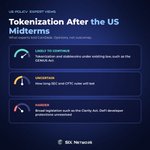
After the US midterms, experts told CoinDesk tokenization and stablecoins can continue under existing law such as the GENIUS Act. Agency rules face a durability question, and broader legislation looks harder. coindesk.com/policy/2026/11/… #SIXNetwork #RWA
1
1
6
443
The Life of a Token, From Issue to Redemption A token passes through several stages over its life, and each stage has rules attached. The path generally breaks into five stages. What is a token lifecycle? It is the set of activities after an asset has been tokenized. Stobox's documentation lists maintaining investor positions, executing distributions, processing redemptions, facilitating governance, supporting transfers under controlled conditions, and managing reporting and compliance. The 5 stages 1. Issue: Tokens are created and allocated to investors who meet the eligibility conditions. 2. Hold: Each investor's position is recorded and holder eligibility is maintained over time. 3. Transfer: A transfer happens only when the token's rules are met. In the system Stobox describes, the transfer is authorized first, and the wallet then executes it. 4. Distribute: Dividends, interest, or revenue share are paid to eligible holders. Voting outcomes can be recorded on-chain or off-chain, depending on the issuer. 5. Redeem: When the asset matures or is repaid, redeemed tokens are burned or frozen. Each project designs the details differently. The sequence and the rules depend on the asset type and on local regulation. When evaluating tokenization, ask about all five stages. Issuance is the first one. Trust in the asset builds as transfers, distributions, and redemptions follow the rules in practice. This article is for informational purposes only and does not constitute investment advice. #SIXNetwork #RWA #Tokenization
1
2
5
499
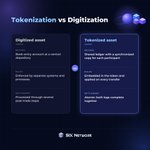
Tokenization vs Digitization Shares that once existed as paper certificates now show up as a balance in a securities account. That is digitization, and markets have used it for decades. Tokenization sits one layer further, and the difference shows up in how records are kept, how rules are enforced, and how trades settle. What is digitization? Digitization turns an asset or document into digital data. In conventional markets, securities are held as book-entry positions in accounts at a central securities depository (CSD), as BIS describes. What is tokenization? Tokenization represents rights in an asset as a token on a distributed ledger, where each participant holds a synchronized copy (BIS). 3 differences 1. Record keeping: Digitized: a book-entry account at a central depository. Tokenized: a shared ledger with a synchronized copy for each participant. 2. Rules Digitized: enforced by separate systems and processes. Tokenized: embedded in the token and applied on every transfer, such as buyer eligibility checks, interest payments, or voting rights (Fidelity). 3. Settlement Digitized: processed through several post-trade steps. BIS estimates trade processing costs at roughly $17-24 billion a year. Tokenized: atomic settlement, where both legs complete together, or the trade does not happen (Fidelity). BIS notes that tokenization may lower cost and complexity, and that the risk of a counterparty failing to settle remains. Fidelity adds that some tokens still reconcile with traditional records off-chain. Digitization puts information in digital form. Tokenization lets the asset carry its own rules. To tell which one you are looking at, check where the transfer rules and settlement live. This article is for informational purposes only and does not constitute investment advice #SIXNetwork #RWA #Tokenization
1
1
5
482
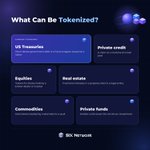
What Can Be Tokenized? Ask people what gets tokenized, and many will say real estate. The largest market today is US Treasuries. Fidelity Digital Assets reports tokenized real-world assets (excluding stablecoins) at about $33.8 billion through May 2026, roughly twenty times the level of early 2024. So which assets are actually on-chain? What is tokenization? Tokenization represents rights in an asset as a token on a blockchain. The token records who holds what, and the asset's rules are written in code. 6 asset groups in the market today 1. US Treasuries: Short-dated US government debt is packaged in a fund and issued as a token that accrues yield. It is the largest single category at roughly $15 billion (RWA.xyz, May 2026). 2. Private credit: A token holder owns a claim on a tranche of a whole loan pool. The structure spreads exposure across many contracts. 3. Equities: Tokens represent shares held by a broker-dealer or trustee. Access depends on each country's rules. 4. Real estate: A property typically sits in one legal entity (an SPV or LLC) and its interests are split into smaller units. The category remains small at around $500 million (RWA.xyz, Q2 2026). 5. Commodities: Mostly gold. Each token references metal held in a vault, with an attestation naming the bar by serial number. 6. Private funds: Fidelity notes that tokenization splits rights into smaller units, which lowers minimum investments in private funds. Every group above rests on the same two things: a legal right tied to the token and clear transfer rules. Assets with a clear legal structure and verifiable value tokenize well, which helps explain why Treasuries and gold came before real estate. This article is for informational purposes only and does not constitute investment advice. #SIXNetwork #RWA #Tokenization
3
2
9
496
Why does blockchain matter for tokenization? Scan a land title, and you get a digital file. Transferring ownership still runs through paperwork and intermediaries. So what does a blockchain add? 1. Atomic settlement Payment and delivery happen together, or not at all. This removes the risk of the other side not following through (Fidelity). 2. Programmability Rules live in the token: buyer eligibility checks, interest payments, voting rights, applied on every transfer. 3. 24/7 Markets can run continuously, subject to regulatory approval. After-hours trading already exceeds 11% of US equity volume (Fidelity). 4. Transparency Every transaction is recorded and auditable. McKinsey estimates full-cycle tokenization could lift bond market operational efficiency by 40-60%. 5. Fractional units Rights split into smaller units, lowering minimums for assets like private funds. Worth knowing: tokenization does not remove every settlement-failure risk (BIS). Some tokens still need off-chain reconciliation, and public chains expose trading activity, which raises privacy questions for institutions. Our take: judge tokenization by what a token can do after it is issued. Transfer, settle, audit. This content is for informational purposes only and is not investment advice. #SIXNetwork #RWA #Tokenization
2
4
10
544
What can tokenization become after a token is issued? Tokenization often gets framed as issuing a token and selling it. The period after issuance is where a token gets put to work. 1. Manage it Look after it across its life: KYC-gated transfers, cap table tracking, and corporate actions. 2. Give privileges Holders receive perks or memberships, as seen with Pas.ss platform. 3. Open a resale market Let holders sell on. Dubai opened tokenized property resale on Feb 20, 2026. 4. Use as collateral Put tokens to work as collateral. Exchanges accept them in some cases, and DTCC has tested with 30+ firms. 5. Connect to DeFi Link into liquidity and yield markets, with terms set by each project. Which paths are open depends on the asset type and each market's regulation. This content is for informational purposes only and is not investment advice. #SIXNetwork #RWA #Tokenization
3
5
17
762
How Tokenization Matters Today In a world moving this fast, AI updates every day. Anyone can build their own Agent with just a prompt and two hands. Technology and longevity science keep advancing and getting closer to us daily. So does tokenization still matter for digital finance? It does, and the reason is speed. AI has made thinking, deciding, and building much faster. The assets those decisions touch, whether cash, bonds, equities, or property, still sit in systems with settlement cycles, closing hours, and layers of intermediaries. Tokenization records these assets as tokens on a blockchain. Ownership transfers directly, usage rules can be built into the asset, and connecting to other financial systems gets easier. When everything speeds up and runs around the clock, assets have to keep pace. Here is how real markets answer. 1. Market scale: Broadridge reports its ledger platform averaged $359B a day in repo in September. Repo is a daily workhorse of finance, and work at this scale runs on tokenized infrastructure. 2. Settlement: The ECB plans for Pontes to link DLT platforms to TARGET in 2026, extend settlement to 22.5 hours a day in 2027, and run 24/7 by mid-2028. Tokenized assets on public chains grew from €4.7B to €23.3B between Q1 2025 and Q1 2026. 3. Real assets: Dubai opened a secondary market for tokenized property on Feb 20, 2026, with about 7.8M tokens activated for resale. Property that used to be bought and held now has a market to trade in. 4. Collateral: At least four exchanges accept tokenized funds as collateral. On markets that never close, fund holdings can be posted as margin right away. Benji AUM has moved with the market, from $1.98B to about $669M. Central banks, market operators and exchanges are choosing tokenization for work that has to be fast and always on. That is the answer from real data. This content is for informational purposes only and is not investment advice. #SIXNetwork #RWA
1
1
9
488
Tokenization Coded ⛓️ The IMF Gives Tokenization a Full Chapter: 4 Conditions for Tokenized Markets to Scale The IMF’s October Global Financial Stability Report launched during the Annual Meetings in Bangkok, and its Chapter 3 is devoted to tokenization (published early on Oct 8). When the institution that monitors global financial stability dedicates a full chapter to a topic, that topic has reached the policy agenda. How big is the market today? The IMF puts tokenized repo at roughly $300-350B in average daily volume, with other tokenized assets (credit, money market funds, equities) adding about $65B a day. The US repo market alone handles about $13 trillion daily. The IMF describes tokenized markets as growing rapidly but still very small and fragmented. Trading data adds two details. More than half of trading happens outside traditional market hours, and about 80% of the tokenized equity trades analyzed were for less than one share. Demand for round-the-clock access and fractional ownership is visible in the data. The four conditions - Legal certainty: tokens must represent enforceable rights. - Regulatory clarity: regulators need to explain how existing rules apply to new ledgers and market functions. - Interoperability: platforms must connect rather than operate as isolated liquidity pools. - Settlement assets: settlement should rely on safe, widely accepted money. The IMF also warns that scaling can amplify fire sales, liquidity runs, and contagion, since today’s slower sequential processes act as buffers. Our take The IMF calls this market small and fragmented. For infrastructure builders, that is the opening. Any business planning to tokenize an asset should test all four conditions at the feasibility stage, before designing the token. #SIXNetwork #RWA #Tokenization #IMF
1
2
7
507
South Korean Banks Now Have the Infrastructure to Issue Stablecoins and Tokenized Assets Through LG CNS's KITL Tested in real conditions with 7 banks and around 80,000 customers, under the Bank of Korea's Project Hangang LG CNS, an IT company in the LG group, announced on Oct 6, 2026, the launch of KITL, a blockchain infrastructure platform that lets financial institutions develop stablecoins, tokenized securities, and RWA services without having to build new systems themselves. KITL handles the back-end work banks need, including a digital wallet system that generates private keys only when needed, transaction processing on public blockchains, gas fee payment, and the collection of on-chain transaction data for reconciliation and audit. It supports multiple blockchains, including Solana, allowing financial institutions to expand into new digital assets without overhauling their core systems. The platform was developed through the Bank of Korea's Project Hangang and tested in real use with 7 banks and around 80,000 customers. Alongside the launch, LG CNS also signed MOUs with 5 global players: Circle (issuer of the USDC stablecoin), Securitize (tokenization platform), Canton Foundation (blockchain network used by financial institutions), Chainalysis (blockchain transaction monitoring provider), and Chainlink (system that brings real-world data onto blockchains). Together they cover stablecoin infrastructure, tokenization services, participation in the Canton network, transaction monitoring, and blockchain connectivity. KITL launches ahead of South Korea's STO framework taking full effect in February 2027. It will be worth watching how Korean banks use this infrastructure to issue tokenized assets and stablecoins next. Source: koreatimes.co.kr/business/co… #SIXNetwork #RWA #Tokenization #UseCases
3
3
10
683