We were very happy to help @danfalk with his article on the Curta calculator!
Here's the one in our collection: utsic.utoronto.ca/wpm_instru…
You’re unable to view this post because this account owner limits who can view their posts. Learn more
We are excited to share our new website! It's a work-in-progress, but is a big step forward.
Take a look around: utsic.utoronto.ca/"
It's not just what you see that has changed. Our developer @mikethicke has also been hard at work at the back end of our online catalogue.
Built on WordPress, our catalogue software makes it easy to make and update catalogue entries so they are immediately visible to the web.
3
When COVID hit, hospitals had to quickly expand their their stockpiles of PPE. Researchers @UofT_dlsph developed apparatus for testing N95 masks from various suppliers.
Dr. James Scott describes the process. Super interesting!
youtu.be/j1iwgAW9fig
#histSTM #histmed
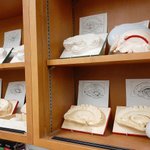
We have started cataloguing a collection of plaster models @uoftmedicine depicting the anatomy of the brain.
These models were made by #UofT anatomy professor Carlton George Smith (1905-2003), a colleague of J. C. B Grant (1886–1973).
#histmed
Yesterday we began a funded project to catalogue several caches of historical artifacts @uoftmedicine.
We are starting with an important collection that belonged to the heart surgeon Wilfred G. (Bill) Bigelow (1913-2005).
en.wikipedia.org/wiki/Wilfre…
#histmed
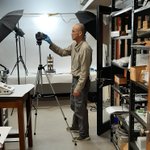
We recently had a visit from Hartwell Fong, a local expert on VR and photogrammetry. We made an initial experiment with a 19th century double siren from the Rudolph Koenig collection. We got a good mesh of the bottom half. It's a start.
#MuseumTech #photogrammetry
Professor Janis Langins contributed a great deal to the history of science, technology, and engineering. He passed away on September 9th, 2019.
We’d like to recognize his contribution to developing the U of T’s collection of scientific artifacts.
hps.utoronto.ca/professor-em…
How was U of T involved in the #Apollo program? One of many ways: Toronto @uoftphysics investigated electrical properties of the moon’s surface using data gathered on the Apollo 17 trip.
This Computing Counter, note NASA sticker, was involved. https://nitter.cf/t.co/fz9cWmf54q #Apollo50
Happy #Apollo50th! From the @uoftastro collection: this commemorative plastic "Texas-ware" plate celebrating the #Apollo11 #MoonLanding c. 1969. https://nitter.cf/t.co/FoeocWNJCm
Complete with precise time: July 20, 1969 9:56 P.M. CDT
2
From 1930: “The... moon is almost certainly a waste of rock and sand. There is no atmosphere and during the day... when the sun beats down upon the moon it must become very hot, but at night the temperature must fall very low. All is dead, deserted, and silent there.” #Apollo50th
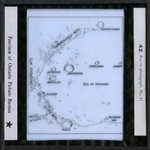
These words, written by @UofT @uofastro Prof. Clarence Chant, are part of a 1930s lantern show designed to teach astronomy to the Canadian public. This key, drawn for the presentation, went with the previous photo taken at @MtWilsonObs #Apollo50
1
Some day we might even go there! This image of the “nearly full” moon was taken by @UofT @uoftastro students on February 25th, 1907. Not wholly in focus! #Apollo50th
This would have been under the instruction and assistance of astronomy Prof. Clarence Chant.
… And here’s another, presumably taken by the same class, this one labelled “4th Year Astronomy & Physics, March 20th, 1907”. @UofT @uoftastro #Apollo50
Why does the moon change? This teaching slide was produced around a century ago to teach @uoftastro students about the moon's phases.
Someone wrote "Error" on it, but I can't see the mistake. Anyone spot something amiss? #Apollo50th #Apollo11
“You have probably seen many globes of the world. Now for the first time you can own an authentic relief reproduction of the moon…”
We're celebrating #Apollo50th #Apollo11 with Moon objects from the collection. Manning’s Moonball c. 1958-67 https://nitter.cf/t.co/9p7HI0ITNv
We're @UofTSR #SciRen and there's still time for you to see us demonstrate our mechanical calculator and put these 120-year-old gears in motion yourself! #historyofscience
Drop by our booth in the Myhal Building!
1
Not all historic objects are gorgeous, but every one has a story to tell.
Find out why these two chunks of metal and glass were important to science at @uoftastro and @uoftphysics at our booth at #SciRen @UofTSR. #historyofscience #STEAMbig
We're in Myhal until 4pm!
Today we're at #SciRen Science Rendezvous U of T with 140 years of spectroscopic history from @uoftphysics and @uoftastro. Peer inside an old spectrograph and learn what makes a diffraction grating so great.
Myhal Building, U of T, 11am-4pm. See you there! @UofTSR
Ever wondered how a mechanical calculator makes multiplication painless?
We're @UofTSR all day demonstrating our 120-year-old mechanical calculator. Come and find us in the Myhal Building! #technology #history #SciRen
We are @UofTSR #SciRen this morning ready to do go with spectroscopic splendors and a curious calculator!
We're in the Myhal foyer. Come and visit! @uoftastro @uoftphysics #science #history


