

building cool things with AI. sometimes sharing them. team @CELE8EX
USA
Joined July 2026
- Tweets2.2K
- Following147
- Followers3.2K
- Likes7.3K
Pinned Tweet
It is becoming f*cking dangerous
A 23-year-old dev from China just ran 300 Claude Code agents in parallel and hooked them to a verification layer so none of them could bullshit him
He opens the live dashboard:
- 300 agents writing and checking at the same time
- Every output verified against the source in ~100 ms
- Three passes over 100 company profiles → zero errors left
- Everything dumped straight into an Obsidian vault
The trick is the split: one model does the work, a cheaper one decides if the claim is actually true. The loop doesn’t stop until everything checks out
An analyst team would bill weeks for this. He got it in one run
Same kind of Second Brain + swarm setup that keeps circulating. Bookmark the full breakdown


Lyren_o retweeted
SOMEONE AT EVERY GAME STUDIO REPLAYS THE SAME BOSS FIGHT HUNDREDS OF TIMES BEFORE LAUNCH. AURA JUST OPEN-SOURCED AN AGENT THAT DOES IT FROM ONE SENTENCE
"Defeat the Ashen Warden." That's the whole prompt in the clip. Autopilot plays the fight, you watch its decisions live, and anything that breaks gets written up
Same with "chop wood, light the campfire, then climb the watchtower". You write the task like a quest, it plays it
Agents write game code in minutes now. Testing is still the slow part. That's exactly what this takes over
Karpathy calls the grown up version of vibe coding agentic engineering: the agent does the work, but someone has to verify it. In game dev, verifying means playing, and now an agent can do that too
Honest note: it runs inside the engine editor for now, not on shipped builds. Unreal and Unity, works with Claude Code or Codex.
Repo and 2 week free trial in the comments
🤝 Paid partnership

We're open-sourcing Autopilot.
A self-improving agent that plays your game and finds bugs. Unity, Godot and Unreal.
→ 43% more accurate
→ Almost 2X faster
→ Beats Claude Code at playtesting
It’s Computer Use for games – closing the agentic loop and solving the most tedious part of game dev.
Stop being your agent’s tester. Free trial + GitHub below.
SOMEONE AT EVERY GAME STUDIO REPLAYS THE SAME BOSS FIGHT HUNDREDS OF TIMES BEFORE LAUNCH. AURA JUST OPEN-SOURCED AN AGENT THAT DOES IT FROM ONE SENTENCE
"Defeat the Ashen Warden." That's the whole prompt in the clip. Autopilot plays the fight, you watch its decisions live, and anything that breaks gets written up
Same with "chop wood, light the campfire, then climb the watchtower". You write the task like a quest, it plays it
Agents write game code in minutes now. Testing is still the slow part. That's exactly what this takes over
Karpathy calls the grown up version of vibe coding agentic engineering: the agent does the work, but someone has to verify it. In game dev, verifying means playing, and now an agent can do that too
Honest note: it runs inside the engine editor for now, not on shipped builds. Unreal and Unity, works with Claude Code or Codex.
Repo and 2 week free trial in the comments
🤝 Paid partnership
We're open-sourcing Autopilot.
A self-improving agent that plays your game and finds bugs. Unity, Godot and Unreal.
→ 43% more accurate
→ Almost 2X faster
→ Beats Claude Code at playtesting
It’s Computer Use for games – closing the agentic loop and solving the most tedious part of game dev.
Stop being your agent’s tester. Free trial + GitHub below.

Lyren_o retweeted
MARKOV COUNTED 20,000 LETTERS OF A POEM BY HAND IN 1913. HE ACCIDENTALLY EXPLAINED HOW TO FIX AI AGENTS
Andrey Markov took the first 20,000 letters of Eugene Onegin and tracked vowels and consonants. No computer. Just paper and patience.
He showed something simple: to predict the next letter, you mostly need the current one, not the whole poem before it.
That idea became Markov chains. The next step depends on the present state, not on the full history.
Most agent workflows do the opposite. One long chat, hours of history, old mistakes and dead ideas all still sitting in the context. The model drags all of it into every new step.
So the fix is to give the agent a clean present instead of a long past.
The simple method I use:
1. Keep one file called state.md: the goal, what's done, what's next, the rules
2. Start each task in a fresh session
3. The agent reads only state.md, not the old chat
4. At the end, the agent updates state.md
5. Old history goes to a log you can check, not into the context
The hard part is the same one Markov had. Your state has to hold everything that matters. If something important isn't in the file, the agent won't know it.
A clean present beats a messy past.
Lyren_o retweeted
KARPATHY MOVED FROM VIBE CODING TO AGENTIC ENGINEERING
He coined "vibe coding" last year. Now he says it's fine for quick experiments, but the professional version is agentic engineering.
The difference is simple.
Vibe coding: you describe what you want and accept the result if it looks ok.
Agentic engineering: you own the spec, the checks and the final call. The agent just does the work.
I was stuck in the first mode for a while. The agent kept saying "done", I kept believing it, and the same mistakes kept coming back.
Now I use a small loop with Claude:
1. Write what "done" means before the agent starts
2. Let it run
3. Check the result against that list, not against "looks good"
4. Save what worked, so the next run starts smarter
Skip steps 1 and 3 and you're still vibe coding.
The agent doesn't get better on its own. The loop does.
Lyren_o retweeted
Karpathy's second brain idea finally clicked for me last week
his point is simple. let the AI keep the wiki, you just drop sources in and ask
i almost spent an evening researching Claude Code agent setups from scratch
before starting i asked my Grok Bot "what do i already have on this?"
it found 3 sources i saved two weeks ago, with summaries and a link to the project i was writing for
20 minutes instead of 2 hours
saving was never the hard part. finding it again was
my exact 5 folder setup and rules file are in the article

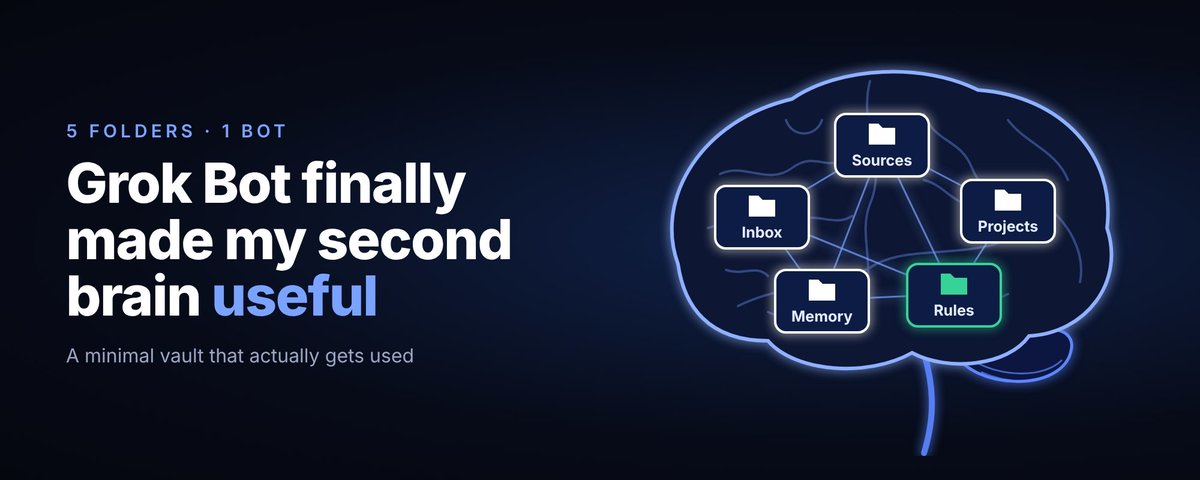
Karpathy's second brain idea finally clicked for me last week
his point is simple. let the AI keep the wiki, you just drop sources in and ask
i almost spent an evening researching Claude Code agent setups from scratch
before starting i asked my Grok Bot "what do i already have on this?"
it found 3 sources i saved two weeks ago, with summaries and a link to the project i was writing for
20 minutes instead of 2 hours
saving was never the hard part. finding it again was
my exact 5 folder setup and rules file are in the article
Lyren_o retweeted
GENIE 4 IS THE MOST STEERABLE WORLD MODEL YET
I work with AI video a lot, and my biggest time sink isn't the idea. It's regenerating. One wrong detail and you start the whole clip again.
That's why Genie 4 got my attention. You type while the scene is running and change it on the fly: weather, camera, new people or objects. No restart.
Scenes now hold for up to 2 minutes, double Genie 3, with native audio: ambient, music, even dialogue.
My take: realism isn't the real upgrade here. Control is. A pretty clip you can't change is still a lottery. A scene you can steer is a tool.
What I'd still watch: Google says details can drift in longer runs and in-world text isn't reliable yet. So for now it's more for testing ideas and pre-vis than final content.
It's a research preview, rolling out to AI Ultra users in the coming weeks. First thing I'll test is whether a character stays the same after 5 prompts in a row.
visual made with Veo, not Genie 4
Lyren_o retweeted
GAVIN BAKER IS RUNNING 17 GROK BOTS
He calls it the most impactful AI product his firm has used. Not Claude Code. Not some custom stack. Grok Bot.
What stands out isn't the number. It's the speed. He says he built better versions of things in minutes that previously took hours.
That gap is mostly friction. Between "I need this" and "it exists" there's almost nothing now.
Once the bot has its own computer, memory and routines, the limiting factor stops being the model. It becomes how clearly you define the job.
That's the shift worth watching.
Lyren_o retweeted
The worst trader I know is me when Barca plays🤭
Last weekend I put Barca in a 4 pick combo because my heart said so. Barca lost first and took the whole combo down with it
This article has the fix, and it's not some magic strategy. It's one line: the risk manager has the final word, not the signal
A bot doesn't care who you support. It checks the limits and says no
Max 1% per trade. Max 3% daily loss, then it stops. Paper money first. A kill switch. And you approve every move
Sounds boring. But boring is what keeps you in the game
AI won't give you an edge on its own. What it can do is protect you from yourself
Lyren_o retweeted
Claude found around 600 photos of my face on my phone that I had never seen before.
Not in my gallery. Not in trash. Just sitting in hidden folders the whole time.
I plugged my Samsung into my laptop and asked Claude to find every front camera image outside my gallery. It pulled everything from the phone and ran face detection on over 14k files.
Old selfies I was sure I deleted. Cached frames from Telegram, Instagram and WhatsApp. Some of them years old.
I just sat there scrolling. Honestly wasnt ready for this
Now I cleared the cache, deleted apps I dont use and took camera access from everything that doesnt need it.
If you want to check yours, plug in your phone and ask Claude to find front camera files outside your gallery. You might be surprised
Lyren_o retweeted
I keep looking at the logs of agents I ship and noticing the same thing: most of the calls aren't thinking. They're forks with answers I already know
"Is this spam?"
"Which worker runs next?"
"Is this draft good enough to show a human?"
"Do we act, wait, or escalate?"
None of these need prose. A big model reasoning through them paragraph by paragraph is just slow and expensive
So I've started forcing a clearer split:
Decision: a cheap layer that only chooses or scores (with confidence).
Code: executes whatever was decided.
Generation: the expensive model only gets called when something actually needs to be written, explained, or researched.
In the terminal it looks boring in a good way: short structured output, then an action, and only sometimes a generation step.
What I find interesting isn't the cost. It's how much of what we call "the agent thinking" turns out not to be thinking at all. And how much clearer the whole loop becomes once you stop hiding those forks inside one big prompt.


I keep looking at the logs of agents I ship and noticing the same thing: most of the calls aren't thinking. They're forks with answers I already know
"Is this spam?"
"Which worker runs next?"
"Is this draft good enough to show a human?"
"Do we act, wait, or escalate?"
None of these need prose. A big model reasoning through them paragraph by paragraph is just slow and expensive
So I've started forcing a clearer split:
Decision: a cheap layer that only chooses or scores (with confidence).
Code: executes whatever was decided.
Generation: the expensive model only gets called when something actually needs to be written, explained, or researched.
In the terminal it looks boring in a good way: short structured output, then an action, and only sometimes a generation step.
What I find interesting isn't the cost. It's how much of what we call "the agent thinking" turns out not to be thinking at all. And how much clearer the whole loop becomes once you stop hiding those forks inside one big prompt.
Lyren_o retweeted
The part that actually matters here is the feedback loop
Most creator campaigns end when the posts go live. CELEBEX reviews every post after the round, tracks what worked, and puts it into the next brief
I’m in the catalogue. From a creator side, this changes the incentives. You’re not just filling a slot. The system is trying to learn which formats and accounts actually move the numbers, instead of repeating the same brief
That’s rarer than it should be

Who is CELEBEX?
An influence agency for AI, Web3 and Tech on X.
We take products to the creators people actually follow. 325 accounts in one catalogue, from micro creators to 734K followers, every price public.
What we've shipped so far:
→ Picsart: 12.5M views in the contract, 77.0M delivered. 938 posts, 91 creators
→ An AI product round in July: 48.3M views across 19 accounts
→ Launches with Tavus, Krea and more
We don't guess, we measure. Our own NotPeople MCP and a live dashboard track every post and every creator. After each round we review it post by post, and what worked goes into the next brief.
Brands: DM us. We build the strategy, write every brief and pick the accounts that give you the most for your budget.
Creators: want in? DM us too.