

Exploring the frontiers of AI | Local LLMs, inference & agents | Building, breaking, experimenting, and sharing along the way.
Earth
Joined March 2017
- Tweets1.4K
- Following341
- Followers631
- Likes4.2K





Pinned Tweet
An AI agent clears an AML alert on Tuesday.
On Friday, the auditor asks why.
The only record is the agent's own log - which it wrote and which anyone with box access can edit.
Nobody can prove what the agent saw, what it was allowed to do, or who allowed it.
We've been building for that gap. Agent Custody is open source, and it sits between the agent and its tools:
→ A Cedar policy checks every tool call before it runs. If the policy forbids the call, the call doesn't run.
→ The policy decides on facts the gateway fetched itself (KYC status, daily limits, the customer record), not on what the agent claims.
→ Every call gets a signed receipt in a tamper-evident Merkle log, allowed or refused.
→ Anyone can verify a receipt offline with public keys only, without access to your systems.
When an agent acted on a wrong fact, you retract the fact and get the blast radius: every action and later belief that depended on it.
Coding agents get the same layer. `agent-custody init claude-code` adds a hook that blocks force push, rm -rf ~, terraform destroy and drop database before they run. It starts in observe mode, so first you see what it would have stopped.
We've been shortlisted for the UK-India AI Adoption Accelerator 2026. One of its financial-services challenge areas is Agentic Runtime Security: control layers that constrain, monitor and verify autonomous agents in production.
If you run agents near money or production systems, the threat model is worth a hard read. Stars are welcome.
github.com/svayatta/agent-cu…
They launched a model so good that even after two months it's competing with the new frontier models, and the lab that released the model is still struggling to release its successor.
17
i've used the ambient light extension on yt for a while and always wished youtube music had the same glow.
so i asked claude fable to build it. then i got greedy and asked it to redesign the whole ui.
first attempt barely looked different, and i said so. then i told it "full freedom" and it actually cooked: glass panels, a proper now-playing page, and a background that takes its colors from the album art.
this is what i listen on now 👇


2
4
106
it's open source: github.com/0xAnto/ytm-restyl…
don't feel like cloning? hand this prompt to your own coding agent and it'll build the same thing: github.com/0xAnto/ytm-restyl…

1
17
Anto retweeted

after months of brainstorming, finally we seem to have zeroed in on one idea. going into stealth on that one for now. day zero. November has been really exciting so far !
Fable defaults all subagents to Sonnet, forcing me to manually select the appropriate model each time.
26

Anto retweeted

Introducing 🎙️ pratidhvani (प्रतिध्वनि, “echo”): open-source voice cloning for Indian languages that keeps the speaker’s accent and dialect.
✅ Works on old, noisy recordings
✅ Runs on your own laptop, so your audio stays private
✅ Consent first, and every clip is watermarked
✅ Apache 2.0
Tested on Kannada so far. Help us bring it to every Indian language!
Try it, contribute, and ⭐ star it:
github.com/svayatta/pratidhv…

Anto retweeted

I cannot explain it but here's how I think current models behave best:
opus 5.5: you need to be 'bro' with it. get him on your team and explain the exact intent you're building with, and you'll see some amazing results when you give it ambitious things.
fable 5.2: you need to put it on a pedestal. state that you believe that it knows better than you, and architect without your assumptions, and you'll be surprised by new things it suggests.
GPT Astra/ Sol 6.2: you need to just yell at it and tell it EXACTLY what needs to be hillclimbed. if you don't know how to, ask fable or opus to do it.
you'll be surprised by how novel approaches it can take sometimes to possibly some dead ends declared by claude models.
ymmv

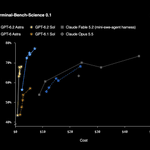
These charts make it clear just how expensive Anthropic's highest level of intelligence is.
I found it a little odd when Anthropic shared a log-scale cost chart to smooth out the curve. But then again, labs use all kinds of tactics to make their models look the best.
OpenAI may not have beaten Fable on agentic coding, but it's A LOT cheaper.
I think this is an interesting direction for the industry to move in.
Pushing the limits of intelligence matters, but so does making it affordable. The real impact might come not just from building the most capable models, but from making high levels of intelligence accessible enough to be useful everywhere.


58
GPT 6.2 Astra delivers performance on par with Opus 5.5 at the same cost, while GPT 6.2 Sol comes pretty close at a fraction of the price.
Looks like OpenAI has figured out how to make its models a lot more cost-efficient than Anthropic's.
The big question is whether this will translate into better usage limits for subscribers. Anthropic still offers the best value with its $100 and $200 plans. Will OpenAI change that?


Some of you have been asking very politely. Some of you have just been asking.
GPT-6.2 Astra and Sol are now available.
Super efficient and built to perform where it counts—the real world.
openai.com/index/introducing…
67
Qwen4-Max is now ranked #14 on Arena's Agent leaderboard, ahead of Claude Fable 5 (High) at #17.
But the more interesting numbers are coming from Artificial Analysis.
Qwen4-Max scores 43 on the Intelligence Index, up 9 points from Qwen3.8 Max and just 3 points behind Kimi K3.1 Pro.
More importantly, it's getting significantly more efficient.
One of the recurring weaknesses of Chinese reasoning models has been token efficiency. They often generate substantially more tokens to solve the same problems. Cheaper tokens don't necessarily translate into cheaper inference.
Qwen4-Max seems to be making real progress here.
• 39% fewer output tokens per benchmark task (105K vs 171K).
• $3.27 per Intelligence Index task, down from $10.02.
• 9 points higher on the Intelligence Index.
That's a 67% reduction in benchmark task cost while improving performance.
There's another interesting comparison.
Anthropic released Fable 5 in June with extensive safeguards around its cybersecurity capabilities. Qwen4-Max arrived in November, roughly five months later.
Chinese labs are now closing the gap with US frontier labs at a remarkable pace.
Alibaba also says smaller Qwen4 models are coming, with open weights planned. I'm particularly interested in what developers will be able to run locally once those models arrive.
The big question now is whether Chinese labs can maintain this pace as Anthropic tightens restrictions on model distillation.
Will the gap widen again, or will they keep catching up?


4
251
What a turnaround from Anthropic.
They dropped Opus 5.5 nearly two months ago and it stayed unmatched until they released Fable 5.2.
Now they own the top three public models heading into an IPO next week at a massive valuation.
OpenAI has finally caught up to Claude on models.
Anthropic extending Fable to paid subscribers suggests they can't afford to keep it APl-exclusive if they want to stay competitive.
The more interesting battle now is execution. Over the past few months, OpenAI has been noticeably more transparent and developer-friendly. Those seemingly small decisions compound into developer goodwill over time.
I wouldn't be surprised if more devs gradually switch to Codex, even though Claude Code is still the stronger coding experience today.
The race is tighter than it's been in a while. Curious to see how Anthropic responds.
1
83
4,837 compromised GitHub accounts were used to probe 61,764 repositories.
The attackers pushed a CI secret stealer, let it run, then reverted the changes and deleted the Actions run.
This wasn't a GitHub Actions zero-day.
It was stolen credentials abusing CI pipelines that already had access to your secrets.
Security researchers from Aikido and StepSecurity have been tracking this campaign.
Here's what makes it dangerous.
The malicious workflow runs inside your own CI environment.
It can access whatever the runner is allowed to access:
Environment variables and repository secrets
AWS, Azure and other cloud credentials
SSH keys and developer tokens
npm credentials
OpenAI, Anthropic, Gemini and other AI API keys
Source code and other files available to the runner
The attackers then try to establish persistence in cloud environments.
And they clean up after themselves.
The commit gets reverted. The workflow run and logs can be deleted.
One clue researchers identified is missing or suspicious gaps in GitHub Actions run numbers.
Another is a seemingly harmless pull request titled docs: dependency audit notes.
A particularly concerning detail: StepSecurity observed a newer version switching to Telegram-only exfiltration on November 12. Blocking previously identified IP addresses is not enough.
If you maintain repositories, check these today:
Review recent PRs and commits for suspicious CI changes.
Audit gaps in Actions run history.
Check unexpected changes to .github/workflows/.
Revoke exposed GitHub tokens.
Rotate every secret accessible to affected runners, including AI provider keys.
Inspect AWS trust policies and Azure federated credentials for unexpected persistence.
Restrict workflow permissions and cloud OIDC trust to specific repositories and deployment environments.
Keep untrusted PR code out of privileged workflows.
One more important distinction: pinning GitHub Actions dependencies is useful, but it doesn't protect against stolen repository credentials that can modify your own workflows.
The bigger lesson is that your CI runner is part of your production security boundary.
Treat it like infrastructure, not just a place where tests run.
Researchers' reports and technical details in the first reply.
stepsecurity.io/blog/wfx-pha…

3
4
310
Anyone tested Qwen4-Max yet?
Haven't come across independent benchmarks. Curious how it stacks up.

Qwen4 is coming.
Deeper knowledge. Richer world understanding. Stronger coding and agentic capabilities.
Built for real-world tasks — from complex coding and knowledge work to front-end builds and professional software workflows.
Qwen4-Max is now in preview on Alibaba’s Token Plan. You can also get early access to the new model on QwenWork, Qoder, Qwen APP, and QwenStudio.
Put it to the test on a real problem. Show us what you build. 👀
Token Plan: qwencloud.com/pricing/token-…

137
One thing I want to see more of in AI coding agents: independent verification.
I was looking at Google's AlphaProof Code, and one detail stood out.
They had 40–80 agents working on formally verifying parts of Signal's Rust implementation.
The interesting bit is that the agents generating proofs aren't trusted to validate them.
The proofs have to pass Lean's kernel. There's also a separate check to make sure the theorem being proved matches the original specification.
They even brought back bugs that had previously been fixed to see whether the system could catch them.
I like this approach because it addresses something we often overlook when building agentic systems.
An agent can write code, run tests, inspect the output and tell you everything looks good. But all of those steps can still share the same blind spots.
Having a separate mechanism verify the result is a different level of confidence.
I wonder how much better our coding agents would get if we spent as much effort on independent verification as we do on making them better at generating code.
deepmind.google/blog/introdu…

7
8
397
Anto retweeted
They should have a look github.com/svayatta/loom @megaeth


PSA: DON'T WASTE YOUR CLAUDE FABLE RESETS!
Fable has its OWN weekly usage limit, separate from your overall Claude usage.
The reset only restores usage you've already consumed with Fable. If you haven't used Fable, there's NOTHING to restore.
Here's how to get the MOST out of your resets:
1. Use Fable until you hit 100% of its dedicated usage limit.
2. THEN apply your Fable reset.
3. Get your consumed Fable usage back and keep going.
If you haven't used much Fable, SAVE YOUR RESETS.
Don't use a reset before you've MAXED OUT your Fable usage!
