

Next-era alternative asset management firm for the digital age.
Hong Kong | Abu Dhabi
Joined January 2023
- Tweets842
- Following256
- Followers9.6K
- Likes745








ICE’s expansion plans now include Hyperliquid.
Its strategic investment in trade[XYZ] pairs an established exchange operator with a team already building 24/7 markets for traditional assets.
For onchain builders, the opportunity is to become product and technology partners for exchanges looking to reach new traders.

trade[XYZ] and ICE, owner of the New York Stock Exchange, are joining forces to bring 24/7 perpetual futures on Hyperliquid to the United States.
In just over a year, our markets on Hyperliquid have surpassed $650 billion in volume. They provide continuous price discovery for stocks, indices, and commodities, and have become trusted reference points for retail and institutions alike when traditional markets are closed. Much of the world trades them. Until now, Americans could only watch.
We intend to change that. Subject to CFTC approval, trade[XYZ] and ICE plan to establish a new, dedicated U.S. market, with novel exchange and clearing infrastructure built on Hyperliquid. Planned contracts span equities, indices, commodities, FX, and crypto, with access through participating brokers and platforms. We’ll share more on products, eligibility, and timing as approvals progress.
ICE brings more than 25 years of experience operating regulated markets, clearing, and managing risk. trade[XYZ] brings the product development, market design, and technology behind the most liquid and robust markets on Hyperliquid.
Innovation and the protections of U.S. regulation shouldn’t be a trade-off. Together, we plan to prove it.
ICE is making a strategic investment in trade[XYZ] and joins us in building towards the future of Hyperliquid. A small group of market luminaries is joining as well, beginning with Stan Druckenmiller. For more than four decades, few investors have anticipated the great turns in markets as often as Stan. We’re proud to have him with us for the next one.
We’re building the U.S. market in parallel with our existing HIP-3 markets, which we’ll continue to expand and innovate on. We expect both to flourish. They each have a long road map ahead, from new asset classes to new ways to trade them.
To the Hyperliquid community, whether you were here before us or came because of us, thank you. You took a chance on new markets and you made them matter. You’ll forever be a part of this story.
Anything. Anytime. On ICE[XYZ].
SATA's new junior buffer also increases Strive's dividend burden.
• October 20: the SATS IPO closed, raising $630M gross from 7M shares at $90.
• SATS ranks below SATA and accrues dividends at 15% annually on a $100 stated amount per share. The IPO shares therefore accrue $105M a year. Cash payments require board declaration and legally available funds.
• October 26: Strive opened up to $1B of further SATS issuance capacity.
Our SATA research separated daily payouts from corporate credit risk. The new junior layer can support SATA's recovery position while adding cumulative dividends to the same company.
For allocators, assets behind a senior claim and cash available for dividends need separate checks.
Read the full article in the first reply.


CustodySync gives DeFi lenders a way to serve borrowers who must keep assets in qualified custody.
The borrower can use custodied assets as collateral while the lending market supplies the loan. Chainlink keeps collateral and loan records aligned across the systems, with Anchorage Digital as the launch partner.
• The custodian retains control of the assets.
• Both systems value the collateral using a common price source.
• Margin and liquidation follow the appointed agent’s process.
This lets lending markets connect to an institution’s existing custody setup instead of requiring a separate collateral holding arrangement.
Curators can build credit products around that setup, with loan terms that account for the custodian’s controls and the time needed to sell collateral.

Introducing Chainlink CustodySync, a new solution that lets qualified custodians give their institutional clients access to DeFi lending markets, all while assets remain securely in custody.
With @Anchorage as the official launch partner, together we’re establishing a new standard for institutional DeFi.
CustodySync keeps custody and lending systems in sync across the full lifecycle of a loan:
→ For custodians: faster time to market and lower operational overhead, with custodian-managed controls
→ For lending markets: independent, verifiable data and a consistent risk framework
→ For institutions: passive capital becomes productive capital
More than $80 billion sits in DeFi lending markets. Meanwhile, the roughly $700 billion in digital assets under custody is less than 0.5% of all $250 trillion in traditional assets under custody. The opportunity to connect traditional institutional capital to onchain finance remains vast.
Large institutions have lacked a secure way of accessing these markets. Regulations require many of them to keep their digital assets with a qualified custodian, a firm that meets specific requirements for holding assets on behalf of clients, and custody systems were never built for DeFi. Even when custody and lending systems are connected, inconsistent loan valuations can trigger premature liquidation or delayed liquidations, exposing borrowers and lenders to significant financial risk.
@Anchorage, home to the first federally chartered digital asset bank in the U.S., is the first qualified custodian to adopt CustodySync, connecting its institutional clients to DeFi lending markets while their assets remain in regulated custody.
Institutional capital no longer has to choose between the security of custody and the liquidity of DeFi.
With Chainlink, it gets both.

Withdrawal capacity belongs beside APY.
@DefiLlama has expanded Verified Yields to Solana.
• October 26: coverage added for 245 Solana pools.
• More than 1,300 pools now covered in total.
The method simulates withdrawals for existing holders at a fixed daily block, measuring what a position could receive. Base returns are shown separately from token rewards.
This gives allocators a way to compare yield with the amount they could withdraw. Published TVL can exceed the liquidity available for exits, and several large withdrawals can compete for that liquidity.
The results describe conditions at the tested block. They don’t guarantee a future exit.
Position limits should reflect how much capital can be withdrawn within the portfolio’s required timeframe.


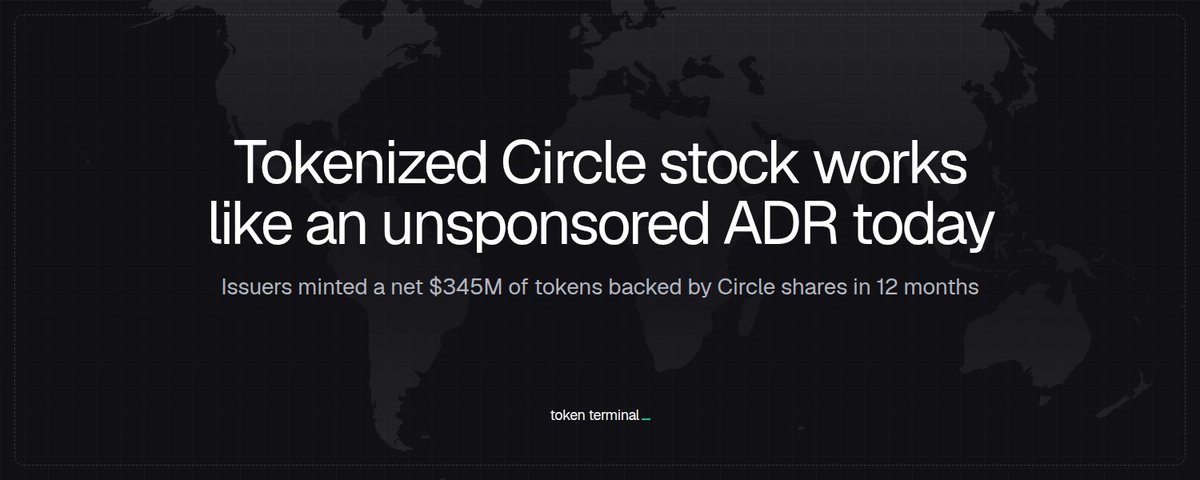
Tokenized Circle stock comes with a choice of issuer.
• October 20: $393M in market cap across 13 issuers or platforms, none of them Circle.
• The largest three held 93.7% of that value.
The other ten platforms account for the remaining 6.3% of tracked value.

fxLOOP packages fxSAVE yield into a managed borrowing strategy.
Our f(x) research explained how trading fees and reserve income support stability-pool yield. fxLOOP adds a separate USDC borrowing cost.
• 9Summits introduced fxLOOP, a managed vault with fxSAVE and its Pendle principal token as collateral options on Morpho.
• The strategy borrows USDC to buy more collateral and adjusts leverage as the gap between collateral yield and borrowing costs changes.
Morpho lenders earn interest. Vault returns reflect collateral income minus borrowing costs and fees.
The spread can turn negative while fxSAVE still earns yield. Unwinding positions can also delay withdrawals.
Read the full article in the first reply.


Brokerage accounts are a distribution channel for tokenized equities.
@Binance lets eligible users convert stock positions they already hold into bStocks, then withdraw the tokens to a compatible wallet.
• Conversion is 1:1 with no conversion fee.
• By October 15, more than $6B had been converted between stocks and bStocks since launch in June, according to Binance.
• October 12–19: bStocks market cap increased by $230.4M.
The conversion total counts conversions in both directions. It doesn’t measure net new investment or deposits into DeFi.
@Backpack offers a similar conversion on Solana. An eligible securities holding can be withdrawn as a token. Depositing the token back converts it into a securities holding in the investor’s Backpack Securities account.
The products have different legal rights, but both allow investors to transfer existing stock exposure to self-custody.
DEXs and lending markets can compete to serve equity positions that investors already hold.


Uniswap’s VolatilePair Hook brings directional pricing into the LP fee strategy.
The aim is to better compensate LPs for the trading risk they take.
VolatilePair changes how the pool charges for trades:
• October 14: Uniswap announced VolatilePair Hook was live on Ethereum, starting with ETH/USDC.
• Buy and sell fees are calculated separately before each swap.
• Baseline fees tilt with recent pool-price moves. Temporary charges also apply to trades that reverse a move.
The mechanism responds to price movements without identifying why someone is trading. Ordinary users can also face the extra charges.
Charging more only helps if enough flow stays to improve LP returns after trading losses. That improvement needs to be measured separately from liquidity rewards.


Pareto's OTC Desk lets FALX holders sell before redemption.
Our FALX research highlighted the liquidity risk of using credit tokens with monthly redemptions as DeFi collateral.
Recent updates show:
• September 28: Pareto announced its OTC Desk was live for FalconX Credit Vault positions.
• Sellers can offer their vault tokens at a discount to NAV. Buyers pay in USDC.
• October 14: Pareto described the standard monthly redemption schedule, with requests at one cycle-end and payment scheduled for the next cycle-end.
The seller receives cash when the offer is filled. The buyer takes over the credit exposure and must complete KYC to redeem.
The purchase discount has to compensate the buyer for the remaining holding period and repayment risk.
Read the full article in the first reply.


Stellar brings cash-management fund shares into onchain wallets.
Recent breakdown shows:
• $3.54B in distributed RWA value, excluding stablecoins, as of October 13.
• $1.79B in Spiko fund products, roughly 51% of that total.
Spiko's SAFO is an Amundi-managed fund for treasury and collateral management.
CACEIS provides depositary and fund administration services, while Stellar and Ethereum host the shareholder register.
Eligible investors can move these cash-management fund shares outside normal banking hours, with ownership changes recorded onchain.

Tokenized stocks are bringing equity order flow to DeFi.
Recent figures show:
• $3.9B in tokenized stock market cap.
• About 70% on BNB Chain, Ethereum and Solana.
• $157.8T in global equity market cap at the end of 2025, according to SIFMA.
• $16.8B in tokenized-stock DEX volume across 22 tracked venues in the 30-day snapshot reported October 10.
Issued equity tokens can change hands repeatedly, creating activity for onchain venues beyond their initial issuance.
DeFi venues can compete for that equity turnover without waiting for broad stock-market tokenization.


Tokenized equities need deeper liquidity outside traditional trading hours.
Analysis shows:
• More than half of trading occurs outside traditional market hours
• Around 80% of tokenized equity trades are smaller than one share
Liquidity remains low across different networks and venues.
Connecting buyers and sellers across these venues could increase liquidity and narrow price gaps for the same asset, improving the efficiency of continuous trading.

Tokenized assets have grown rapidly, reaching roughly $65b. Yet they remain tiny compared with traditional capital markets’ $300t in assets. Our new GFSR explores the policy and market conditions needed for tokenization to scale safely: imf.org/en/blogs/articles/20…
