

Cofounder @TryBrickroad • Prev AI R&D @GovUK @JPMorgan
EU (CET)
Joined July 2021
- Tweets538
- Following1.7K
- Followers1.2K
- Likes2.2K









Pinned Tweet
Training runs on GPUs. So should your data discovery.
Scouts: predictive, parallel, 24/7. They find the data your models need before they need it.

Data discovery is throttled, still running on CPUs in a GPU world.
It's slow, it's reactive, and it doesn't scale.
Today we're launching Scouts: Agents for predictive data discovery, running in parallel, 24/7.
Walkthrough from our co-founder @0xMichaelGordon 🧵
5
3
154
Michael Gordon retweeted

PlanFalcon is now listed on @Trybrickroad 🏗️
UK planning apps, tenders and contract awards, scraped nightly from 360 councils and turned into sales-ready leads for groundworks, drainage, SuDS and highways subbies.
#ConstructionTech #UKConstruction #PlanningApplications

Iykyk

Hey @a16zfrontier - both @datafdn and @withprotegeai have "Data Labs" - why haven't you built one for your PortCos?
Skill Issue?
2
33

Michael Gordon retweeted

upvote
a revolving world needs revolving frontier data foundries
that is why we are building data multiplexers for data consumers and producers

I've been thinking about where the data for the next generation of open models will come from.
The internet gave us a remarkable commons for pretraining. Posttraining is different: it consumes tasks, not documents. And that commons doesn't exist. Not yet. openathena.ai/blog/there-is-…

Michael Gordon retweeted

Reviewed 20+ data supplier pitches today.
1. Stop password-protecting sample.
2. Tell me the target price and licensing terms upfront.
3. Put the volume, update cadence, and eval results up front and center.
Few did that - I cannot forward your pitch along if it's half-baked.
Help me Help You!
If you really want to sell data, make a sample public, show the eval results and how it performed against benchmarks, and sell a story!
We developed, alongside a handful of data buyers, a vendor checklist here - complete it, download the zip, and share the PDF.
brickroad.network/supplier-o…
If you want us to host and display it in front of our clients agents, there is a fee 😱
Michael Gordon retweeted

Fast access to the right data at low transaction costs are the foundation of useful learning systems. That is why we co-initiated Croissant. We are grateful to see its growth and will continue supporting its development, towards composable data systems and beyond!

we will have two papers @NeurIPSConf this year from the croissant community 🥐
1. "croissant baker" led by rafi al attrach and @tompollard
2. "croissant miner" led by berke arda and @akhtarmubashara
i took a quick glance at the rearview mirror
since early 2023, our idea for a unified ml data access layer has grown into an expansive ecosystem, incl
- data aggregators spanning hundreds of thousands of datasets incl @huggingface @kaggle @dataverseorg @CommonCrawl and others
- tooling spanning auto-generation and -verification of croissant files
- the formal spec maintenance under @MLCommons
- and a growing list of community extensions spanning verticals such geo, responsible AI, health and others
onwards towards the composable data dream(:

Michael Gordon retweeted

ok yeah, ran this against my company's repo and landing page, same prompt
opus 5.5, truly insane where ai has come

Michael Gordon retweeted
thx everyone who came out! tldr:
1. rate of compute adoption far exceeds rate of frontier data access
2. by construction, high value tasks rely on frontier information (access gated, low diffusion data)
3. roi on compute adoption across economy hinges on access rate acceleration for frontier data
we are building some fun things @TryBrickroad to get us to 3. if you are bottlenecked on frontier data access or interested in solving just that, lmk!
im back to where the wild weights are this september and october
9/18 talk at the ai application base hangzhou on the data multiplexer ive been working on w my team @TryBrickroad
we will have oss meetups in hk, shanghai and beijing
to the data frontier and beyond!

Michael Gordon retweeted
didn't know how the interest rate hike would affect the market? this company is trying to help you get alpha by finding hidden data sources across the web

Michael Gordon retweeted
im back to where the wild weights are this september and october
9/18 talk at the ai application base hangzhou on the data multiplexer ive been working on w my team @TryBrickroad
we will have oss meetups in hk, shanghai and beijing
to the data frontier and beyond!
Michael Gordon retweeted
One of the challenges with tools like "Invent a Dataset" or "Build Your Dream Dataset" (which we built last year at @TryBrickroad) is psychological. It's also why OTC data marketplaces haven't worked - data doesn't sell itself. There is a reason why the $40B data brokerage market remains primarily human-driven.


Michael Gordon retweeted
Everyone Wants to Sell Data. Here's Why You Won't - and How You Might.
Let me explain.
At some point over the last few years, almost every company has considered data licensing as a revenue stream. AI opened up a new buy-side archetype for unstructured data in a way that made most data suddenly valuable - in theory.
We've talked to major league sports orgs, hospital networks, every major credit card and payments company, and even certain governments about data licensing.
Most decide not to go down the path for a handful of important reasons:
1. It's worth less than you think - much less.
in finance, data suppliers typically aim to earn a tenth of a tenth (1%) of the value their dataset returns to the firm. When your dataset is one of ten combined to generate $1M for a firm, you're looking at around $1k a year from that firm.
It gets worse when selling to a lab. A lab has to spend expensive compute to process your data, and it isn't generating a monetary return from your data that you can take a cut of. There's no denominator.
Lab pricing is anchored to what your data replaces - compute, annotation, the next-best alternative - not to returns. That's why doing evals before selling is so important.
2. It costs money - upfront - no matter what anyone tells you.
Between your database and a signed licensing deal sits a wall of technical and back-office work: data normalization, evals, backtesting, IP stripping, marketing, and legal.
Most companies see this list, reason that it's going to take 6-12 months before they get their first receipt, and shelve the project.
3. There is a $40B market of institutionalized frictions.
If data were easy to sell, everyone would sell it, and broker margins would evaporate. For incumbent data vendors who have been doing this for decades, the frictions around relationship building, normalization, validation, and access are their moat. It's a $40B moat that you're up against.
Now: here's how you might sell data.
The companies that make the most money selling their data typically share three core traits.
1. Their data is actually scarce - and it's recurring, ideally with low latency.
If someone, somewhere, cannot do their job without it and cannot get it anywhere else - then you're golden. but importantly, it can't be a one-time dump: buyers pay subscriptions for data that refreshes. A scarce asset that regenerates every day is a business. A scarce asset you can only sell once is a transaction.
2. They invest to validate demand and value.
There is a reason @mercor, @handshake, @micro1_ai and others are investing so heavily in RL gyms. Successful data deals are done on the basis of known results and savings.
3. They treat data licensing as a secondary revenue stream, but not a side hustle.
There's nuance here. First, the best data is a byproduct - exhaust from great operations. Focus on keeping your core operations sustainable so they keep producing more data. Second, you do need to invest up front in a dedicated owner, a real budget, and a multi-year horizon.
Data buyers can smell a tourist, and they don't do second meetings.
Michael Gordon retweeted
fan of efforts like this!
some overlap with popular endpoints across our data registry in august
to efficiently route frontier data at gpu clock rates, we need more than static indices though. adaptive models that track the data frontier and pipe access at scale @TryBrickroad


I added a robotics data section to pavlov's list:
- Scale (Natasha Dadabhoy, Don McCullough)
- microagi (@bercankilic @joinshift)
- micro1 (@aliansarinik)
- Human Archive (@babugi28 @Rush26agarwal)
- Mecka (@joshavata @jasontheutopian @mog3n @NotDeu)
- XDOF (@philippswu @YideShentu @itsnemojin)
- Build (@eddybuild)
- Sieve (@mokshith @thpicy)
- Claru (@DaniYogatama @artetxem)
- Midcentury (@dgmonsoon @ckxyz_)
- Datoric (@NickelReady @Jeffjinlin)
Thanks to @dgmonsoon @dygk_0x1 @markgrinev @jayparth_ @bercankilic @aliansarinik @Thom_Wolf @NickelReady @sincethestudy @elvisnavah and @rajivpoc
pavlovslist.com/robotics-dat…

Michael Gordon retweeted
We bootstrapped @TryBrickroad
in the early days by brokering data deals to AI labs.
From that work, we learned that there is a massive missing infrastructure layer needed to power efficient access to data. The access necessary to square with the worlds growing computational needs.
Most people stop at data production and brokerage. Its neither sustainable, not civilizationally impactful. Build shit that matters.


Michael Gordon retweeted
The Inevitable Consolidation of Data Markets - Mercor, Data Production, and the Missing Technology Layer
TLDR: The data industry doesn't need more brokers or production companies. It needs better technical rails.
I've been seeing a lot of narratives here about the state of data and RL environments.
Few of these tales are grounded in actual data market dynamics - likely because few have actually sold data, very few have done it at any significant scale (vc scale), and even fewer have the right incentives to solve the most critical issues in the data markets with technology.
A couple of things to keep in mind when exploring this space.
1. Data procurement is a $400B industry run almost entirely on human-to-human rails - it thrives off of artificial frictions and economic inefficiencies (for an in-depth analysis, see nitter.cf/Freeman_Lewin/status/2…). Outside of a few commodities markets - plastics, scrap metal - I know of no more inefficient market.
2. It is inevitable that the human-centricity of data markets will, and must, change in the next 24 months. Buyer archetypes are shifting, the information frontier is expanding, and access is becoming the bottleneck.
The work Mercor, Surge, Scale, Micro1, Handshake, and the RL labs have done in this space is not trivial. Mercor's rumored $20B valuation is cheap in the grand scheme of the production layer.
But production is only a small portion of what makes up the market.
The access layer — massive by comparison — simply doesn't have a technical winner yet. The dominance of production companies is the market pricing in what doesn't exist: the technical rails underneath it. Mercor and its peers are winning because the access layer hasn't been built. That won't stay true for long.
You see, labs rely on large production houses because accessing what's actually valuable - closed, private corporate data repositories - is hard. It's simply easier and cheaper to go to a producer for marginally good data than to negotiate with the companies that hold alpha as a byproduct of their operations. To get deals done in the current environment, every buyer negotiates bilaterally with every seller.
That is an n×m problem - and it hampers the progress of every lab, production house, financial firm, government, and corporation that relies on external data to drive strategy, operations, sales, and alpha generation.
Bilateral deal-making carries significant fixed costs - discovery, diligence, contracting. It's why almost every established data producer has a minimum-value entry point. Below a certain deal size, nobody can serve you profitably. The massive long tail of data buyer TAM is not being serviced as a consequence of these transaction costs(cf. details at brickroad.network/thesis.pdf).
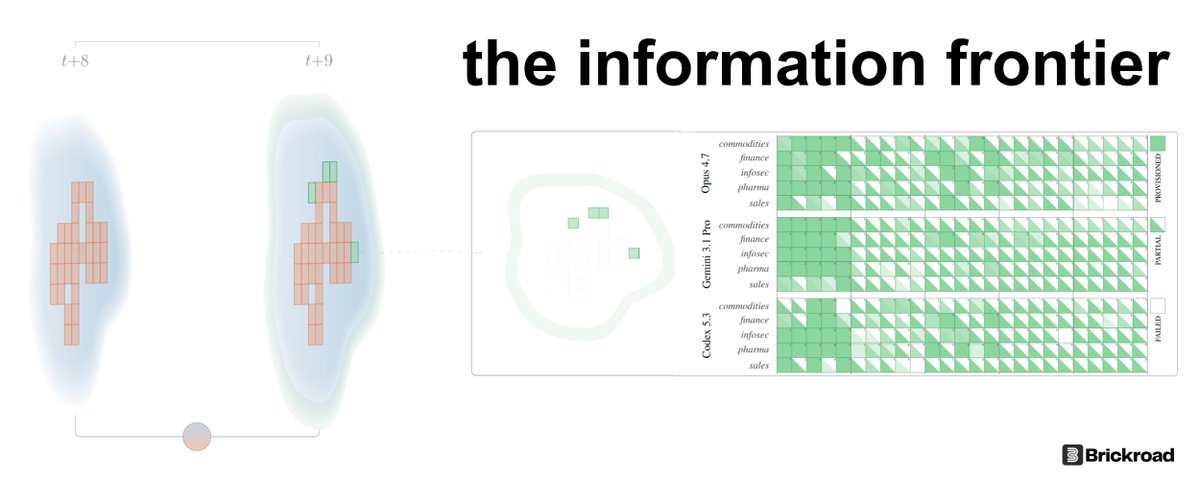
The human-centricity of the data market is also meeting a demand problem. We are scaling computation — LLMs, agents — into every corner of the economy at an accelerating rate. But computations cannot scale their ROI without inputs. What good is all that horsepower if you can't get it on the road? The rate at which we're deploying compute and the rate at which we can access frontier data (cf. brickroad.network/blog/the-i…) have diverged. If we can't close that gap, we'll be hard-pressed to earn a return on our computations.
And finally, the buyer archetype is changing. Data acquisition was once the primary domain of regulated industries like finance and banking. Now the archetype is entirely different: agents buying data via APIs for context, AI labs doing pre- and post-training on unstructured multi-modal data, corporations buying data not just for strategy but to train their own models, and governments purchasing real-time feeds for intelligence and national security. More buyers, buying more types of data, in smaller increments, at faster rates.
All these forces point in one direction. The data layer needs a technology that can scale at the rate of compute. That's what we're building at @TryBrickroad

Michael Gordon retweeted
We're headed to @icmlconf! @LuisOala is hosting an intimate dinner on July 9th to talk AI Supply Chains.
From discovery, procurement, through pre- and post-training, and everything in between and after.
Join Us: luma.com/l6z5tlv7

Michael Gordon retweeted
Source Streaming is now live on Brickroad.
Data strategists and sourcers need a way to get a continuous feed of novel and net-new potential data sources before they reach catalogs, directories, newsletters, and competitors.
Source streaming is that tool - a continuous, agent-driven feed of novel data suppliers that match to a thesis you define. The agent runs in the background indefinitely, scanning the complete corpus of its resources to find new suppliers that fit your criteria.
Check out the latest changelog: brickroad.network/blog/sourc…

