







ivx 👾💀 retweeted

hashcat v8.0.0 released!
The largest update in the history of hashcat, with PCFG attacks, hash recipes that crack hashes without a hash-mode, and bcrypt on FPGA boards.
Release notes: github.com/hashcat/hashcat/b…
Download: hashcat.net/hashcat/

ivx 👾💀 retweeted

Just found a zero day
If you right click on an executable on Windows, select run as administrator, it will run as administrator
I'm calling it Program2Shell


ivx 👾💀 retweeted

A Certifying Authority used the number “4” as a private key.
eMudhra’s weak keys could let fraudsters fake your bank’s website, padlock included. We’ve written to eMudhra, the Controller of Certifying Authorities and CERT-In asking for a fix.
#eMudhra #Cybersecurity #DigitalIndia #InternetFreedom
ivx 👾💀 retweeted

Open-sourced CryptSn0w, our now obsolete untethered iOS ≤27/≤A20 Pro jailbreak via rare Apple server-side TSS/Cryptex bug. PATCHED, educational only. NOT a working jb
Built w @GenericCoding @D4RK7ET. SBInject: @htrowii. Help: @Jakeashacks @forcequitOS
github.com/0xjohnnydev/crypt…

ivx 👾💀 retweeted
The .IN Registry took chalosansad.in off the internet three days after it went live, without notice or reasons. The site was a fully sourced, non-commercial record of the NEET paper-leak protests and the “Chalo Sansad” march. On 14 October 2026, the Delhi High Court issued notice in Sriram Viswanathan v. National Internet Exchange of India & Ors. (1/7)
Read More: internetfreedom.in/no-notice…
ivx 👾💀 retweeted
Delhi Police spent ₹161.27 crore on 34 signal jammers between July 2024 and May 2026, all bought from the public sector Electronics Corporation of India Limited on a nomination basis, without a tender. Three units of the force have given us RTI replies that contradict each other on what the jammers do and who can switch them on. The only rulebook they have named is one no citizen can read. (1/8)
Read More: internetfreedom.in/delhi-pol…

ivx 👾💀 retweeted

India’s Ministry of Electronics and Information Technology (MEITY), issued a blocking order against the bitchat Android app. Consequently, the app has been removed and is no longer available on Google Play for users in India.

Verification is so effective that Google has removed all the malware from Play Store. Now we can play totally safe games like @Fortnite, @TEKKEN 7 and 8. Android Developer Verification Program will bring more effective protection to all /s
eval.blog/blog/authoritarian…


Previously, I started a new Play Store account because I wanted to make video games for Android. But I never got time to finish my game. As a result, my personal play store account was closed by @Google because of inactivity.
Now, I developed a new app, let's publish it on play store. But I cannot restore my old account. The message now says "To start publishing apps on Google Play, create a new account." but I haven't found any method to create a new play console account yet either.
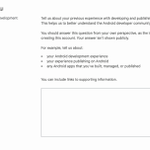
Okay no problem, I don't need a play store account just to publish apps, I could maybe ship an APK via @fdroidorg . But wait, what's this? To distribute my APK in the future, I must sign up for Android Developer Verification Program?
Okay it should be just a sign up then. No big deal. But wait, this Android Developer Verification Program costs 25$? I just wanna publish my little app for free. I am not even making money out of it. Why should I be paying this tax to Google? Okay 25$ isn't a big amount, I can pay. But what's this, I need to tell them who I am as well? WTF is this shit!
Okay how about I will just share a development build with my friends. Tf? Even for the users below 20, I must register with the techno overlord? Sure there is no 25$ for 20 or less, but I still need to have a verified payments profile and must tell them my opinion about publishing on android?
Tell me @Google, can I write "Fuck you" there? or should I be a lickaboot loyal little rule-follower and write a love letter there?

BitChat is just the start. Google has quietly built the best possible weapon for governments to block such apps.
eval.blog/blog/authoritarian…


ivx 👾💀 retweeted
Statement : The removal of BitChat from the India App Store is unconstitutional. Section 69A permits the blocking of unlawful information, not of a messenger for working during internet shutdowns.
New Delhi, 3 October 2026
An Apple App Review notice published today by Jack Dorsey on X records that BitChat has been removed from the India App Store "per demand from the Ministry of Electronics and Information Technology", issued under Section 69A of the Information Technology Act, 2000, on the ground that the application "includes content that is illegal in India". The notice adds that BitChat's TestFlight builds are no longer available for testing in India. It does not identify the content said to be illegal or the ground under Section 69A invoked. The blocking order has not been published. The Internet Freedom Foundation condemns the order and calls for its immediate publication and withdrawal.
BitChat relays end-to-end encrypted messages between nearby phones over Bluetooth mesh. It has no servers and hosts no content of its own. What travels through it is the private speech of its users, so the claim that the application "includes" illegal content is incoherent. The State's actual objection stands recorded in the notices the Indian Cyber Crime Coordination Centre issued on 23 July 2026 to GitHub, Google and Apple against BitChat, Briar and Bridgefy which stated that such applications work even during internet shutdowns and hamper lawful interception, attribution and traceability. Those notices, issued under Section 79(3)(b) were reportedly withdrawn after public disclosure. The same end has now been pursued through Section 69A. The objection is to capability of an application, not to content it transmits. A citizen's ability to speak to another citizen while the State has switched the internet off is not a ground of restriction under Section 69A or Article 19(2) of the Constitution.
Section 69A survived constitutional scrutiny in Shreya Singhal v. Union of India (2015) because of its safeguards which included the need for a reasoned, recorded order, committee review, and a hearing to the originator under Rule 8 of the Blocking Rules, 2009, which the Delhi High Court enforced in Tanul Thakur v. Union of India (2022). Further, Anuradha Bhasin v. Union of India (2020) requires that orders restricting fundamental rights be published and adopt the least restrictive measure. However, it appears in this instance, each safeguard has been evaded. A secret order blocking an entire application, rather than any identified unlawful information, is the most restrictive and disproprotionate measure available. Further, the confidentiality claimed under Rule 16 cannot defeat the right to challenge an order, and the constitutionality of this blocking regime is itself pending consideration before the Supreme Court.
While removal from the App Store does not delete BitChat from phones, it stops new downloads and security updates, leaving existing users on unpatched versions, and it ends security testing in India through TestFlight. During the Jantar Mantar protests, when mobile internet was suspended and jammers were deployed, Bluetooth mesh messaging was a channel of last resort through which young people coordinated their safety. To our knowledge, Apple has removed BitChat on a government's demand in only one other country. This is in China, in April this year.
Our demands
1. MeitY must publish the blocking order, the ground invoked and the record of the committee's proceedings, and serve the developers with a copy and an opportunity of hearing.
2. The direction must be withdrawn. Any specific unlawful use must be met with targeted proceedings under due process, not the removal of a communications tool for everyone.
3. Apple must disclose the demand in its transparency reporting and notify its users in India, and must state whether parallel directions have been received in respect of other app stores.
4. The secrecy of the blocking regime must end. The Blocking Rules, 2009 should be amended to require publication of orders and notice to originators, without awaiting the outcome of the pending constitutional challenge.
The Internet Freedom Foundation will file applications under the Right to Information Act seeking a copy of the order, and stands ready to assist the developers and affected users in India.



Previously, I started a new Play Store account because I wanted to make video games for Android. But I never got time to finish my game. As a result, my personal play store account was closed by @Google because of inactivity.
Now, I developed a new app, let's publish it on play store. But I cannot restore my old account. The message now says "To start publishing apps on Google Play, create a new account." but I haven't found any method to create a new play console account yet either.
Okay no problem, I don't need a play store account just to publish apps, I could maybe ship an APK via @fdroidorg . But wait, what's this? To distribute my APK in the future, I must sign up for Android Developer Verification Program?
Okay it should be just a sign up then. No big deal. But wait, this Android Developer Verification Program costs 25$? I just wanna publish my little app for free. I am not even making money out of it. Why should I be paying this tax to Google? Okay 25$ isn't a big amount, I can pay. But what's this, I need to tell them who I am as well? WTF is this shit!
Okay how about I will just share a development build with my friends. Tf? Even for the users below 20, I must register with the techno overlord? Sure there is no 25$ for 20 or less, but I still need to have a verified payments profile and must tell them my opinion about publishing on android?
Tell me @Google, can I write "Fuck you" there? or should I be a lickaboot loyal little rule-follower and write a love letter there?
ivx 👾💀 retweeted
₹2 buys a stranger's home address. We tested a Play Store app with 10M+ downloads selling VAHAN/eChallan data, one number plate gave us the owner's full name, father's name, permanent address, insurance policy, chassis and engine numbers, all of which Parivahan masks behind an OTP.
This isn't a hack. Researchers at Cyderes traced it to licensed API keys given to KYC companies, now resold on Telegram.
IFF has written to MoRTH, NIC & CERT-In demanding a forensic audit, and filed RTIs on 22 Sept. Found your own data on these apps or similar website? Write to [email protected]

ivx 👾💀 retweeted

Just for your information:
We (offensive or defensive cybersec people) and threat actors don't have the same capabilities as the frontier labs do.
The API cost of testing ExploitBench like they did would be a whopping ~$59.3M (Astra).
Oh, and you cant do it like they do, they remove all guardrails and classifiers.
What about renting AI hardware in the cloud?
DeepSeek v4? $3.4M
Kimi K3? $16.9M
GLM 5.3? $9.3M
Not to mention the engineering cost to make a harness operate 10,000 agents.
(Napkin-Math based on the Huggingface reports. Exploit bench eval consisted of 10,000 concurrent agents, 8day non-stop run, no limiters)
I am sleepy af and don't have the motivation to write a post, but good news. ivx/ai Chat is now available on chrome webstore and firefox addons store. Still on v0.2.2, but 0.3 is coming soon! Some of the upcoming features:
- Easy access to any open tab
- Support for images and videos and other files.
- Improved integration of MCP
- Visibility on your current page (still private of course)
- Ability to summarize selected text, translate it or ask AI
- Let AI write on any text box in your browser
You can find ivx/ai Chat on ai.ivx.run
Browser extensions are still not linked on the website, but you can search in the stores to find them easily.
Also please follow @ivxlabs

ivx 👾💀 retweeted

ivx/ai Chat v0.2.0 is out.
Run LLMs locally with WebLLM, no API keys or servers.
Agents & delegation
MCP & Skills
Provider/Agent Store
Shareable private chats
github.com/ivxlabs/ivxai-app…
#AI #LLM #OpenSource
