
Smart Contracts Developer @yieldnestfi. prev @aave @amazon
Blockchain
Joined December 2020
- Tweets913
- Following5.4K
- Followers2.7K
- Likes9.9K
good article on @binance on how do they prove or build proof of reserves binance.com/en/academy/artic…
didn't understood things about how zk-snarks proof works in that case since not much familiar with it but it seems time to deep dive on ZK in sometime

3
185
so the AI tool used internally gave access to each other machine in same org? Would like to read detailed postmortem as lot of things are missed in this and not properly explained.


2
193
good read on this eip for integration with signatures where there is need for contract signing
eips.ethereum.org/EIPS/eip-1…
the best usecase of this is implemented in gnosis safe implementation github.com/safe-fndn/safe-sm…

1
340

did a deep dive on how rlp encoding works, good read
ethereum.org/developers/docs…

1
200
Deep diving on EIP-7702 this weekend
Great introductory video by @lightclients youtube.com/watch?v=_k5fKlKB…
and by @PatrickAlphaC youtube.com/watch?v=0uy4nd8v…
Reading official eip spec was overwhelming at first but this two videos + AI made it click.

254
great overview on market making on exchanges

"Greed makes markets."
Annanay Kapila (@annanay) spent years as an HFT quant at Flow Traders and Tower Research before founding QFEX (@QFEX), a perpetual futures exchange for equities, commodities & FX. Cambridge Maths.
At his last job, the desk traded $10B+ of volume a day, run almost entirely by algorithms.
In this lecture, he builds market making from first principles:
- The map of systematic trading: prop money vs. other people's money, HFT vs. mid-frequency, and why every strategy lives in one quadrant
- Why prop firms can return 50-100% a year while hedge funds can't: HFT never leaves you holding a big position
- The order book from scratch: bids, offers, limit orders, and why the first order on a price level gets the trade
- No free lunch: how arbitrageurs force every order book to reveal a fair price without anyone trying to
- The entire strategy in one line: bid below fair value, offer above it, collect the difference forever
- Market making is "time-spreading risk," warehousing positions between a seller who shows up now and a buyer who shows up later
- Adverse selection: you're most likely to get filled precisely when your price is most wrong
- Why market makers are completely self-serving, and why that's exactly what makes markets work
- The competitive race that compresses spreads: greed among market makers means lower costs for everyone else
- Thick books vs. thin books, and the vicious loop that keeps illiquid markets illiquid
Highlights:
(00:45) The systematic trading map: capital vs speed
(01:45) Prop firms vs hedge funds: return-on-capital economics
(06:29) A message from Onyx
(07:55) Where market making sits: high-Sharpe prop HFT
(08:55) Fungibility and why exchanges exist
(11:00) How a central limit order book actually works
(17:40) No free lunch: arbitrage-free pricing in the book
(19:55) Theo: reading fair value from the mid
(22:45) Who really posts the book (not retail)
(24:35) Market making as warehousing risk across time
(27:20) Edge: quoting around your fair value
(29:45) Queue priority and the adverse selection problem
(33:05) How competition compresses the bid-offer spread
(37:40) Thick vs thin books: liquidity begets liquidity
(43:55) Scaling to $10B a day on algorithms
243
Good explanation on Morpho Midnight by @DeFiSaver
youtube.com/watch?v=9P76U3LK…
Next read: midnight whitepaper

1
310
Great guide on events in solidity and the underlying opcodes for events. Was great read for weekend
paragraph.com/@spacesailor/t…
1
5
399
🧵1) Spent time this weekend on understanding of low level solidity and evm. Was refreshing to read and brush up internal workings.
Resources linked:
How does ethereum contract creation works internally by @RareSkills_io rareskills.io/post/ethereum-…

1
297
2) Solidity metadata appended at solidity deployment bytecode and its significance by @RareSkills_io rareskills.io/post/solidity-…

138
Great writeup on setting proper liquidation threshold and liquidation bonus for lending protocol to ensure no bad debt is created s3v3ru5.github.io/posts/part…
Another one on spectrum of Health factor and position's recovery based on HF
s3v3ru5.github.io/posts/part…
h/t @S3v3ru5_
2
5
326
great work. Nice to see different initiatives taking place to secure onchain contracts and vulnerabilities

Phylax just blocked its first live exploit attempt on Linea.
An external integration misconfiguration caused some wallets to approve a 0x Settler address directly. Working with @0xProject, we deployed a targeted mitigation...
and the first drain attempt was stopped!
Read on
1
336
nice article by @trailofbits on thinking in terms of dimensions for understanding formulas in defi
blog.trailofbits.com/2026/03…

1
277
Is there any detailed articles comparing slippage of Uniswapv2 vs curve V1 and how the dynamics changes based on the reserves in the pool?
Any blogs, resources or papers?
173

Good writeup by @ret2basic on Solv protocol hack
taichiaudit.com/blog/solv-pr…

too many cases like this. How can we make bug bounty great again?

I Saved Injective's $500M. They Pay Me $50K.
I like hunting bugs on @immunefi . I'm decent at it.
- #1 — Attackathon | Stacks
- #2 — Attackathon | Stacks II
- #1 — Attackathon | XRPL Lending Protocol
- 1 Critical and 1 High from bug bounties (not counting this one)
Life was good. Then I found a Critical vulnerability in @injective .
This vulnerability allowed any user to directly drain any account on the chain. No special permissions needed. Over $500M in on-chain assets were at risk.
I reported it through Immunefi. The next day, a mainnet upgrade to fix the bug went to governance vote. The Injective team clearly understood the severity.
Then — silence. For 3 months. No follow up. No technical discussion. Nothing.
A few days ago, they notified me of their decision: $50K. The maximum payout for a Critical vulnerability in their bug bounty program is $500K. I disputed it. Silence again. No explanation for the reduced payout. No explanation for the 3 month ghost. No conversation at all. To be clear: the $50K has not been paid either.
I've seen others share bad experiences with bug bounty payouts recently. I never thought it would happen to me. I can't force them to do the right thing. But I won't let this be forgotten.
I will dedicate 10% of all my future bug bounty earnings to making sure this story stays visible — until Injective pays what I deserve.
Full Technical Report: github.com/injective-wall-of…

437
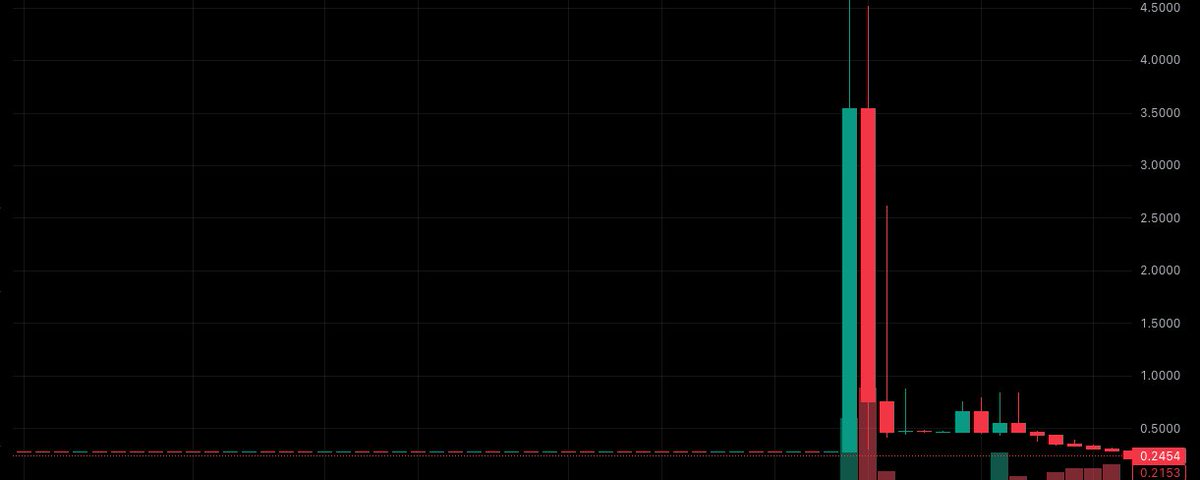
wondering what would be better way to price this type of collaterals where chainlink feed is not available and there is not enough onchain liquidity for twap pricing. maybe best solution for lending protocols is not to list this collaterals in first place

1
1
420
Oracle misconfiguration issue strikes again. Such issues will be having huge issue on protocols with high TVL like AAVE.
This post is from a suspended account. Learn more
278
@ethereum devs, have you seen proper usecase of optional access list in transactions? eips.ethereum.org/EIPS/eip-2…
It was proposed long time ago but I am not aware if anyone is using it meaningfully.

1
2
112