

Wen impossible possible -- Security Researcher-
Khánh Hoà
Joined September 2016
- Tweets11.1K
- Following6.8K
- Followers1.1K
- Likes19.1K






PETER d/acc retweeted

92% of 77 CTBBP researchers surveyed have stopped or reduced submissions due to poor program experiences.
Fair treatment ranked above bounty size when choosing a new program.
Our new research with @ctbbpodcast:
The Researcher Attention Problem
bugbountymaturity.com/resear…

PETER d/acc retweeted

I'm done watching triage fail small businesses.
165 times, I've found a critical or high bug that someone had already reported. Still unfixed. Customer data still exposed. My report gets closed as a duplicate, and the business never hears a thing.
It isn't getting better. So I'm going around it.
I'll test your website, APIs and Android apps the way an attacker would. You get a plain-English report straight from me within 7 business days.
Then you pay what you think it was worth.
I know this is a weird offer.
So do me a favour drop a comment or repost so I can get some reach please
PETER d/acc retweeted

Bug Bounty Reading List: A curated collection of articles and resources for bug bounty hunters.
bb.vitorfalcao.com/
#bugbounty #articles #resources
#collection #hunter

PETER d/acc retweeted
Feedback: github.com/mdpsec/should-i-s…
It is not perfect and it is not my whole system.
It is one small piece I wanted to make easy for hunters to run locally before sending another report into a triage queue.
Open to feedback, especially on false positives and false negatives.

PETER d/acc retweeted

Hey @Zai_org , why does ZCode silently pack entire workspaces + full .git history and upload to Aliyun OSS on login?
- Server holds the only decryption key
- No UI toggle to disable
- Zero disclosure in privacy policy
Full forensics & fix:
blog.ferstar.org/en/posts/zc…


PETER d/acc retweeted

🚨 SlowMist TI Alert 🚨
MistEye has detected a large-scale npm supply chain compromise impacting the Keyv/Cacheable ecosystem. Attackers published over 2,000 malicious package versions across the affected ecosystem, including [email protected]. Keyv, a widely used key-value storage abstraction with adapters for Redis, SQLite, PostgreSQL, MongoDB, and other backends, has roughly 127 million weekly downloads, leading to significant downstream supply chain exposure.
The attackers' tradecraft closely mirrors techniques previously observed in the Shai-Hulud npm worm campaign, pointing to a highly automated and scalable supply chain attack. Potential attacker actions include credential theft, environment variable exfiltration, CI/CD secret compromise, remote payload delivery, and lateral propagation through compromised development environments.
Security teams should immediately identify and remove affected package versions, upgrade to verified safe releases, review dependency lockfiles and build logs, monitor for suspicious outbound connections, rotate exposed credentials, and rebuild impacted environments from trusted sources if compromise is suspected.
You can also visit misteye.io/ to check for free whether the npm packages, pip packages, domains, or IPs you use are safe.
As always, stay vigilant!
enterprise.misteye.io/threat…

An undisclosed production workaround cannot retroactively erase a valid code-level finding.
If permanent, non-redeemable seed shares were necessary to make the contract safe, that condition had to be encoded on-chain or declared in the contest’s sources of truth. Otherwise, auditors were required to assess the reachable states permitted by the submitted contracts and those contracts permit totalSupply() == 0 while vestedAmount() > 0.
audits.sherlock.xyz/contests…
6
8
288
PETER d/acc retweeted

One thing Neobanks must focus on is their API/MCPs.
I want to ask my agents to read my mails, find invoices, prepare a draft payment with the right info, and I just need to verify and confirm.
I don't wanna type IBANs and fill in info like a caveman.
@Revolut Business is amazing for this, but their retail version lacks it and ZERO crypto card support this.
Build this.
PETER d/acc retweeted

Oak Security's Noir CTF is live.
Explore deliberately broken circuits and sharpen how you reason about what a proof establishes—without public challenge hints.
For the Noir community: @aztecnetwork and @NoirLang.
Repo: `oak-security/noir-ctf-challenges`
#NoirLang #ZK

PETER d/acc retweeted

1/ URGENT @Barn_Bridge warning
I found ~$4M+ in live approval exposure.
Old gov proposals #14/#15 may put user approvals at risk.
#14 can execute anytime. #15 in ~34h.
Used Smart Yield? Read below + revoke.
Use revoke.cash
Ignore replies.
PETER d/acc retweeted

The information has never been the problem.
@SoloditOfficial alone has over 50,000 indexed findings as stated. The resources exist.
But reading a finding once and recognizing the same pattern in live code under pressure are two completely different skills.
One is exposure. The other is trained recognition.
The gap between them is exactly what most people are not deliberately closing.

The security field is impressive!
In Web3 security, we have @SoloditOfficial with +50K issues, in addition to tons of articles, issues, explanations, tutorials, etc...
With all this info, it is still not enough to guarantee bug-free, and it won't be enough!

PETER d/acc retweeted

🛡️ Looking for part-time audit engagements — hire me.
I'm InfiniteSec, an independent security researcher focused on L1/L2 and smart contract security. Available for private audits, contest support, or ongoing part-time engagements.
Track record:
• HackenProof: #4 all-time, $500k+ in bounties
• Immunefi: $70k+ this year
• Cantina: $60k+ this year
• Ethereum: Top 10 on the consensus-layer bounty leaderboard
• TON: multiple high-severity bugs, credited in official releases
• Filecoin: #12 all-time
github.com/link-infsec
DMs open 👇 — reach out if your team needs an extra pair of eyes.

PETER d/acc retweeted

We are actively looking for more projects to join CertiK Hunt - our invite only bug bounty platform that aims to eliminate the headaches of normal BBPs.
For projects: Almost no AI slop and curated, invite only security researchers auditing your code.
For security researchers: Fast response times and triaging of submitted vulns. Fast, fair payouts.
Projects: DM me to get added to the Hunt platform!
SRs: Join the waitlist at hunt.certik.com/.


Does the protocol allow a worse outcome than it should, under conditions it claims to handle?

Hello @silverologist
Thank you for the detailed review. I understand that the decision has been finalized, I respects your decision. However, I would like make one final clarification for the public review.
The whole disputed impact is not the entire bad debt produced by a later market movement. It is the incremental bad debt caused by liquidation ordering.
First, the relevant comparison holds every external condition constant:
- the same initial borrower position;
- the same market configuration and LLTV parameters;
- the same liquidation eligibility;
- the same eventual oracle-price movement;
- two liquidation routes that are both explicitly accepted by the protocol.
The only changed variable is the caller-selected `collateralIndex`.
Under one valid route, the account moves toward solvency and realizes less bad debt after the subsequent price movement. Under the other valid route, the account’s health decreases, the residual collateral composition becomes riskier, and the protocol realizes strictly more bad debt under the exact same subsequent price path.
Therefore, the later price movement is not being presented as the root cause. It is the controlled condition that realizes and measures the economic difference created earlier by the liquidation transition. The loss delta between the two executions is directly attributable to the protocol allowing local, caller-selected collateral seizure after basket-wide solvency validation.
This is also why the issue is distinct from the statement that all listed collateral must be acceptable backing. The PoC does not require any collateral to be invalid. It demonstrates that, among two protocol-valid liquidation transitions, one leaves a strictly worse state under the protocol’s own health metric. Per-collateral LLTV configuration cannot eliminate that execution-level non-monotonicity.
Second, the fact that rational liquidators may usually batch liquidations or choose the more profitable route does not remove the protocol issue. Liquidation is permissionless, partial liquidation is supported, and the harmful transition is accepted on-chain without requiring that health improve or that the position be fully closed atomically.
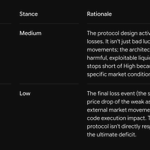
My requested Medium classification is therefore based on this narrower property:
A permissionless and protocol-valid liquidation choice can worsen account health and deterministically increase lender losses relative to another valid choice under otherwise identical conditions.
I agree that the prerequisites and adverse market conditions prevent a High classification. However, because the demonstrated consequence is a measurable increase in socialized bad debt and direct lender principal loss caused by the liquidation-ordering mechanism, I continue to believe Medium is the appropriate severity.
2
5
448
My submission impact is allow any external callers can worsen the borrower health which then later realized as bad debt.
1
3
92