




Pinned Tweet
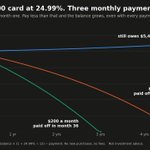
A $5,000 card at 24.99%. $100 a month, never missed. It never gets paid off.
One of five places compounding runs backwards. All five, with the math, below.
Which one is running in your life?

Aaron retweeted

The new GTA 6 money reel: paste someone's viral GTA video into an AI tool, it scripts, voices and posts the clips, you "grow your channel."
The proof at the end is a YouTube Studio screen. Read the dates on its chart: April 2025 to April 2026.
That's seven months before GTA 6 even came out. Whatever earned that channel its money, it wasn't GTA 6 clips.
Two more tells on the same screen:
→ 90.8K watch hours over 2.1M views is about 2.5 minutes a view. That's long videos, not Shorts.
→ The method starts by pasting another creator's link. YouTube won't monetize reused content, and the owner can file a copyright strike.
And one screenshot of one channel never shows the ones that made nothing.
Have you ever seen anyone show the channel behind these screenshots?


Aaron retweeted
This reel is everywhere right now: GTA 6 + YouTube Shorts = $22,477.
The method: find someone else's viral GTA video, paste the link into an AI clipping app, download the clips, upload them as yours.
What it skips: YouTube's reused content policy. Channels built on other people's videos without real commentary don't get monetized, and since July 2025 the rules on mass-produced content got stricter.
And the $22K screenshot never shows which channel or which videos it came from.
The version that actually pays: your own take on the footage, AI only for the editing.
Have you ever seen a channel get paid just for reuploading clips?
Aaron retweeted
IT'S INSANE. I CAN'T WRITE A SINGLE LINE OF CODE, AND IN 10 MINUTES I SHIPPED A GAME.
One prompt to Claude Opus 5.5. It built the whole thing, then ran a bot through it 24 times on four screen sizes before letting me play.
Your lighthouse storm, made playable. And Opus did the waves this time.
Hold to steer. Dodge the rocks. Ride the beam for 3x points.
My best is 288. Beat it. Link in the reply.

CLAUDE FABLE AND CLAUDE OPUS GOT THE SAME F*CKING PROMPT AND ONLY ONE OF THEM BUILT THE STORM
1 prompt: a lighthouse on a cliff in a storm at night. Huge waves, rain, a beam cutting through fog.
1 HTML file. Raw WebGL shaders. No libraries.
Neither model got to see its own result before I hit render.
Fable: 7m 46s, 104K tokens.
Waves smashing the rocks, spray everywhere, the beam slicing straight through the clouds.
Opus: 6m 10s, 98K tokens.
A detailed red and white lighthouse, a keeper's house, rain and fog.
The huge waves from the prompt are barely there.
Fable is Anthropic's most expensive model. Here you can see where the money goes.
Which one would you pick for your next project?
Aaron retweeted
IT'S INSANE. A PEN DOODLE OF A BOAT BECAME A PLAYABLE RACING GAME IN TWO PROMPTS.
He can't draw. The sketch is a few pen lines of a speedboat.
He snaps a photo, drops it into Claude with Fable 5.2, gets a realistic boat from one prompt. Then types: "ok now make it a game."
Rival boats, a start gate, a speedometer. Playable.
The sketch is the whole skill now. What would you draw first?
Aaron retweeted
2-3 hours of actual work. Fable 5.2. Running in a browser tab.
A friend built this shooter while I sat next to him and understood almost nothing.
Container port, missions, radio callouts, reloads, real lighting.
Next one I'm building myself, from zero. What should it be?

I wanted to test Fable 5.2's quality with one-shot prompts without human feedback.
Everything in this game is from scratch: models, sounds, textures. ~$550 at API pricing, ~2.7M output and 445M input tokens, heavily cached. Took 8 hours!
Play it here: claude.ai/artifact/BGY1SztrA…
Aaron retweeted
IT'S INSANE. ONE ROOM IS PUMPING OUT 500,000 INSTAGRAM REELS A MONTH.
Racks of iPhones on USB hubs. A few Mac minis driving all of them. One curved screen showing dozens of Instagram accounts posting at the same time.
500K a month is the number on the video. That's about 16,700 reels a day, or 6 million a year. Even with 100 phones, each one posts 160+ times a day, so every phone is running a whole stack of accounts.
Why real iPhones? A phone with its own SIM looks like a normal user. Emulators get flagged.
Posting is the easy part now. The bottleneck is content, and that's where AI comes in. Claude can write thousands of captions and video prompts in an afternoon.
The catch: Instagram's terms ban creating accounts or posting automatically without permission. These farms bet they can replace banned accounts faster than they lose them.
Would you rather build one account people trust or 1,000 nobody remembers?
Aaron retweeted
IT'S INSANE. AN AI GRANDPA FROM SIBERIA HIT 57.5K FOLLOWERS IN TWO WEEKS.
Arkady Zlatogorov. Instagram labels him "AI-generated". Shirtless, tattooed, beard down to his chest, living like a billionaire. Here he sprints up a dam wall in front of a crowd and slides back down on his feet. 15 seconds.
First reel went up October 18. His second day did 1.1M views. Yesterday's reel: 773K.
The money line is the bio: "Hotels · cars · real estate. DM for collaborations." He was built to get booked by luxury brands, and a highlight called "PROOF" already shows him next to a red supercar.
Risk: the whole joke is the contrast. The day he looks like any other rich guy, there's no reason to watch.
Would a hotel actually pay an AI grandpa to stay there?


Aaron retweeted
IT'S INSANE. AI SHAGGY HAS 205K FOLLOWERS AND HIS WHOLE BIO IS AN AD FOR THE APP THAT MADE HIM.
Salsicha, the name Shaggy goes by in Brazil. Here he rides a motorbike backwards with a can in hand while Scooby steers. 15 seconds. Instagram labels the profile "AI-generated".
129 posts. Top reels: 1.6M, 446K, 380K views.
The bio is a promo code for the AI video tool behind him, plus a highlight that says "create here" in Portuguese. Every viral clip doubles as a demo of the app.
Risk: Shaggy and Scooby belong to Warner Bros. One takedown and the whole funnel goes with them.
Would you download an app because Shaggy told you to?


Aaron retweeted
THIS IS F*CKING UNREAL
one suno account, one photo of herself, and a suno profile showing 3.1 million plays.
"3.1M PLAYS · 125 SONGS · 7.9K FOLLOWERS"
she says it takes minutes to turn a song into a music video. three of her tracks did 976K, 936K and 891K plays on their own.
the whole pipeline is one song and one photo:
→ make the track in suno
→ open openart's director, drop in the song + a reference photo
→ "create a performance narrative style music video. must feel cool and funny. y2k style."
out comes a shot-by-shot music video with her as the singer, party scenes and all.
two things worth knowing before you copy it:
→ those three tracks are ~90% of her 3.1M plays. the other 122 songs average roughly 2,400 each
→ a play on suno isn't a stream on spotify. royalties start only after distribution, and spotify pays nothing on tracks under 1,000 streams a year
the honest math on what ai content actually pays is in my faceless youtube guide below.
would you spend your next hour on a new song or on a video for the one that already works?
Gear 2 of the article showed the cost: the more a return bounces, the further the real growth rate falls below the average.
This MIT lecture shows the cheapest way to turn that gear down.
Peter Kempthorne runs a simulation with two assets that don't move together. Then he mixes them.
The portfolio's volatility drops. And the return doesn't. In his words, you reduce volatility "without compromising, and in fact improving, the return."
Here's why that matters more than it sounds. Volatility isn't just discomfort. It's a direct tax on compounding. Two portfolios with the same average return don't end up with the same money. The calmer one does better.
Ten minutes later in the same lecture comes the warning. Even in a simulation where the true numbers are known, the estimated returns come out far from the truth.
That's gear 3. Every sizing rule, Kelly included, runs on an estimate of your edge. And the estimate is always noisier than it feels.
Lower the volatility you don't need. Distrust the edge you think you have.
How many of your holdings actually move independently of each other?

In 1958, Bank of America mailed 60,000 credit cards to people in Fresno who never asked for one.
The card was never the business. The balance was.
The first charge cards had to be paid off every month. Then banks let customers carry part of the bill forward — for a fee called interest. That one change turned a payment tool into compounding's reverse gear.
Today it looks like this: $5,000 at 24.99%, $100 paid every month, and the balance still rises — because $104.13 of interest lands before the $100 does.
The 5-minute history below shows how we got here. One correction: interest caps didn't fall in 1968. The Supreme Court's Marquette ruling came in 1978, and it let banks charge their home state's rate to customers in every state.
Five places compounding runs against you — the full breakdown is in the article.
Which one is running in your life right now?
Not investment advice. Mechanisms and their prices.

$5,000 on a credit card at 24.99%. $100 paid every month, on time, for four years.
The balance goes up. To about $5,335.
Not because anyone missed a payment. Because $104.13 of interest arrives every month before the $100 does.
That's compounding in reverse. Same exponent everyone puts on the growth chart. It just takes instead of gives.
I wrote up five places it runs against you: the interest line, the average that lies, betting too big, the exit at the bottom, and paying with an asset that compounds. Each with the number that exposes it and a check you can run tonight.
Which one is running in your life right now?
Not investment advice. Mechanisms and their prices.
In 2013 the Nobel committee gave one prize to two men who disagreed about almost everything.
Eugene Fama had spent his career arguing that market prices reflect all available information.
Robert Shiller had spent his arguing that prices swing far more than the businesses behind them justify.
Same prize. Same year. Opposite conclusions.
Shiller's case began with a 1981 paper and a simple question. If a stock is worth its future dividends, how much should its price move? Then he measured how much prices actually moved.
Far more. Not a little more. Far more.
The committee's answer was that both could be right on different clocks. Over days and weeks, prices are close to unpredictable. Over three to five years, their broad course is not.
That gap between the two clocks is where investors get hurt. Not by owning the wrong asset. By reacting to a price that has briefly stopped meaning much.
Shiller walks through the whole argument in this Yale lecture. Free since 2008.
Which clock are you investing on?
Most people read this and fix number 1. Save more. Start earlier.
Number 3 is the one that quietly decides whether the first two ever matter.
His math on the first two checks out. $7,500 a year for 25 years at 7% grows to about $474,000. Double the savings on half the salary and it's $885,000. The spreadsheet part of wealth is easy.
The hard part is the other side of the spreadsheet.
In February 2020 the S&P 500 fell about a third in five weeks. By August it was back at its old high.
Millions sold somewhere in between. Selling wasn't even the expensive part. Waiting too long to buy back was.
Andrew Lo, who has spent decades at MIT studying exactly this, tells the story in the clip below.
How much does that mistake cost on average? Nobody agrees.
Morningstar puts bad timing at 1.2% a year — about 15% of what funds earned from 2015 to 2024.
This year a paper in the Financial Analysts Journal ran the same data and got 0.1%.
Whichever number is right, it's an average. An average spreads the damage across millions of investors.
A panic sale at the bottom doesn't spread. It lands on one person, once, at full size.
Lo's fix is the same as the article's: run the "what if" in a calm moment. What if the market drops 20%? Can I afford to wait two years? Five?
The rule you write down before the drop is the only one that survives it.
What's yours if the market falls 35% next year?


The best part of this piece is the one Buffett would call "most gruesome."
Dexter Shoe, 1993. $433 million, paid in Berkshire stock.
By 2002, shareholders were asking him whether Dexter would go the way of Berkshire's old textile mills. It did.
But the dying shoe business was the cheap part of the mistake.
The expensive part was the currency. Cash spent is gone once. Shares given away keep compounding — for someone else.
By 2007, Buffett put the real cost at $3.5 billion. Later estimates run far higher, because the shares never stopped growing.
When you pay for something with an asset that compounds, what is it really costing you?

Aaron retweeted

Warren Buffett looked at Jamie Dimon on television and said he could make almost any earnings number he wanted appear on a financial statement.
For a moment, it sounded almost like a confession. Then he explained what he actually meant.
Dimon was arguing that public companies should give investors more guidance about what they expect to earn. Buffett hated the idea.
His reason was simple: once a CEO publicly promises Wall Street a number, that number stops being just a forecast. It becomes a target everyone inside the company feels pressure to hit.
Buffett gave Dimon an example from insurance. Estimates about future losses and reserves involve enough judgment that management can have enormous influence over when profits appear. Add derivatives to the equation, and Buffett joked that a phone call could move $100 million of revenue from one period to another.
He looked at Dimon and told him that if JPMorgan gave him the earnings number it wanted, “believe me, I can come up with that,” carried out to eight decimal places.
But underneath the joke was a much darker point.
Buffett said he'd watched what happens when managers realize they're going to miss the numbers they promised. At first, they try desperately to make the numbers.
And when they find they can't make the numbers, sometimes they make up numbers.
That's where Buffett and Dimon fundamentally disagreed.
Dimon believed forecasts gave investors useful information about where a company was going. Buffett worried that the moment management publicly promised where it was going, people would start doing things they otherwise wouldn't do just to make sure they arrived there.
Dimon wanted companies to tell investors where they were going. Buffett worried about what they might do once they'd promised to get there.


A Bell Labs engineer published it in 1956, in a paper about sending information over noisy telephone lines.
He died nine years later, at 41, on a Manhattan sidewalk.
The formula outlived him. Ed Thorp took it to the blackjack tables, then to Wall Street.
It answers one question: how much of your capital to put on a bet where you have an edge.
The clip below is one run of 300 coin flips, identical for all three bets. Double Kelly was up 4,000x at one point. It finished below where it started.
Thorp's own advice was half Kelly — because in markets, unlike casinos, nobody knows the true odds.
Is your edge something you measured, or something you feel?
Not advice. Just the mechanism.


5
93
In finance the real edge isn't a strategy. It's a reflex: don't trust a number until you've found its timeframe, its denominator, and a source you can open yourself.
This lays out four ways a number lies. The most expensive one hides inside the word "returns."
Swensen's Yale example: the top 10 internet funds returned about +1.5% a year from 1997–2002 technically true, while the investors who actually lived through the timing lost roughly 72% of their dollars. Same funds. Two numbers. The gap is which dollars, over which window exactly what a clean headline drops.
A return with no denominator isn't a fact yet. It's a claim you haven't checked.
The free lecture that example comes from, worth the hour


The five equations are the right napkin. Compound growth, Rule of 72, present value, geometric mean, real return — that genuinely is the toolkit, correctly named, and most of this checks out.
But the piece's own thesis is "run the math yourself." So I ran it. Two numbers don't hold.
The big one: it claims a 25-year-old who invests $10k once beats a 40-year-old who invests $10k every year to 65 — "almost twice as much." Run it at 8%. The one-time bet reaches ~$217k — their own figure. The yearly saver puts in $250k and ends near $730k. The consistent late starter wins by roughly 3x. That's not imprecise. It's backwards.
The small one: on +50%, −50%, +50% it calls the real return "closer to +7%." The geometric mean there is 4% — which the article itself states one line later. Two answers, one correct.
Neither breaks the lesson. Time compounds. Contributions compound harder. Volatility drags. All true. But "trust the math, not the pitch" only holds if you also run it on the person handing you the math — including this post.
Check the number before you feel anything about it. That's the sixth equation nobody prints.
not a gotcha. just the homework they assigned.

