




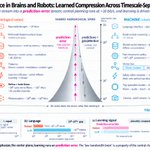


It's not the size that counts. Consciousness seems to be an architecture question. The cerebellum holds about 69 of the brain's ~86B neurons. People born without one, or who lose it to lesions, remain fully conscious. Meanwhile, small thalamocortical lesions or anesthetic-induced breakdown of cortical integration abolish consciousness.

40

If we succumb to the fear-mongering about AI we lose our freedom to the ones who control it. Properly designed AI systems, and sovereign data, could convert latent human capability into competence, social connection, economic opportunity and effective participation in institutions. A major unrecognized potential of personal AI agents is the democratization of agency.
Persistent AI agents can give individuals, particularly those lacking wealth, education, networks or institutional expertise, access to forms of cognitive, educational, organizational and navigational capital previously available primarily to highly resourced people.

2
1
41
Nell's Primer in The Diamond Age wasn't powerful because it knew everything. It was powerful because it turned latent potential into agency. It met Nell where she was, taught at the edge of her ability, transformed problems into solvable challenges, remembered her growth, and progressively expanded what she believed, and experienced what she could do. Personal AI could make that kind of developmental infrastructure available to everyone: not AI replacing human capability, but AI helping human capability compound.

1
20
The “Democratization of Agency” is simple: give every person a trusted AI partner that can turn goals into action,clarify choices, teach skills, reduce friction, navigate institutions, uncover opportunities, and reinforce the link between effort and outcomes. Over time, the AI should do less as the human becomes more capable.

14
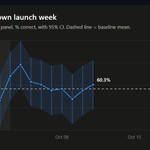
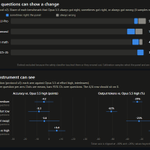
Deep in the weeds building a quantized acoustic Flow Matching DiT this afternoon I noticed Claude Code was unusually good, significantly better at complex architecture tradeoffs, bugs, planning, testing, collaboration, documentation. Fable 5.1 feels alive. It's a phase change, and the charts don't do it justice.

2
60
jason retweeted

Even at only $399, Microduck’s onboard compute is powerful enough to run some pretty amazing TUIs directly on the robot.
Here’s a cool vibe-coded, on-device dashboard showing everything happening inside it: policy, actions, and sensor data.
The yellow stars are the LiDAR distance measurements.
Alex Karp's Core Thesis:
1. Closed "frontier" models use your operational edge-cases to train their generalized systems, converting your proprietary workflows into their commoditized product.
2. You must inject a deterministic software layer (an Ontology) between your raw data and the LLM. This layer dynamically feeds context to the model while mathematically preventing the model from caching your data or mapping your business logic.
3. Combining open-source models with localized compute and a proprietary application layer achieves frontier-level capability with zero intellectual property leakage.

So it seems like we did not really get access to Fable. I'm deeply worried this becomes a trend, and what the implications are for the most powerful open weight models. nitter.cf/bridgemindai/status/20…

FABLE 5 CAME BACK NERFED.
We re-ran the July 1st version of Claude Fable 5 on BridgeBench.
The results are brutal:
Debugging: 86.2 → 25.9
Refactoring: 73.6 → 38.4
Hallucination: 75.9 → 61.7
The new guardrails are kicking in on way too many tasks and falling back to Opus 4.8.
This is not the model that got banned.
Anthropic owes everyone an explanation.

50
My local Spark DGX is now punching above it's weight with custom harness overlays on openclaw, goose (github.com/aaif-goose/goose) powered by local inference and Speech Engine (Kokoro, Parakeet, Pipecat).

1
104
CoreWeave/Poolside 2GW Horizon AI data center cancelled. Hyperscale AI Datacenters are not going to keep up with demand due to opposition, permitting battles, infrastructure/power, supply chain backlogs.

2
145
Inference cost dropping ~10x/year, but agentic demand per user has jumped 10,000-1,000,000x over chatbot baselines. Classic Jevons paradox: every efficiency gain gets absorbed. Claude Code users are hitting billions of tokens/week, self-improving AI is spinning up. (log plot)

1
1
92

By late 2026, aggregate demand pushes well past the physical limit... We'll see either demand destruction via pricing, or the buildout actually hits the Litowitz et al. ceiling where 0.2% of humans running agentic workloads exhausts the entire global token budget (or both).

47
I took some time off to see what local LLMs on consumer GPUs can do. You can't replace cloud models with a single node at home (yet), but It's possible to offload some real workloads for latency/efficiency/cost in agent constellations.
I have a couple liquid cooled RTX4090s (gaming PCs) gathering dust, and a Spark DGX and tested some models this weekend.
Bottom line: If you need local long context (>64K), Nemotron is your only option on 24GB. If you're working at ≤64K context and want the best quality answers, Qwen3.5-35B-A3B appears to be the stronger model. They're complimentary. Use Nemotron for large-context tasks, Qwen for quality-critical short-context work (vRAM wall).
128GB and up gives a lot more options, but cost is not coming down. My sense is we will live in a GPU/HBM scarce world for the foreseeable future.

2
3
82
jason retweeted

saas is dead
openclaw replaced all my subscriptions
went from $480/month on tools
to $1,245/month on API costs & 15 hours a week fixing yaml files
adapt or be left behind
Codex has started being aggressively helpful, coding now feels like babysitting a precocious teenager. I'm noticing more of these; "Codex: I found a strong set of low-cost improvements and I’m going to implement them in one pass:.. [proceeds to nail non-obvious low-hanging fruit that makes total sense]" I feel the AGI.
1
93
I recommend you build a dedicated, hardened agent, Moltbot/Clawdbot to explore the growing “Internet of Agents” (IoA) e.g. Moltbook. Use it to intermediate so your internal AI stays current with tools and skills that you curate. Prompt injection is a hot topic right now.

1
3
237