

From Terrestrial To Celestial📡
Herndon, VA
Joined July 2015
- Tweets1.8K
- Following238
- Followers3.6K
- Likes2.4K




In the fall of 1931, two men stood next to a giant machine inside London’s Royal Albert Hall. On the left was General Jan Christiaan Smuts, a well-known South African leader. On the right was Colonel Walter Adolphe Vignoles, who helped organize the big Faraday Centenary Exhibition. Between them rose the world’s largest radio transmitting valve.
Metropolitan-Vickers built the valve for the big Rugby wireless station in England. One of these giant valves was meant to replace about fifty smaller ones. For the first time, a single tube could handle the full power needed to send signals across the ocean.
Smuts was in London to open the Faraday Centenary Exhibition. The event celebrated Michael Faraday, who one hundred years earlier had discovered the science that made electricity and radio possible. The photo of Smuts and Vignoles with the huge valve was sent out by a news agency under the simple headline “World’s Largest Radio Valve.”

On November 2, 2000, the first permanent crew of the International Space Station (ISS), known as Expedition 1, arrived aboard the orbiting laboratory. The three crew members were NASA astronaut William "Bill" Shepherd (KD5GSL) and Russian cosmonauts Yuri Gidzenko and Sergei Krikalev (U5MIR).
Eleven days later, the crew began amateur radio operations aboard the ISS. The radio setup included an Ericsson handheld VHF/UHF transceiver, a headset with microphone, and a push-to-talk (PTT) switch. The station also included a Terminal Node Controller (TNC) for digital packet-radio communications, along with supporting interface and power equipment.
On November 13, 2000, the ARISS (Amateur Radio on the International Space Station) station was activated, marking the beginning of amateur radio operations aboard the ISS.


The HW-7 Low-Power CW Transceiver offered by Heathkit from 1972 through 1975. It was designed for amateur radio operators who wanted to explore the challenge of making contacts with very little power.
The little radio covered three popular amateur bands: 40, 20, and 15 meters. Its solid-state design delivered approximately 3 watts of RF input on 40 meters, 2.5 watts on 20 meters, and 2 watts on 15 meters. Operators could use a built-in VFO or crystal control, depending on their preference.
And there was something special about owning one: you had to build it yourself.


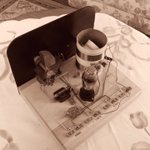
Homemade Single-Tube Armstrong Regenerative Shortwave Receiver (1930s-1940s).
The receiver uses a vacuum tube and a feedback coil called a tickler coil to amplify weak signals. The tickler coil is mounted inside the main tuning coil and can be rotated using a front-panel knob. This adjusts the feedback, allowing the operator to control the receiver’s sensitivity and tune in distant shortwave stations.


Radio Bargain News, October - November 1932, features a young radio technician relied on hands-on experimentation, electrical measurements, and practical repair skills.

Ethel Leginska, the “Paderewski of woman pianists,” listening to a Westinghouse Aeriola Senior one-tube (WD-11) radio receiver. New York, circa 1921

The early Land’s End Radio Station (Wireless Telegraph Station), located in St Just, Cornwall, England, was established in 1913. It served as an early ship-to-shore wireless telegraph and radio station for the Land’s End area.


Heathkit Visual-Aural Signal Tracer, Model IT-12, 3 Vacuum Tubes, Metal Cabinet, Made In USA, circa 1962


