

Thoughtful international advocacy for the humanities--backed up by research & projects of local chapters; powered by international digital humanities community.
Joined May 2011
- Tweets2.6K
- Following1.3K
- Followers4.7K
- Likes676
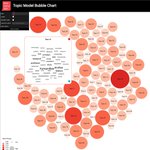
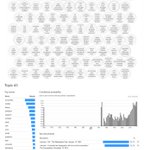




We recommend playing with the interactive visualizations of our 4Hum @WE1Sproject’s topic models of articles mentioning humanities--e.g., Dfr-browser, TopicBubbles, or pyLDAvis vizs of models of our C-1 collection at various granularities of number of topics. It’s a lot of fun.

Each data "collection" comes with a "start page" with metadata & links to topic models viewable in different interactive visualizations. E.g., here is the start page for Collection 1: bit.ly/WE1S_C1_start
Start with Dfr-browser, by @goldstoneandrew. (Alas, where original tool links to full JSTOR texts via institutional subscription, copyright & database licensing of our news texts limit us to a “view metadata” link only to word frequencies/text features for statistical modeling)

1
This was one of the findings about their fellow students that our @WE1Sproject's student research assistants working on surveys and focus groups on the humanities found most interesting and thought-provoking.
Key finding of @WE1sproject: Students we surveyed are twice as likely to think others stereotype them based on their majors than that they stereotype others. we1s.ucsb.edu/wp-content/upl…
To @CHCInetwork (& individual humanities centers): is there is list of Twitter handles for humanities centers in the Consortium of Humanities Centers and Institutes? We're trying to assemble these (& other humanities-related Twitter handles) to help share humanities advocacy news
1
Online open-access guidebook published by @4Hum's co-leader, Christine Henseler: Arts and Humanities: Don’t Leave College Without Them! (2022). It's a “flipbook” giving a broad overview of the humanities and arts, & specific kinds of careers they lead to. bit.ly/arts_humanities_guide
Here's our blurb about the guidebook on the @4Hum site: 4humanities.org/2022/01/new-…. Pass the book on to students!
Read the wonderful post for @4Hum by recently graduated student Helen Foley, an English and Economics double major who was a crucial member of @4Hum’s “WhatEvery1Says” (@WE1Sproject): bit.ly/foley_post
4Humanities.org's "WhatEvery1Says" (WE1S) project enters home stretch in its final summer research camp! bit.ly/2CMsdId (@WE1Sproject)
Mellon Foundation awards $275,000 to the American Academy of Arts and Sciences' Humanities Indicators to survey the general public about the humanities: humanitiesindicators.org/con…. Congratulations to the Humanities Indicators team.
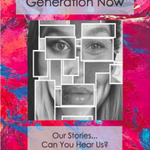
The second book in the "Generation Now" series, "Our Stories...Can You Hear Us?" by @NY6Thinktank and her students is now available to purchase here on Amazon: amzn.to/2NKEpxB. #4Hum post with more info: bit.ly/2LdUABK

1
1
For those who have asked: 4Humanities.org is offline because the server of the ADHO (Alliance of Digital Humanties Organizattions) where its site is hosted went down 10 days ago. While the server is rebuilt, users can access 4Hum via the Internet Archive’s Wayback Machine
1
Interview with @mary_robson on fostering interdisciplinary research is up on the @4Hum site: bit.ly/2GqWlrK
Post about new #WE1SProject Curriculum Lab course, “Uses of Literature: How to Solve Problems with Books” taught by WE1S postdoc @abigaildroge bit.ly/2AIlzON
New posts from @abigaildroge about her @4Hum/@WE1Sproject Curriculum Lab course on "Reading with Scientists": "Students Become Editors to Inspire Interdisciplinary Exchange " & "Isaac Asimov and Driverless Cars"

Check out the latest blog post for my @WE1Sproject "Reading with Scientists" course! As a final project, I'm asking students to edit their own scholarly edition of a text to inspire interdisciplinary conversations: we1s.ucsb.edu/research_post/…

Abigail Droge’s new course for the @4Hum @WE1Sproject's Curriculum Lab: “Reading with Scientists: How to Export Literature” bit.ly/2DNDace. “The purpose of the course is to imagine ways that we might teach literature in non-literary settings, like science classrooms”
Fascinating op-ed by @4Hum co-leader @henselec in @insidehighered today: "We Need More Men in the Humanities" bit.ly/2RjmPyw: “today we are witnessing a crisis of male leadership.... but not one national program appears for boys in the arts and humanities. Why not?”
Our @WE1Sproject has started a Curriculum Lab (directed by Abigail Droge). How might research on public discourse on the humanities “change our own frames of reference as humanities advocates in the classroom?” we1s.ucsb.edu/curriculum-lab…
Inaugural post from the @WE1Sproject Curriculum Lab by its director, Abigail Droge: “An Introduction to the WE1S Curriculum Lab”
we1s.ucsb.edu/research_post/…
1
Research in progress from the @4Hum "WhatEvery1Says" project #WE1Sproject, which is holding its first summer research camp this July at @ucsantabarbara
and @csunorthridge. nitter.cf/alanyliu/status/102218…

#WE1Sproject post by @giorginapaiella & @_tshoemaker: "Scoping Representativeness"--Reflections of researchers in the project on trying to create a "representative" corpus of newspaper articles on the humanities: bit.ly/2LMocm1 Fuller reflections: bit.ly/2Oiq9bM
@4Hum co-leader @henselec and her students publish new book: "Generation Now: Millennials Call for Social Change" (4humanities.org/2018/07/gene…). "the students in this class had become changemakers themselves…. Their collective calls for change became this book"
The @4Hum "WhatEvery1Says" project (#WE1Sproject) is delighted to welcome postdoctoral scholars Dan Costa Baciu and Abigail Droge to its team. Announcement: bit.ly/2JIDI4H
2
The @MellonFdn granted the #WE1Sproject $1.1 million for 3years to scale up and advance its earlier prototype efforts to use digital humanities methods to study public discourse related to the humanities. Information about the project: we1s.ucsb.edu/
The @MellonFdn has granted the #WE1Sproject $1.1 million for three years to scale up and advance its earlier prototype efforts to use digital humanities methods to study public discourse related to the humanities. Information about the project: we1s.ucsb.edu/