

Joined January 2025
- Tweets2.4K
- Following26
- Followers681
- Likes12




A bus ticket can be made free overnight. The poorly lit walk to the stop, the last service that ends before a shift does, and the unpaid work waiting at home are much harder to remove.
Free bus rides for women are often debated as either a costly giveaway or a vote-winning promise. But there’s a more useful question: what does that ticket actually make possible?
The data suggests the real cost of a commute isn’t just the fare:
📍 Only 41.9% of women workers travel at least 1 km to work, compared with 61.9% of men
📍 Women spend 236 minutes a day on unpaid domestic work. Men spend 24
📍 Many women pay an implicit “pink tax” on mobility, reaching fewer jobs because of safety, time and cost constraints
Free transport can raise women’s participation in paid work, but the evidence is mixed. A fare waiver removes one barrier, not all of them.
Read the full piece:
basispointinsight.com/Story/…
@Nishat_21
#WomenInWorkforce #FemaleLaborForceParticipation #PinkTax #PublicTransport #IndianEconomy #GenderAndEconomics #BasisPointInsight

A bus ticket can be made free overnight. The poorly lit walk to the stop, the last service that ends before a shift does, and the unpaid work waiting at home are much harder to remove.
Free bus rides for women are often debated as either a costly giveaway or a vote-winning promise. But there’s a more useful question: what does that ticket actually make possible?
The data suggests the real cost of a commute isn’t just the fare:
📍 Only 41.9% of women workers travel at least 1 km to work, compared with 61.9% of men
📍 Women spend 236 minutes a day on unpaid domestic work. Men spend 24
📍 Many women pay an implicit “pink tax” on mobility, reaching fewer jobs because of safety, time and cost constraints
Free transport can raise women’s participation in paid work, but the evidence is mixed. A fare waiver removes one barrier, not all of them.
Read the full piece:
basispointinsight.com/Story/…
@Nishat_21
#WomenInWorkforce #FemaleLaborForceParticipation #PinkTax #PublicTransport #IndianEconomy #GenderAndEconomics #BasisPointInsight
Patna Municipal Corporation raised ₹2 billion at a 9.20% coupon, the highest on an Indian municipal bond since 2019. The rate is 115 basis points above Nashik’s March issue, as cities return to the bond market at a higher cost.
Read more: basispointinsight.com/Story/…
#MunicipalBonds #Patna #BondMarket #IndiaMarkets
Can bond markets force governments to fix their finances before a debt crisis does?
That question is becoming harder to ignore as public debt rises, borrowing costs stay elevated and fiscal pressures build across advanced economies.
Debt sustainability depends on more than the size of the debt stock, Nouriel Roubini writes for Project Syndicate. Growth, interest rates, the currency in which governments borrow, central-bank credibility and market discipline all matter.
Bond vigilantes can play an important role.
If yields and spreads rise sharply enough, governments may be forced to cut spending or raise taxes before a full-blown crisis develops. But history also shows that markets do not always impose discipline early enough.
There are other ways governments can reduce debt burdens — inflation, financial repression, restructuring or capital levies — but each carries substantial economic costs.
The more durable answer remains less dramatic: stronger potential growth and credible fiscal adjustment.
France may be one of the first major tests, but it is far from the only country facing the question.
Read Nouriel Roubini’s column: Can Bond Vigilantes Prevent the Next Debt Crisis?
basispointinsight.com/Story/…
@ProSyn
#PublicDebt #BondMarkets #FiscalPolicy #InterestRates #GlobalEconomy #SovereignDebt #Markets

Is AI pushing inflation higher before it eventually brings prices down?
That is becoming an increasingly important question for central banks.
The current AI investment boom is adding to demand for chips, data centres, electricity, cloud infrastructure and critical raw materials. That can raise prices in the short run, especially when supply struggles to keep pace.
At the same time, AI promises something very different over the longer term: higher productivity, lower unit labour costs and more efficient production.
The problem is timing.
If the inflationary impact arrives first and the productivity gains take years to materialise, central banks may have to manage a difficult transition, writes former RBI Deputy Governor Michael Debabrata Patra.
They are already watching several channels closely — energy and hardware costs, AI-driven investment demand, labour-market effects and algorithmic pricing.
The key question is whether today’s inflationary phase gives way to sustained productivity gains, or whether expectations run ahead of what AI ultimately delivers.
Read Michael Debabrata Patra’s column for BasisPoint: Is AI in Inflation? Should Central Banks Care?
basispointinsight.com/Story/…
#ArtificialIntelligence #Inflation #CentralBanks #MonetaryPolicy #Productivity #Economy #AI

The rupee may look calmer, but the cost of keeping it stable is rising.
Recent RBI measures have helped steady the spot market. But the pressure has not disappeared; much of it has shifted into the forward market.
One-month forward premia surged, bid-ask spreads widened and price discovery weakened as access tightened and hedging costs rose.
That creates a difficult policy trade-off.
Restrict dollar demand in spot, and it can migrate to forwards. Make forwards more expensive, and importers may rush to hedge before conditions tighten further.
At the same time, the RBI’s forward book has grown, future settlement obligations are rising and the balance-of-payments outlook remains vulnerable to oil prices and uncertain capital flows, writes Madhavi Arora, Chief Economist at Emkay Global Financial Services.
The central question is no longer just whether the rupee is stable.
It is how much that stability costs — in liquidity, market functioning and monetary-policy flexibility.
Read Madhavi Arora’s column: RBI’s FX Strategy: Mounting Costs of Rupee Defence Amid a False Calm
basispointinsight.com/Story/…
@MadhaviArora7
#RBI #Rupee #Forex #CurrencyMarkets #MonetaryPolicy #IndiaEconomy #FinancialMarkets

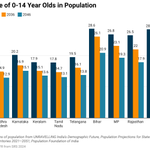
South India spent decades bringing fertility down. Now some states are trying to push it back up.
Why?
Because the demographic consequences of low fertility are becoming harder to ignore, writes Deepa Vasudevan.
Southern states already have older populations and fewer children. Over time, that means a smaller pool of women of reproductive age, fewer births and a faster shift towards ageing.
That matters for labour supply, migration, public finances and even political representation.
The contrast with northern states is striking. States such as Bihar, Uttar Pradesh, Madhya Pradesh and Rajasthan remain younger and have higher fertility rates, giving them a very different demographic trajectory.
The policy challenge is equally difficult. Migration can offset some labour shortages, but not fully. And global experience shows that once fertility falls sharply, raising it again is not easy.
So the debate is no longer simply about population control. It is about how states manage ageing, labour needs and demographic imbalance.
Read Deepa Vasudevan’s column for BasisPoint: Why South India Wants More Babies
basispointinsight.com/Story/…
@dvasusg
#Population #Demographics #SouthIndia #Fertility #Migration #PublicPolicy #India

Peace can make history easier to forget. That is precisely when remembering it matters most.
October 27 marks the arrival of Indian troops in Srinagar in 1947. But argues that its significance extends far beyond Infantry Day.
It is also a story of resistance, sacrifice and decisions taken when the future of J&K hung in the balance.
From Brigadier Rajinder Singh’s delaying action and Lt Col Dewan Ranjit Rai’s defence of Srinagar to the courage of Maqbool Sherwani and Major Somnath Sharma, the events surrounding October 27 shaped far more than a military campaign.
As J&K moves towards greater security and normalcy, the challenge is to ensure that peace does not erase the memory of what made that future possible.
Remembrance, the article argues, should move beyond ceremonies and cantonments into classrooms, public discourse and the historical consciousness of another generation.
Read Lt Gen Syed Ata Hasnain’s column for BasisPoint – The Anchor of Memory: Why October 27 Must Remain the Bedrock of India’s National Security Consciousness
basispointinsight.com/Story/…
@atahasnain53
#JammuAndKashmir #InfantryDay #NationalSecurity #IndianArmy #MilitaryHistory #India #Kashmir

Stablecoins could make dollar exposure easier to acquire. For India, that creates a new external-sector challenge.
Former Finance Secretary Dr Arvind Mayaram argues that the rupee’s vulnerability is not just about the dollar’s global dominance. It also reflects domestic weaknesses — from high input costs and fuel taxation to weak competitiveness and dependence on imported energy and technology.
Digital dollarisation could add another layer.
As dollar-backed stablecoins become easier to hold and transfer, households and businesses may gain a faster route into dollar-denominated assets. That does not mean stablecoins explain the rupee’s past weakness. But they could become another channel through which existing pressures are transmitted.
What should India do?
Keep domestic payments anchored in the rupee. Regulate stablecoin gateways. Track cross-border flows. Protect users. And make rupee-based international payments more competitive.
The larger point is simple: monetary sovereignty cannot rest on regulation alone. It also depends on building a stronger productive economy and making the rupee more useful internationally.
Read Dr Arvind Mayaram’s column for BasisPoint: The Rupee in the Age of Digital Dollarisation
basispointinsight.com/Story/…
@MayaramArvind
#Rupee #Stablecoins #RBI #DigitalPayments #Dollarisation #IndianEconomy #MonetaryPolicy #IMF

AI is the new corporate FOMO. As banks race to deploy it, they may be expanding an attack surface boards barely see. From Storm-0940 and agentic AI to supply chains, geopolitics and quantum risk, the next cyber threat may come through something we already trust, writes @ssmumbai
Read: basispointinsight.com/Story/…
#AI #Cybersecurity #CyberRisk #Banking #AIGovernance #CyberResilience

AI is rewriting India’s forex equation: replacing labour-led services exports with imported compute, silicon and energy. The RBI can buy time with reserves and FCNR. But what must India build before that time runs out?, write @ssmumbai @iam_anandv
Read: basispointinsight.com/Story/…
#AI #IndiaExports #Rupee #RBI #ForexReserves #FCNR

Mumbai airport’s T1 redevelopment is not just an infrastructure story. It is a governance test.
MIAL says the airport must shed around five million passengers a year from the Summer 2027 schedule and has proposed cutting 33% of international departures or shifting them to Navi Mumbai.
Airlines have pushed back.
Their objections go beyond commercial inconvenience. They are asking who has the authority to redistribute scarce slots, what evidence supports the proposed capacity cuts, and whether the process complies with the rules governing coordinated airports.
The issue becomes more significant because both Mumbai and Navi Mumbai airports sit within the same corporate group.
Sharmila Chavaly argues that the real question is not whether T1 needs redevelopment. It clearly does.
The question is whether the cost of that redevelopment can be allocated by the airport operator, or whether a regulated process must decide who bears the loss.
Read Sharmila Chavaly’s column for BasisPoint: The Mumbai Airport Shuffle: MIAL vs the Airlines, or a Question of Authority?
basispointinsight.com/Story/…
@SharmilaChavaly
#MumbaiAirport #Aviation #MIAL #NaviMumbaiAirport #Infrastructure #Competition #IndiaPolicy

Who is really benefiting from India’s retail investing boom?
Foreign institutional investors have sold heavily since April 2024. Promoters have also reduced stakes, while IPOs have given founders and venture capital investors an exit at high valuations.
Yet the market has not collapsed.
Vivek Kaul argues that the reason is the steady flow of retail money into equity mutual funds, SIPs, pension products and direct stock investing.
That liquidity has supported valuations and made it easier for larger investors to sell. But it may also be contributing to another pressure point: the rupee.
If foreign investors can keep exiting without sharply disrupting markets, should policymakers be encouraging even more retail money into equities through favourable tax treatment?
Read Vivek Kaul’s column for BasisPoint: Nirmala Sitharaman, Retail Investors and the Great Indian Wealth Transfer
basispointinsight.com/Story/…
@kaul_vivek
#RetailInvestors #IndianMarkets #MutualFunds #FII #Rupee #Investing #IndianEconomy

The Rupee Hired Bodyguards, and Someone Else Is Paying Overtime
From the RBI’s attempts to defend the rupee and the limits of borrowed stability to India’s productivity challenge, subdued private capex and the changing dynamics of gold and equity flows, the week’s stories examine the costs of economic choices. We also look at the Supreme Court’s Yes Bank AT-1 bond ruling, the quick commerce dilemma facing FMCG brands, and the risks of investing in a world of shifting correlations.
These are just a few of the themes covered on BasisPoint Insight in the week gone by.
Check out the newsletter for the full coverage: share.google/BuJzTOF2dJNBZxk…
@kkalyanram, @Dhananj89102936, @AbheekBarua, @SparshChhabra6, @dravirmani, @rakeshkhar, @MayaramArvind, @AtulPrakash14, @kaul_vivek, @csoyantar, @krishnadevanv
#Economy #RBI #Markets #Banking #Investing #India

A reassuring headline can conceal a more difficult reality.
The RBI says rural India has become less vulnerable to weak monsoons as non-farm activity expands and wages account for a larger share of income for small farming households.
But Former Finance Secretary Dr Arvind Mayaram argues that the household picture looks far less resilient.
Real rural wages have barely grown for much of the past decade, he says. Pay in several forms of non-farm work has stagnated or fallen in real terms. And changes to the rural employment guarantee may weaken the bargaining power that once allowed landless workers to refuse the lowest wages during peak farm seasons.
That matters because resilience is not only about output holding up after a bad monsoon. It is also about whether rural workers retain enough leverage to protect their incomes when conditions turn difficult.
Read Arvind Mayaram’s column for BasisPoint: The Bargaining Power Rural India Is Losing
basispointinsight.com/Story/…
@MayaramArvind
#RuralIndia #MGNREGA #IndianEconomy #Wages #Agriculture #Policy

Pakistan is becoming more visible abroad even as its domestic pressures deepen.
Field Marshal Asim Munir has expanded Pakistan’s diplomatic reach, strengthening ties with Washington, China and West Asia. But the country he represents is dealing with a difficult mix of fiscal strain, political confrontation, provincial resentment and a worsening security relationship with Afghanistan.
That creates a strategic paradox.
Pakistan remains important because of its geography, military strength, nuclear capability and regional links. Yet international relevance does not necessarily translate into domestic resilience.
For India, that distinction matters. Pakistan’s economic weakness should not be mistaken for strategic irrelevance, just as Munir’s diplomatic visibility should not be read as evidence of national recovery.
Bihar Governor Lt Gen Syed Ata Hasnain examines whether Pakistan can sustain its external ambitions while its internal political and economic foundations remain under pressure.
Read his column on BasisPoint: Pakistan's Strategic Paradox: Global Ambition, Domestic Fragility
basispointinsight.com/Story/…
@atahasnain53
#Pakistan #India #AsimMunir #Geopolitics #Afghanistan #SouthAsia

Does the RBI really need another 2013-style interest-rate defence of the rupee?
Forward foreign exchange markets are already doing part of the tightening. Short-tenor implied rupee rates have risen to punitive levels, while the RBI has used reserves, forward-market intervention and new macroprudential tools to curb speculation and manage dollar demand.
That weakens the case for an outsized MSF hike.
But the policy question may soon shift. If inflation moves back towards 6% and the rupee remains under pressure, the MPC could have reason to front-load normalisation with a 50-bps repo rate increase in December rather than move in smaller steps, writes Abhishek Upadhyay of ICICI Securities Primary Dealership.
The key distinction is between defending the currency through emergency liquidity measures and restoring real policy rates before they turn negative.
Abhishek Upadhyay’s column for BasisPoint examines how much ammunition the RBI still has, what elevated forward premia are signalling, and why a repo hike may make more sense than a fresh MSF shock.
Read: Does RBI Need to Mount an Interest Rate Defence of Rupee, Again?
basispointinsight.com/Story/…
#RBI #Rupee #InterestRates #MonetaryPolicy #Forex #IndiaMarkets

Can India sustain 7% growth all the way to 2047?
Dr Arvind Virmani believes the underlying strength of the economy has improved — but says deeper reform, stronger economic expertise and better implementation will determine whether India can convert that potential into durable growth.
In a wide-ranging conversation with Rakesh Khar on The Big Picture, the former Chief Economic Adviser discusses:
• Why UPI should not remain indefinitely subsidised
• Why continued free food raises an economic contradiction
• How India should respond to China’s manufacturing dominance
• Why FTAs with high-income economies could be transformative
• Why state-level reforms remain critical
• Why learning, rather than credentials, may be the most important metric for India’s 2047 ambitions
He also revisits the lessons of the 2008 financial crisis and explains why he continues to see 7% as India’s underlying growth trajectory, even amid global uncertainty.
Watch the full conversation
youtu.be/7GIqmPh2gVA
Or
Listen to the full conversation
open.spotify.com/episode/4pL…
@dravirmani @rakeshkhar
#IndiaEconomy #ViksitBharat #EconomicReforms #UPI #China #Manufacturing #FTA #ArvindVirmani #TheBigPicture #BasisPointInsight

From 1944, under the Bretton Woods agreement, countries adopted a system of fixed exchange rates pegged to the US dollar, with US inflation and growth determining inflation and growth in all other countries.
That system gave way a long time ago and now, how the exchange rate is determined shapes in a fundamental way the manner in which monetary policy is conducted. When the exchange rate is fixed or managed to ensure some degree of fixity, the role of monetary policy is to maintain the exchange rate at the fixed level. Other objectives like inflation and growth become subservient to the exchange rate objective. Implicitly, domestic inflation and growth become tied to global inflation and growth.
In his Masterclass, Michael Debabrata Patra explains International Dimensions of Monetary Policy and how, if the exchange rate is freely floating and determined by market forces of demand and supply, monetary policy is freed from the exchange rate parity goal to serve the objectives of domestic price stability and growth that may be different from global inflation and growth.
basispointinsight.com/Story/…
#MonetaryPolicy #ExchangeRates #CapitalFlows #RBI #CentralBanking #BrettonWoods
