

econ phd; assistant prof @ odu
Norfolk, VA
Joined March 2012
- Tweets6.5K
- Following490
- Followers477
- Likes6.4K






alex cardazzi retweeted

webrarian is a new R package. It turns a folder of R scripts and data into a static website where R runs in the visitor's browser, with no compute server and nothing to install.
blog.thecoatlessprofessor.co…
#rstats

ALT A card for the R package webrarian. Large text reads "A folder in. A website out." On the left, a small card lists a folder named lab-01 holding lab.R, setup.R and a data folder. A red arrow points from it to a browser window that shows a scatterplot of car weight against miles per gallon with brick-red points. The address coatless-wasm.github.io/webrarian is on the card.
alex cardazzi retweeted

This paper by @davidautor & co-authors is one of the most important papers to date in the space of what AI does to learning.
It's highly credible. And very much consistent with my own experience with use of agentic AI in research and teaching.
nber.org/papers/w35720

alex cardazzi retweeted

For six months, Google Maps sent a slice of drivers in ten American cities down deliberately slower routes.
About 30 seconds slower on average, and under 2% of trips were touched. The experiment ran on roughly 100 of the most congested road segments in each city, switching on and off day by day so each city acted as its own control. The results are out now in Nature Cities, from Google Research with collaborators at Berkeley and Stanford.
The reasoning behind it is old and slightly counterintuitive. Every navigation app does the same thing: it finds you the fastest route right now, for you alone. When millions of phones do that at once they all pour onto the same handful of arteries, and those arteries stop being fast. Transport economists have been writing about the gap between what's good for one driver and what's good for the network since the 1950s. Nobody had tested a fix at city scale with real drivers, because you'd need to steer routing for a large share of a city's traffic, and about three companies on Earth are in that position.
So Google put a penalty on the worst segments during their worst hours, which nudged the routing engine towards alternatives of similar road class and comparable travel time, then measured what happened across the whole network on weekdays between 7am and 8pm.
On the targeted segments, traffic moved roughly 2% faster in the median city. Los Angeles got 4.56%, Atlanta 3.30%. Fuel burn on those stretches dropped between 0.5% and 1%. Across every road that saw a change in traffic, which covers around 80% of each city's driving, speeds rose 0.35%, reaching 0.5% during the morning and evening peaks. Total travel time on affected trips fell 0.69%. Their Bayesian model put the probability that the speed effect was genuinely positive at 99.8%.
That adds up to more than 1,000 tonnes of CO2-equivalent saved per year, per city, in most of the places studied. Cars and vans account for around 10% of global carbon emissions, and the average driver spends about 2.6 years of their life behind the wheel, so a fraction of a percent across an entire road network is a serious amount of fuel.
Per driver, the saving comes to about 0.25% of an average journey, roughly one fortieth of the normal day-to-day wobble in how long the same commute takes. Nobody in those ten cities noticed anything, in either direction, including the people sent the long way round.
The authors are careful about what they haven't shown. They measured the immediate effect, not what happens once drivers work out the freed-up route is quicker and pile back onto it, which is the standard way road improvements get eaten. Their penalty scheme was deliberately crude, so the ceiling on the approach is unknown. And the underlying Google Maps data is commercially confidential, so nobody outside can check the numbers.
The finding sitting underneath all this is that a private company's routing algorithm has become a piece of transport infrastructure, tunable in the way a traffic light or a congestion charge is tunable. The obvious follow-up experiments are the ones a city government would want to run, not the ones a mapping company would.
link to full article: nature.com/articles/s44284-0…


alex cardazzi retweeted

The New York Knicks win the 2026 NBA championship over the San Antonio Spurs, snapping a 53-year title drought.
A champion constructed with a series of moves over several years; notably Jalen Brunson, OG Anunoby, Josh Hart, Mikal Bridges and Karl-Anthony Towns, then hiring of Mike Brown.
alex cardazzi retweeted

"Murder in the Marketplace" with @ACardazzi and @VictoriaBi74104 is online today in @_PublicChoice. We look at the spatial concentration of violence around physical marketplaces in medieval and Georgian London
rdcu.be/fl73T
alex cardazzi retweeted

The New York Knicks just played the most dominant 10-game stretch in NBA history, and it's not even remotely close


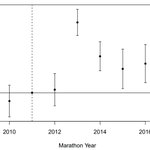
12 years ago yesterday, there was an explosion at the finish line of the 2013 Boston Marathon, changing the race forever. We (@zach_et_al) studied how directly experiencing this terrorist attack affected future competitive performance.
papers.ssrn.com/sol3/papers.…

We also find that diverted runners were less likely to participate in future Boston Marathons. However, given how their experience in Boston impacted their performances outside of Boston, it is likely that these runners were pushed out of qualifying rather than stepping away.
Terrorism doesn't just hurt wellbeing in the short-run. It costs people their livelihoods. And so, long-term victim services matter.
Feedback / comments welcome: papers.ssrn.com/sol3/papers.…
alex cardazzi retweeted

If you're going to plot means and CIs to show your results, they should be 83% CIs (not 95% CIs). Why? Because then when people look at whether they overlap, the implicit statistical test has the correct size.


alex cardazzi retweeted

I have a guest essay in @nytimes today about autonomous vehicle safety. I wrote it because I’m tired of seeing children die. Done right, we can eliminate car crashes as a leading cause of death in the United States
@Waymo recently released data covering nearly 100 million driverless miles. I spent weeks analyzing it because the results seemed too good to be true. 91% fewer serious-injury crashes. 92% less pedestrians hit. 96% fewer injury crashes at intersections. The list goes on.
39,000 Americans died in crashes last year. More than homicide, plane crashes, and natural disasters combined. The #2 killer of children and young adults. The #1 cause of spinal cord injury. We’ve accepted this as the price of mobility.
We don’t have to.
In medicine, when a treatment shows this level of benefit, we stop the trial early. Continuing to give patients the placebo becomes unethical. When an intervention works this clearly, you change what you do.
In driving, we’re all the control group.
Cities like DC and Boston are blocking deployment. And cities are not the only forces mobilizing to slow this progress.
It’s time we stop treating this like a tech moonshot and start treating it like a public health intervention that will save lives.
Link to article below.
👀 this video of Waymo cars evading crashes with people and vehicles. I especially note the ones that require it having a 360° view.
My sincere thanks to Alex Ellerbeck and @acsifferlin for their wisdom and sure hand in editing this piece.
alex cardazzi retweeted

We are excited to announce the creation of the Coates-Humphreys NAASE Distinguished Research Award, with Dennis Coates and Brad Humphreys as the inaugural winners. It will be given in odd-numbered years (the Hadley Award is given in even-numbered years). Congrats Brad & Dennis!
alex cardazzi retweeted

Replacing the US federal gas tax with a mileage-based tax would benefit rural, central, and Republican areas, but increase taxes in urban and coastal regions, from @KnittelMIT, @gibmetcalf, and Shereein Saraf nber.org/papers/w33894

Free exogenous variation: nyc.gov/office-of-the-mayor/…
