Pinned Tweet
AI is already in your inbox, your phone calls and your search results. This account is about the parts that actually affect you.
Real, documented AI incidents and what they teach you about protecting yourself.
Plain explanations of how this stuff works.
Practical guides, checklists and the occasional prompt that's genuinely useful.
And when something big happens, what it means for you.
153
Someone in accounting gets an email from the CEO about a private deal. Then a call where the CEO's voice sounds right. Then a lawyer from a big firm. None of them is the real person.
U.S. prosecutors in New York say a ring used this playbook to take about $129 million from companies. The charges were announced Nov 5.
How it worked, according to prosecutors:
→ An email posing as the CEO asks for help with a "confidential financial transaction"
→ On a phone or video call, AI mimics the CEO's voice, sometimes the face too
→ The employee is passed to a fake attorney at a major law firm
→ That attorney gives wiring instructions
→ The money is converted to crypto
Reported losses include about $11.6 million at a UK fintech and $4.8 million at a Missouri hospital system. These are allegations in an indictment.
What made it work: each fake vouched for the next one.
To protect your team:
1. Check payment requests through a contact you look up yourself.
2. Don't rely on email alone. The FBI says to contact the person directly.
3. Treat secrecy plus pressure to act fast as a reason to slow down.
57
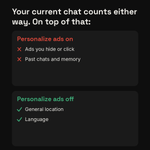
On ChatGPT Free or Go, your past chats and memory can help pick the ads you see. Two switches turn that off.
Settings > Ad Controls
→ Turn off Personalize ads
→ Turn off Past chats and memory
→ Select Delete ads data to clear your ad history and topics
Ads can still match the chat you're in. Your past chats, memory and ad history stop counting.
Good to know:
1. OpenAI says advertisers get totals like views and clicks, not your chats, memories, name or email.
2. Deleting ads data doesn't touch your chats. Full removal can take up to 30 days.
3. Temporary Chats don't show ads.
4. Plus, Pro, Business, Enterprise and Edu plans have no ads.
Was Personalize ads already on for you?
57
A vague question gets you a vague answer. And sometimes a confident wrong one.
These fix that. 6 prompts to try:
1
92
Why these work: OpenAI's prompting guide says to be specific about context, outcome, length, format and style, and to show the format you want. Anthropic's docs say giving the model permission to say "I don't know" can sharply cut false answers.
1
11
Gemini can tell you if an image was made with Google AI. But a "no" doesn't mean it's real.
Upload the image or video and ask: "Was this created or edited by Google AI?"
If no SynthID watermark is found, Google says other AI tools still could have made it.
Treat that answer as unknown, then run a reverse image search to find the original source.
116
An AI agent can't reliably tell your instructions apart from text it finds along the way. That's how prompt injection works.
Picture a new assistant who sorts your mail and does whatever any letter tells them. A stranger mails in a note asking for your bank statements. They send them.
Now swap the assistant for an AI agent, and the letter for hidden text on a web page, in an email or in a document. OpenAI describes prompt injection as a type of social engineering attack aimed at conversational AI.
Why it's hard to fix: the UK's National Cyber Security Centre says current models don't enforce a security boundary between instructions and data inside a prompt. It warns the problem may never be fully mitigated the way SQL injection attacks can be.
So you limit the damage instead:
→ Give an agent only the access the task needs
→ Ask for one specific job, not broad control of your inbox
→ On your bank's site, watch it work
→ Read every confirmation before you approve it
The more an agent can reach, the more one sneaky sentence can do.
3
3
154
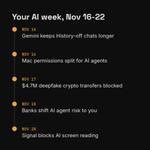
Five AI changes from this week that touch your phone, your bank and your private chats. What happened, and what it means for you:
1
98
5. The macOS 27.3 beta splits Mac permissions so it's clearer when an app, like an AI agent, can control other apps. You can also make apps ask every time.
For you: permissions granted before 27.3 stay in place. Review them when it lands.
1
30