

👨👩👦👦 💻 🧬 ➡ opinions are my own and do not represent any institutions I am affiliated with
--|--
Joined January 2012
- Tweets1.8K
- Following384
- Followers292
- Likes6.1K





Pinned Tweet
The traders grew rich; and with riches came power. Tales without end are told of these massive, lonely figures who bore half-seriously, half mockingly a motto adopted from one of Salvor Hardin's epigrams, "never let your sense of morals prevent you from doing what is right!"


@akermany ➡️ retweeted

The Cohere story is not tall poppy syndrome.
If Canada wanted sovereign AI, then we could easily create a RFP for highly competitive and well established players like NVDA, META, GOOGL, etc... to bid for building and maintaining the infrastructure while larger players, researchers, and startups gain access to compute.
There is a big difference between Alberta attracting Meta to build a $13b data center with $0 taxpayer dollars vs. Federal government "investing" $1.6b of taxpayers funds into a highly-overvalued round where Brookfield and insiders like Dominic Barton bought early rounds and are using taxpayers as exit liquidity.
What ends up happening instead is that regulatory capture takes place, a few big players get cherry picked, some low-tier infra gets built, a bunch of insiders get access, and the rest of the industry gets to go through 1000 bureaucratic loopholes instead of just grinding it out from a garage.
You don't need billions to be a frontier lab.
You need access to massive amounts of compute like GOOG, AMZN, A16Z, Dubai, and several other players are doing.
This could easily be drafted into the incentive/competitive model to have large infrastructure players establish themselves in this country that has incredibly adversarial/unstable regulatory and industry framework.
Right now, as-is, Canadians startups and researchers have very limited access to this, and the gap continues to grow wider between companies that get to bed with government vs. grassroot innovators.
The latter, just leaves and goes to SF, NYC, and every other hub that's actually being competitive instead of bootlicking the socialist regime.
Canada won't become a prosperous free-market economy until we change every inch of this entrenched culture.
Accepting this status-quo culture is how we continually fail to get past this mediocre reality.

This is not tall poppy syndrome.
There is a big difference between Alberta attracting Meta to build a $13b data center with $0 taxpayer dollars vs. Federal government "investing" $1.6b of taxpayers funds into a highly-overvalued round where Brookfield and insiders like Dominic Barton bought early rounds and are using taxpayers as exit liquidity.
We should celebrate and leverage success wherever possible while at the same holding government accountable and calling bullshit on croynism. These two things can both be true at the same time and not mutually exclusive.
That's what being an accountable taxpayer, voter, and citizen looks like in the face of an ongoing horrible economical crisis so we can change the culture of this country towards better, free-market dynamics, that can lead us towards being the most prosperous country.
Grow a pair of prairie oysters and call a spade a spade. Canada won't change otherwise.
The model that Canadian tax payers just spent 1.6B to invest in, does not even appear anywhere here. You go figure.


72
@akermany ➡️ retweeted

I strongly condemn Prime Minister Mark Carney’s statement regarding Iran’s three islands of Abu Musa, Greater Tunb, and Lesser Tunb.
By endorsing the UAE’s territorial claims and referring to Iran’s presence on these islands as an “occupation,” Canada has taken an unacceptable position that disregards Iran’s sovereignty and territorial integrity.
Canada should know better than to compromise the fundamental principles of sovereignty and territorial integrity for the sake of economic and political partnerships.
The three islands are an inseparable part of Iran. Iran’s territorial integrity is not negotiable.
Iman Vaez
First secretary of Iranmadari Global Network
@MarkJCarney @CanadianPM
pm.gc.ca/en/news/statements/…

Scott Brick’s narration of Asimov’s Foundation series is worth million times more than the Apple TVs (not a high bar though). Highly recommend listening to it even if you’ve read the books. Can’t imagine any other time better to do so.
55
@akermany ➡️ retweeted

The Iranian government is now publishing public service announcements about what to do in the event of a nuclear attack.
Given the failure of the US to deliver a knock out blow with conventional weapons a tactical nuke is not impossible.
@akermany ➡️ retweeted

Pretraining a frontier-class model no longer requires a massive team! Mirendil just trained a model with 100B–500B parameters from scratch in 3.5 months, with a single researcher leading the effort. Very excited to see how this work will push the AI boundaries!

We formally announced Mirendil less than 4 months ago. Today, I'm excited to share an important milestone for:
Pretraining at scale without a pretraining team.
Mirendil's mission is to solve Recursive Self-Improvement (RSI) and use it to democratize frontier AI development, ultimately accelerating science and technology. At Mirendil, when we think about RSI, we think holistically about the company as an intelligent entity that self-improves toward its goal. From that perspective, the most powerful notion of acceleration is reducing the time and resources (number of human experts, compute, and other costs) needed to achieve ambitious goals.
Given that pretraining is perhaps the most important yet most challenging part of frontier AI development, we decided to run an ambitious controlled experiment: Starting fully from scratch, can we significantly reduce the time, number of human experts, and compute resources needed to go all the way to successfully pretraining a strong coding model at scale?
Mirendil-Base is the result of this experiment. Our first pretrained model was built by one researcher in 3.5 months, with less than $10M in compute. This includes all the research and small-scale experiments it took to get there, as well as the final training run.
The recipe holds up as the models get bigger. For reference, Mirendil-Base is in the 100B-500B parameter range, Mirendil-Base-Large in the 500B-2T range, and Mirendil-Base-XL in the 2T-10T range.
We're beginning to see a world where a single researcher, empowered by AI, can take on work that once required an entire research organization. As these systems improve, the bottleneck shifts from the size of a team to the ambition and judgment of the people directing them. This has profound implications for who gets to build AI and, ultimately, who gets to push the frontiers of science and technology forward.
We’ll share independent evaluations, post-training benchmarks and API-access sooner than you think so stay tuned!

🤔 but judging by Nobel prizes awarded in science over the last 20 years or so, I rarely see any Chinese scientists, mostly are from the West.

China is on a trajectory to lead the world in science, a development that will reshape technological advancement, innovation and the balance of global power
go.nature.com/4yqb1Oj

1
1
53
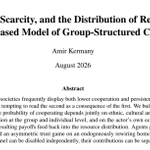
I've long been curious about how ethnic identity and poverty interact in deciding who ends up with what. I had a rough model in my head for years but never had time to build it. So I tried doing the whole thing with Claude, from simulation to paper.
The model is simple. Agents play cooperation games with each other. Whether they cooperate depends on how similar the other person is, what they've learned about that person's group, and how broke they are. You can turn each of those off separately and see what changes.
Results mostly matched what I expected, but a few are worth spelling out ->
1
88
3. Redistribution made people cooperate more, not less. A 35% tax roughly halved inequality and pushed cooperation from 52% to 65%. And forcing people to mix with strangers made cooperation worse, not better.
caveat: this is a first pass, and the paper is very much a first draft. The full simulation should be built on top of a population genetics model, which will come later.
The paper are here:
github.com/kermany/resource_…

20

@akermany ➡️ retweeted

In an extraordinary new paper, just out, in Nature @Sergiu_P_Pasca and his team genetically altered mice to make them "apallial" (missing a cortex). And then, postnatally, transferred organoids derived from human neural cells into that space.
Three months later, in the animals measured, the cortex was 91.9% human-derived neural cells by volume.
The result is not quite a mouse mouse (albeit I would still say, it's a mouse!), and certainly not anything like a human. Nothing the researchers measured suggests these animals have human-like experiences.
What a model like this promises for neurological disease modeling and drug discovery cannot be overstated. It's nothing short of an extraordinary breakthrough.
It also raises complex ethical questions (to be clear, these researchers carefully engaged external ethicists (I was one of them), and followed every ethical and legal guideline possible.) Which is why In a forthcoming commentary, Anil Seth and I explore what an ethical roadmap forward would be for this work. We address whether these mice chimeras could have any human-like capacities, how we might measure and know, and who, and how, we decide together what the next steps in this research should be.
