

We've developed a two-phase, direct-to-chip liquid cooling solution that delivers 4500W per socket and up to 50% energy savings for the AI and HPC era.
Austin, Texas
Joined August 2025
- Tweets386
- Following31
- Followers907
- Likes6


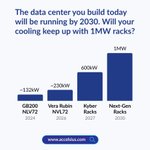



A data center designed today will open for business around 2030. The chips it'll cool are still a mystery. That's why the cooling technology you install today needs to handle the heat of multiple GPU generations.
Learn why flow rate is a key metric to assess whether your cooling technology is prepared to cool next-gen chips, and how two-phase can cool three times more compute on the same flow. (01/09)
#ai #liquidcooling #datacenters

2
114

DON'T FORGET: Are you at SC26? We're joining Legrand in Booth 2556 to showcase the NeuCool® IR150, the industry's first fully integrated rack plus CDU, and discuss why two-phase direct-to-chip is the inevitable next step for mission critical cooling. We hope to see you there!

199
Today, Accelsius honors the veterans who have served our country, including those on our own team. You've taken on the most mission-critical work there is, and your courage and commitment to something bigger than yourselves inspires us.
We're proud that 90% of our manufacturing is based right here in the U.S., supporting American jobs and the communities that so many veterans call home.
Thank you for your service.

1
291
Your data center takes two years to build, and up to four years to get fully powered. Meanwhile, NVIDIA ships a new GPU generation every year. That means the cooling you install today has to handle racks that don't exist yet.
How do you ensure your cooling is ready for 2030's thermal challenges? Make sure its flow rate doesn't strain your current infrastructure. Higher flow means higher risk of erosion, corrosion, pump failure, and leaks.
Two-phase has one-third the flow rate of single-phase. That translates to roughly 3X more compute on the same flow, or multiple generations of high-density racks.
Read the full article to discover why our NeuCool two-phase direct-to-chip solution is truly a "set-it-and-forget-it" solution: accelsius.com/less-liquid-lo…

NEXT WEEK: Attend a webinar with CEO John Hewitt to learn why two-phase adoption is inevitable — and how operators can build experience with two-phase technology today to prepare for this transition.
WHEN: Wednesday, November 11th
WHERE: 9 to 10 AM ET
LINK TO REGISTER: datacenterdynamics.com/en/dc…
Alongside Legrand's Nick Schweissguth and host Kat Sullivan, Hewitt will discuss:
🫧 Why rising AI densities are accelerating interest in two-phase cooling
🫧 How hybrid cooling and RDHx can support evolving infrastructure requirements
🫧 Where two-phase could deliver advantages in density, efficiency and maintenance
🫧 How POCs, universal components and flexible architectures can simplify deployment
We hope to see you there!

1
2
474
At OCP Global Summit 2026, Dr. Richard Bonner sat down with Vlad Galabov and Shen W. of the AIDC Debate to discuss what the CPU's comeback means for data center cooling, and how chipmakers pushing clock speeds "is a thermal issue" at heart.
WATCH HERE: youtube.com/watch?v=JromwQlT…
Dr. Bonner explained that advanced liquid cooling approaches like two-phase direct-to-chip can raise primary loop temperatures and reduce reliance on chiller infrastructure. This allows facilities to put that saved power back into compute, allowing operators to deploy 5% more GPUs in the same power envelope.
Accelsius has shown that better cooling can enable new, denser architectures that improve tokens per watt, and has delivered the data that proves "two-phase is looming."
Special thanks to Vlad and Shen for having us!

495
Data center water consumption is a chief concern for communities. Two-phase direct-to-chip cools AI without draining local water supplies.
In a recent story on Marketplace, Dr. Richard Bonner explained that water is lost in two key places: a data center's cooling tower, and at the power plant cooling the facility.
With 9°C greater thermal headroom vs. single-phase, two-phase can run on warmer facility water. That makes dry coolers practical, reducing or outright removing the need for cooling towers.
NeuCool also offers energy savings up to 56% compared to single-phase. Lower energy consumed means less power drawn from the grid, and therefore less water used at the power plant.
So far, efficiency gains have been outpaced by AI demand. Accelsius aims to close that gap by matching mission critical thermal performance with a significant boost in sustainable operations.
Special thanks to Marketplace for this coverage! Be sure to hear the full story here: na2.hubs.ly/H08Nswl0

Today, Accelsius has announced it will provide the NeuCool® IR150, the industry's first fully-integrated rack plus CDU, to Villanova University, a founding member of the Energy-Smart Electronic Systems (ES2) federal research program.
READ THE FULL ANNOUNCEMENT: na2.hubs.ly/H08N8zk0
With support from fellow industry partners including Google, Microsoft, and Meta, ES2 aims to improve the energy efficiency of U.S. data centers by 20-35% — by its own estimate, the equivalent of removing one to two power plants every three years. The ES2 laboratory also performs extensive research for OMNICOOL, the NVIDIA-led research project under ARPA-E's COOLERCHIPS program.
Our participation in ES2 continues our ongoing support in data center energy efficiency research. Villanova is one of three university sites participating in ES2, alongside The University of Texas at Arlington, where Accelsius participates in a COOLERCHIPS project led by Dr. Dereje Agonafer.
We hope you get a chance to see our NeuCool IR150 in action at Villanova. If interested, please feel free to contact Dr. Alfonso Ortega, James R. Birle Professor of Energy Technology and ES2 Site Director.

1
5
674
See you at SC26? We'll be joining Legrand in Booth 2556 to showcase the NeuCool® IR150, the industry's first fully integrated rack plus CDU, and discuss why two-phase direct-to-chip is the inevitable next step for mission critical cooling. We hope to see you there!

2
3
437
NEW RESEARCH: Presented at InterPACK 2026, our latest research highlights key takeaways when optimizing microchannel cold plates for two-phase boiling — paving the path for highly efficient two-phase cooling solutions in next-gen high-performance data centers.
Be sure to click the link in the replies to download the full findings from our expert team of thermal engineers.

1
2
384

