Founder @magnetmonsteruk - Klaviyo Elite Agency
Free Email Marketing Audit 👉
Joined February 2021
- Tweets3.4K
- Following228
- Followers2.2K
- Likes2.2K



Pinned Tweet
DTC Subscription brands: we partnered with Loop Subscriptions across 1,917 brands to benchmark your data across:
> Churn rate
> ARPU
> Cancellation save rate
> Payment failure rate
Read it now and benchmark yourself.

6
5
601
Paper & Tea’s flows went from 6% to 24% of email-attributed revenue in one month.
And against the same month last year:
🧲 5.5x flow revenue
🧲 8x post-purchase revenue
🧲 3x abandonment revenue
🧲 +72% welcome click rate
We rebuilt every flow around how their customers actually drink tea, across email and WhatsApp, in English and German.
Retention revenue plateaued? DM me for a free audit.

47
What does Zirkzee have to do to get a start for United? Same for Lacey above Diallo? Both impress whenever they come on but never get a start.
105
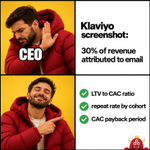
“30% of DTC revenue from email” means nothing to a CEO doing north of $10 million a year.
Serious operators laugh at this during a pitch.
What they’re really interested in is the following 3 metrics:
🧲 LTV:CAC ratio
“Lifetime value” can be an indefinite period so you need to measure 30/60/90/180/365 day periods.
A fast-scaling brand should have a LT:CAC ratio at least above 3.
Anything less in under a year means you’re heading towards serious cash flow issues.
🧲 Repeat purchase rate by cohort
Don't fall for a blended average across the whole database or Shopify’s “returning customer rate”.
Instead track each month's new customers separately and see how many come back for a second order (and in which timeframe).
This shows whether retention is improving or whether your newest cohorts are degrading.
🧲 CAC payback period
How many days it takes for a customer's gross profit to pay back what you spent to get them.
Critical as so few brands are profitable on their first purchase these days.
The faster you recoup the difference, the more $/£ you can reinvest for growth.
We track all of these for brands under our roster and put proven strategies in place to grow each.

5
4
190
Terrible tragedy to hear the news about Adam Robinson & his young family this evening.
I, like many, greatly admired Adam and had spent dozens of hours analysing and enjoying his content on LinkedIn.
He was even courteous enough to be a guest on my last podcast, back when it had 0 listeners, to share his genius.
I don't know Adam personally but if he was anything like his online persona, he will be terribly missed.
Rest in peace and may his memory be a blessing.
Woke up to a giant leap of usage for GrokBot. Anybody else seen the same? Going to blitz through usage now.
158
As somebody who has grown up surrounded by welfare culture, everything she says is 100% correct. The whole system is designed to be gamed and perversely even seems encouraged.
This country is on its knees and thrives off punishing working people trying to get ahead in life.
A sad state of affairs we find ourselves in.

Kemi Badenoch tore Labour to shreds today at the budget. A serious leader.
“They love to dish it, but they can’t take it.”
“Those on benefits are getting an increase, those going out to work are not. That is not fair…Labour are addicted to welfare”.
We deserve better.
1
3
228
My sisters love shopping at Zara.
But they aren't interested in its discount codes as much as its new product releases.
Which is a good reminder that 90-day LTV and repeat purchase rate aren't the same lever. There's overlap, but you can increase LTV without touching the repeat rate.
One of our fragrance clients builds their entire content calendar around new scent drops. It's how they stop 90-day LTV from going flat.
Here are two ways to do that:
🧲1: Sell more upfront
Bigger initial basket, subscription or not. This is one of the best ways to lift LTV without needing a single extra repeat order.
It matters even more if you've got a churn problem. Collect more cash upfront and you can afford to spend more acquiring the customer in the first place.
🧲2: Give people a reason to come back
New flavours. New scents. New seasonal drops. It doesn't matter what category you're in, novelty is one of the biggest drivers of retention there is.
It works across any time frame, not just the 90-day window, and it isn't about repeat purchase rate specifically.
What you'll need to get right is your planning. Map your key release periods onto the calendar for the year and build towards them.
That fragrance client I mentioned has new scents, limited editions and influencer collabs mapped out months in advance.
It's core to how they keep the business sustainable.
Learn how to track the 4 metrics that will fix your rising CAC in my YouTube video. Link in the comments ↓
3
1
132
Email Won't Fix Your Rising CAC. These 4 Metrics Will. youtu.be/eVcc51iWg-8
58
3 ways to grow a DTC subscription business:
1. Get more subscribers
2. Get them to stay longer
3. Get them to spend more
Everything else is noise. Here are the best strategies for accomplishing all 3.
1. Get more subscribers
Make Subscribe & Save the default option on your product page. Brands that switch often see take rate jump from 10-20% immediately.
Add three value-prop bullets under the subscribe option that emphasise the value subscribers get vs 1-time purchase.
Build continuity into the 2nd purchase from the first (i.e. all subsequent subscription orders get 20% off).
Don't chase take rate at all costs. An offer that has ~50% churn by order number 2 is likely being gamed by subscribers. You have to find the sweet spot.
2. Get them to stay longer
Track churn by order number, not calendar month.
Around 70% of subscriber churn happens before the 3rd order, so that's where your effort should go. After this, retention curves tend to play out as fate will be.
Get them using the product in the first 10 days. Set a goal for the customer and hold them accountable to it. Do NOT be afraid to overcommunicate during the onboarding phase - it'll decrease churn, not increase it.
Fix failed payments, since up to 15% of churn can come from these. Smart retries and incentives for payments that consistently fail. Keep it simple.
Always offer flexibility - don't default to a fixed renewal cadence. Subscriber behaviour is often at odds with how brands want to generate cash, but you need to respect the customer's needs.
Treat your cancel flow as the highest-intent screen in the entire lifecycle. Start with a founder video reiterating the benefits, then overcome objections, before finishing on your best offer.
3. Get them to spend more
Build an irresistible quarterly subscription offer. It brings more cash in upfront, and less billing reminders equate to less churn.
Offer the upgrade post-checkout to get as many people onto it as possible.
Once subscribers pass order 3, send them 1-2 upsell/cross-sell offers a month. They're your best customers and the ones most likely to bite, so stop being terrified of contacting them.
Give them something new to buy. How often you do that is one of the biggest levers on LTV.
Reward tenure: acknowledge your best subscribers at milestones (i.e. annually). They're your biggest spenders and deserve VIP treatment to fuel WoM growth.
What did I miss?
6
5
345
3 ways to grow a DTC subscription business:
1. Get more subscribers
2. Get them to stay longer
3. Get them to spend more
Everything else is noise. Here are the best strategies for accomplishing all 3.
1. Get more subscribers
Make Subscribe & Save the default option on your product page. Brands that switch often see take rate jump from 10-20% immediately.
Add three value-prop bullets under the subscribe option that emphasise the value subscribers get vs 1-time purchase.
Build continuity into the 2nd purchase from the first (i.e. all subsequent subscription orders get 20% off).
Don't chase take rate at all costs. An offer that has ~50% churn by order number 2 is likely being gamed by subscribers. You have to find the sweet spot.
2. Get them to stay longer
Track churn by order number, not calendar month.
Around 70% of subscriber churn happens before the 3rd order, so that's where your effort should go. After this, retention curves tend to play out as fate will be.
Get them using the product in the first 10 days. Set a goal for the customer and hold them accountable to it. Do NOT be afraid to overcommunicate during the onboarding phase - it'll decrease churn, not increase it.
Fix failed payments, since up to 15% of churn can come from these. Smart retries and incentives for payments that consistently fail. Keep it simple.
Always offer flexibility - don't default to a fixed renewal cadence. Subscriber behaviour is often at odds with how brands want to generate cash, but you need to respect the customer's needs.
Treat your cancel flow as the highest-intent screen in the entire lifecycle. Start with a founder video reiterating the benefits, then overcome objections, before finishing on your best offer.
3. Get them to spend more
Build an irresistible quarterly subscription offer. It brings more cash in upfront, and less billing reminders equate to less churn.
Offer the upgrade post-checkout to get as many people onto it as possible.
Once subscribers pass order 3, send them 1-2 upsell/cross-sell offers a month. They're your best customers and the ones most likely to bite, so stop being terrified of contacting them.
Give them something new to buy. How often you do that is one of the biggest levers on LTV.
Reward tenure: acknowledge your best subscribers at milestones (i.e. annually). They're your biggest spenders and deserve VIP treatment to fuel WoM growth.
What did I miss?
2
4
229
You can't email someone into running out faster.
Yet most replenishment flows fire on day 30 because someone picked a round number.
Yes, supplements might reorder every 30-45 days but a mattress could be 10 years!
Your category sets the buying cycle. So your job is to be first in line when it becomes due.
Here's how I'd build it, using Omnisend's ready-made Replenishment Reminder workflow as the example:
1. Find your real number
Pull the median days between 1st and 2nd order for each core product.
Use the median (not average because a handful of heavy buyers will drag the average and throw your timing off.)
Recheck it every quarter. It moves as your customer mix changes.
2. Build a sequence
- Just before the median: a reminder, with an offer to subscribe
- A few days later: an SMS + email nudge for anyone who hasn't reordered
3. Measure the right thing
Instead of the flow's open rate, track the % of first-time buyers who place a 2nd order. That’s the business KPI you’re trying to influence.
If you’re on another ESP, Omnisend migrates your account for free, usually within 5 days. They say brands that switch end up paying up to 35% less.
And if you want to set this up, code ADAM gets you 30% off paid plans for your first 3 months.
Link in the comments.
P.S. If you don’t sell consumables, skip this. Use that window for reviews, referrals and complementary cross-sells instead.
2
91
Try Omnisend with 30% off paid plans for 3 months, code ADAM:
your.omnisend.com/adamkitche…
28
Last month, I convinced a founder to dump his five customer personas so his team can ship emails faster.
I’ve been doing this for 2 decades now, and simple always beats complexity.
On paper, personas sound like sophisticated marketing.
Right message, right person, right time.
But here's what actually happens when you build a campaign calendar around five personas:
→ Five sets of creative
→ Five sets of copy
→ Five approval loops
→ Five reports to interpret
Every send now needs five decisions instead of one.
And for what benefit?
Your resource allocation goes up dramatically and the gains are never commensurate with the increased output.
Here's how I’d segment by engagement for brands doing 8 to 9 figures:
🟢 Highly engaged: high frequency
🟠 Moderately engaged: reduced frequency
🔴 Low engagement: occasional sends, but never ignored
One set of creative → one decision per send → maximum reach (90% of the time).
I’m not saying persona data (or zero-party data) is useless. In fact, you need it on the first purchase.
Collect zero-party data at signup, personalise the welcome journey, and map the attributes of your highest LTV customers back to your acquisition team.
That's where individual context has real leverage, because intent is high and the message decides the sale.
But for the weekly campaign calendar, go broad.
The founder summarized it better than me: "We're a small team. Fewer decisions, fewer approvals. That's easier for us."

2
2
153
Want to know how a subscription brand really feels about its subscribers?
Try cancelling.
For a lot of brands, it's a single button. There's no option to skip, swap or push the next order back a month.
I don't think most brands chose that on purpose.
The portal was built by the subscription app, while the emails were created by the retention team.
Neither of these teams is looking at what happens when a subscriber tries to leave.
So cancelling is the easiest thing a subscriber can do.
That's a problem, because ~70% of subscription churn happens before the third order.
When we audit a subscription programme, I start with the cancellations:
→ Where they happened
→ Why they happened, and
→ What the subscriber was offered before they left
Then I check what the portal actually lets them do on their own.
What I want to see is a practical alternative before the cancel button, and ideally in the inbox.
We've partnered with Zaymo to run those actions inside the email, so skipping or swapping is one tap instead of a login.
Give people a reason to stay before you give them a way out.
P.S. If you want to see how Zaymo puts skip and swap inside a Klaviyo email, take a look here: zaymo.com/examples

Every brand right now is planning its BFCM discounts.
But the data says that’s the wrong place to start.
Klaviyo’s 2025 BFCM data says that the brands with the smallest discounts grew the fastest, up 14% year on year.
Meanwhile average discount depth actually dropped, and stayed under 30% even at the peak.
Which flips the usual discount-first logic on its head.
That’s exactly why Travis Bonneteau, our Head of Lifecycle Marketing, used his years of expertise to put together a full BFCM working plan covering:
🧲 The decisions you need to take first before writing an email
🧲 List growth and segmentation strategies that aren’t generic
🧲 A complete send calendar across Email, SMS, WhatsApp and Direct Mail
🧲 A QA checklist so nothing breaks on the biggest weekend of the year
🧲 A 30-day post BFCM winback email minus the discount codes
Comment “BFCM” and it’s yours.
P.S. Follow me if you haven’t already.

3
2
120
I think many people are writing Wardley off too easily for this one.
I favour Dubious as well heavily but there's a chance Wardley could jump all over him early and go for it. It's heavyweight boxing at the end of the day and he has the power to hurt him and finish anyone.
#DuboisWardley
198
This is 100% true. American mindset - for better or worse - is ravenous for success (financially). You can't not visit every corner of America and feel the infectious desire to level up. The contrast to Europe is night and day.
Saying that, there's plenty of downsides to this culture as well but that's for another post.

Hot take (that will make everyone fight):
If you are young and ambitious, you are better off being in ANY city in America vs 99% of Europe.
Sure London beats Columbus Ohio.
But outside of like 4 cities in Europe, any mid sized city in the USA has a better chance of making you rich
107