




Nandish retweeted

Some pre-market thoughts to Substack group:
Markets gapping down again today. Looks like it’s going to be an another easy sit out day.
Short week anyway and way too much volatility to even think of getting positioned.
May sound boring but boring is good in trading.
Less is often more in this game which is hard sometimes but always seems to pay off long term.
So much of trading is patience.
Patience to wait for better environments.
Patience to wait for leaders to set up.
Patience to sit in a winner and let it work.
Each market cycle I realise how much better I would have done if I’d done less.
And right now it’s time to sit on my hands snd wait for better times.
Been saying for a while that the ideal scenario would be another flush so hopefully this can be the start of that.
For now use this time to study and refine your strategy so you’re ready to take full advantage of the next strong trend.
Nandish retweeted

My watchlist + EC are two of my favorite market breadth indicators.
rather than obsessing over traditional breadth indicators/oscillators, I keep my situational awareness stupidly simple.
...is my watchlist shrinking or expanding?
...am I seeing leadership/new themes emerge + an abundance of constructive setups?
...what is my equity curve moving up/down/sideways?
simple is better for me.
- green = press
- yellow = proceed with caution
- red = sit on my bum
we're still operating in a red light environment IMO, but I'm seeing glimpses of yellow.
I don't need to put time/energy into trying to predict the turn because my scans & equity curve will tell me when it's time.
keep it stupid simple!!

Nandish retweeted
Market context FIRST, RS second, setup third!!
I hate to break it to you, but there is no magic formula, and I see a lot of newer traders get this concept completely backwards. They find an A/B+ setup, fall in love with the chart + then try to convince themselves the market will support it.
My process is pretty dang simple for a reason.
- Market Context... Are the $SPY & $QQQ above or below the EMAs? Am I seeing a lot of setups? Are breakouts following through, or are leaders getting sold into strength? This tells me how aggressive I should be.
- Relative Strength... Which stocks/groups are refusing to go down when the indexes get smoked? Who's making higher lows, holding their inclining 9/21EMAs + pushing towards 52week highs? This tells me where I should be looking.
- Setups... Are those leaders finally compressing into actionable pivots? Low-volume HT flags, 9/21EMA pullbacks, U&Rs off weekly support pivots, flat base b/o's. This tells me when + where I can execute with asymmetric risk.
It's not that easy though...
I can identify an A+ RS name with an A+ setup and STILL choose to do absolutely nothing bc of the intuition I've built over the years... why? bc if the indices are rolling over, groups are breaking down + my recent trades aren't showing any sign of life, why would I want to press risk when caution flags are popping up everywhere??
Instead during those times, I keep tracking those leaders/laggards/names setting up while the market sorts itself out. Once the indexes start confirming, the strongest groups begin participating + my individual setups trigger, that's when I start putting risk on and progressively increasing exposure as positions work.
The market permits me, RS points me toward opportunity, and the setup gives me a place to define my risk.
All 3 need to work together to add as many layers of probability as possible.
That's the entire biz for me!!
Nandish retweeted
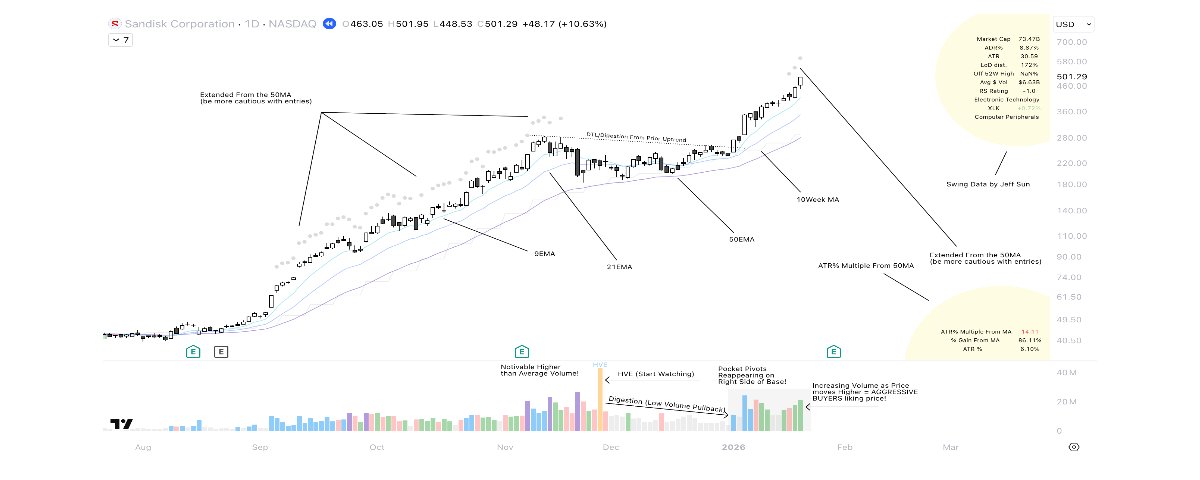
“Patience is essential for trading. When there is nothing to do, do nothing”
“The big money is not in the buying and selling, but in the waiting”
“The stock market is a device for transferring money from the impatient to the patient”
Just wait, then wait & wait some more.
Nandish retweeted
About 16 months ago, I met a trader who was making way more money than me. I'm talking about an entire collection of supercars, everything I could've ever dreamed of owning at the time.
He invited me to watch him trade one morning, and of course, I'm not an idiot... I'm taking that offer. I sat there watching him scan, build his watchlist + prepare for the open, and the funny thing was, nothing he was doing was particularly special. Heck, his routine looked almost identical to mine. About 30-40 minutes into the session, he shuts off his monitors, turns around and goes, "wanna grab some food?" I'm sitting there confused... "wait, aren't we gonna trade?" He goes, "nah, I'm done for the day." done? brother, the market hasn't even been open an hour. And that's when something started clicking for me.
He wasn't sitting there trying to squeeze every last dollar out of the market. He knew what he was looking for, and once the opportunity was gone, so was he. Then he showed me his trade statements... this guy averaged around 10 trades a month. TEN. I was over here convincing myself I needed to be involved in every move I could get my hands on. That morning taught me something I've spent the last 2 years trying to get better at... the difference between a mediocre trader and a great one isn't some secret strategy, it's the ability to sit on your effing hands when there's nothing worth trading.
Nandish retweeted
A few things I personally look for when buying pullbacks in leading stocks:
- strong stocks in the strongest sectors + themes.
- clear relative strength vs the indexes & its peers.
- favorable market conditions with improving breadth.
- a constructive weekly chart (non-negotiable).
- price > rising 9/21EMAs on the daily + weekly.
- prior momentum leg = strong institutional demand.
- meaningful catalyst, earnings reaction, etc.
- orderly pullback rather than erratic price action.
- Declining volume as price pulls into support.
- tight price action + volatility contraction.
- higher lows showing buyers stepping up.
- support near the 9/21EMA, AVWAP, or prior b/o pivot.
- price holding above key daily + weekly pivots.
- constructive base forming after the initial expansion.
- RS holding up during broader market weakness.
- right-side reclaim of major pivots
- favorable R/R with room for another expansion leg.
- my existing positions working before progressively adding exposure.
The more evidence (layers of probability) that I stack in my favor, the more interested I become.
I'm not buying a stock simply because it's pulled back. I'm buying a leader that's resting within a healthy trend, preferably at a location where I can be wrong quickly + small.
That's the difference between buying weakness in strength and catching a falling knife.
- iain 🩵
Nandish retweeted
If you're struggling to make money during this correction, here's what I'd be doing instead of trying to nail the exact bottom.
A few lessons I've learned, many of which you'll find echoed throughout the Market Wizards books:
1) Protect your capital FIRST.
you can't take advantage of the next uptrend if you've already blown yourself up trying to predict the bottom.
2) Let your equity curve dictate exposure.
taking repeated paper cuts? Cut size, don't double down.
3) Stop averaging down on losers.
a stock getting cheaper doesn't automatically make it a better opportunity.
4) Track relative strength, don't force trades in it.
study which leaders are holding up while the indexes get smoked.
5) Pay attention to leadership breaking down.
when former leaders start losing weekly moving averages, that's a clue to be cautious.
6) Keep updating your watchlists.
add emerging leaders, remove broken names & identify which groups are attracting capital from institutions.
7) Study price + volume every evening.
some of my best preparation happens when I'm barely trading, so... prepare, prepare, prepare.
8) Wait for the market to confirm your thesis.
higher lows, improving bases + weekly pivot reclaims mean more to me than guessing where the low should be.
9) Don't confuse a bounce with a new uptrend.
mean reversion into declining moving averages isn't the same as institutional accumulation.
10) Know your invalidation before entering.
if I can't identify where I'm wrong, I'm not interested.
11) Trade smaller when uncertainty is elevated.
especially ahead of major earnings, FOMC + other market-moving catalysts.
12) Stop looking for trades out of boredom.
the market doesn't owe you an opportunity just because you opened your charts.
13) Don't borrow conviction from other traders.
somebody else's profitable setup might be completely outside your edge.
14) Keep your losses stupidly small.
a few paper cuts are manageable. one oversized emotional trade can undo months of progress.
15) Start small when conditions improve.
let your first positions prove themselves before progressively adding exposure.
16) Press when you've earned the right to press.
strong leadership, quality setups + a rising equity curve are what I want to see before getting aggressive.
17) Quit obsessing over being first.
i'd gladly miss the bottoming day if it means participating in a healthier, more sustainable trend.
18) Protect your mental capital.
stepping away from the screens is likely the most productive thing you can do.
Just a few thoughts to chew on. enjoy your weekend, family!! Feel free to add your own additions below!
keep it stupid simple. :)
Nandish retweeted
Nobody cares what your favorite Wall Street analyst upgraded or downgraded this morning.
Price doesn't care about their fancy price targets, and neither should you. learn to read price/volume instead of useless words from some dude in a suit who probably bought the top himself.
Nandish retweeted

"By tracking RS, you can find quality trades during any market conditions. When money is flowing out of one sector, it is likely flowing into another. It's our job to track and follow smart money as it rotates around the market. No guessing, all systematic" -EST
Nandish retweeted
The secret to trading isn't finding a magic indicator, it's learning how to lose.
As Tom Hougaard highlights in Best Loser Wins, the elite 5% succeed because they master a simple paradox: they take small, clean losses without ego, while letting their winners run.
Amateurs destroy themselves by holding onto losers out of hope and cutting winners too early.
Your losses are just operating expenses. Cut them fast, protect your capital, and let the math work. 📉📈
Nandish retweeted
You don't need 2 hours of scanning every morning to find the best opportunities.
Give me 20 minutes, and here's where I'd start...
1) Market check:
Look at $SPY, $QQQ, $IWM, and $VIX.
...is the market in an uptrend (higher highs/higher lows, above rising moving averages)?
...os $QQQ leading $SPY (growth risk on) or lagging?
...is $IWM participating or lagging (broad participation vs mega cap only)?
... $VIX elevated and rising (caution) or subdued?
--
2) Sector ranking:
Rank the 11 Select Sector SPDRs ($XLK, $XLV, $XLF, $XLY, $XLC, $XLI, $XLP, $XLE, $XLU, $XLRE, $XLB) by relative strength versus $SPY.
Focus on the top 3-4 and bottom 2-3. Note any sudden changes in ranking... these often signal rotation.
--
3) Theme scan:
Within the leading sectors, check the relevant themes.
this is just for an example, but...
Technology leading... look at $SMH, $SOXX, $AIQ & $BAI, $CIBR, $DRAM, $IGV, $BOTZ.
Industrials leading... check $ITA & $SHLD, $PAVE, $GRID.
Energy or Utilities leading → check $NLR + $URA and related power/infrastructure names.
Only then look for individual setups inside the strongest themes, and if the market or sector is weak, reduce size or stay in cash.
Simple & repeatable.
Nandish retweeted
Finding the right stock and finding the right time to trade it are 2 completely different skills.
You can find the strongest stock in the strongest group, execute a precise entry, and still get stopped out simply because the broader market isn't cooperating. I like to think about it like swimming against a current.
You might be the strongest swimmer in the water, but you're making your life unnecessarily difficult fighting something much bigger than yourself, and I think the same applies to trading.
A huge portion of an individual stock's performance is influenced by the broader environment + its respective industry group. That's why, during corrections, I'm not necessarily looking to buy the stocks holding up best. I'm studying them. Which names are holding their 9/21EMAs while the indexes lose theirs? Which groups are refusing to make new lows? Where is volume drying up on pullbacks, and where are buyers consistently defending key weekly levels?
Those are the footprints I'm paying attention to while everyone else is trying to predict the exact bottom.
Then, when the $SPY & $QQQ begin curling off the right side, reclaiming key moving averages (like today) and showing broader participation, I've already done the homework. I'm not scrambling through 100s of charts trying to figure out what's strong.
I've spent the entire correction adding and subtracting names from my watchlists, identifying the strongest groups, and narrowing down the leaders within them. From there, I'm looking for my familiar setups such as constructive daily pullbacks, tight consolidations, 9/21EMA reclaims, etc where I can define risk against a nearby low.
I'll typically start with smaller exposure and only press as my positions begin working + the market confirms the turn.
I'm just trying to be prepared enough to recognize leadership when the wind finally shifts in my favor. Some of my best opportunities have come from the work I did when there was absolutely nothing worth trading.
That's the part of this business I wish I'd understood sooner.

A friendly reminder:
“When the market is going down, don’t trade relative strength, just track it.”
“When the market starts to trade higher, then you trade relative strength.”
- @RealSimpleAriel
Nandish retweeted
The 30min pivot has become one of the most important entry tactics in my entire system.
Huge credit to @1ChartMaster because he was the one who really opened my eyes to how powerful this entry tactic can be on true leadership names.
And it also solved one of the biggest problems I used to struggle with...chasing strength emotionally.
I think a lot of momentum traders can relate to this.
You see a stock like $MU, $ARM, $INTC, or $MRVL exploding intraday, your brain starts screaming “don’t miss it,” and before you know it you’re buying extended candles after a huge expansion move. Then the stock pulls back 3-5% immediately after you enter, you get shaken out, and somehow the stock ends up going higher without you anyway.
That cycle used to happen to me constantly.
The 30min pivot completely changed that for me because now instead of chasing emotional strength, I wait for controlled weakness *inside* strong trends.
I’m specifically looking for:
-a true leader,
-inside a strong theme,
-holding key moving averages,
-while institutions continue defending dips.
Names like $MU and $ARM recently are perfect examples. These aren’t random low-float junk names bouncing around. These are institutional leadership stocks inside powerful themes like semis, AI infrastructure, memory, networking, and data centers.
Momentum persistence in leading stocks is often driven by institutional accumulation and trend continuation behavior, especially during strong sector rotations.
"But how do I enter using the 30min pivot?"
No need to fret, my friend.
This is my EXACT entry process:
I wait for the stock to flush intraday into a key area:
usually the 9EMA, 21EMA, prior breakout pivot, AVWAP, or some obvious support zone where I think buyers may defend.
I do absolutely nothing during the flush itself, because I’m not trying to catch the exact bottom...all I’m doing is waiting for proof the selling pressure is slowing down.
Then I look for the first green 30min candle after the selloff. That candle becomes my pivot candle!
The second price takes out the high of that candle, I enter immediately. My stop goes under the low of the day or slightly beneath a support pivot.
That’s what creates the asymmetry for me.
If I’m wrong, I know very quickly.
Small loss, then move on.
But if I’m right, I’m entering a leading stock at the exact moment momentum begins shifting back higher after weak hands just got flushed out. That’s why I love this setup so much in momentum environments.
It allows me to participate in leadership without chasing vertical expansion candles emotionally.
A stock can be incredibly strong and still offer a terrible entry if you’re buying emotional extensions into resistance. The 30min pivot forces me to stay patient and wait for the stock to come into my areas instead of forcing trades because of FOMO.
The real edge comes from combining the setup with *stock selection*.
Strong stocks in strong groups tend to offer repeated opportunities during uptrends as pullbacks into moving averages often become areas institutions defend before continuation higher.
That’s why this setup has helped me catch some of my biggest winners recently like $ARM, $MU, $INTC, $DELL, etc.
Give it a try and let me know if it helps!

The 30-minute pivot strategy used by Elite Swing Traders (@1ChartMaster) is a tactical entry method designed to help traders buy high momentum stocks at defined support levels while minimizing the risk of "chasing" a move. It is particularly effective for traders prone to FOMO (Fear Of Missing Out).
Core Components of the Strategy
Identifying Relative Strength (RS): The strategy focuses on "RS names" stocks that are holding up better than the broad market. The goal is to find a stock you want to own that is currently experiencing a short-term pullback.
The "String of Red" Setup: A key signal for this entry is seeing a string of red 30-minute candles in a stock that is otherwise in a strong uptrend. This represents a healthy, short term "cooling off" period.
The Pivot Entry: Rather than buying as the stock is falling, the trader waits for a "pivot" a specific point where the downward momentum on the 30minute chart shifts back to the upside.
Defined Risk: By entering at the 30 minute pivot, you have a defined spot for a stop loss, usually just below the recent 30 minute low.
Why Use It?
Patience over FOMO: It forces the trader to wait for the stock to come to them rather than buying at the top of a parabolic move.
Institutional Alignment: It seeks to buy the "dip" in a leading stock, often near short term support levels like the 8 EMA or the 8 wee EMA
High Expectancy: When a High Tight Flag (HTF) or a high momentum name pulls back, the 30minute pivot often provides a low risk entry into the next explosive leg higher.
Key Takeaway: The strategy is about finding the "beachball underwater" a strong stock being temporarily pushed down by market noise and entering at the moment the pressure is released and the stock begins to "pop" back up.
Nandish retweeted
I break most of my pullback entries into 3 parts:
1. LOCATION: Stock pulls into the 9/21EMA, prior support or another meaningful level.
2. CONFIRMATION: Buyers respond + a 15/30 minute pivot develops.
3. EXECUTION: Enter through the pivot with risk defined against the relevant low.
The mistake I made for years was skipping step 2.
Nandish retweeted
The 30-minute pivot strategy used by Elite Swing Traders (@1ChartMaster) is a tactical entry method designed to help traders buy high momentum stocks at defined support levels while minimizing the risk of "chasing" a move. It is particularly effective for traders prone to FOMO (Fear Of Missing Out).
Core Components of the Strategy
Identifying Relative Strength (RS): The strategy focuses on "RS names" stocks that are holding up better than the broad market. The goal is to find a stock you want to own that is currently experiencing a short-term pullback.
The "String of Red" Setup: A key signal for this entry is seeing a string of red 30-minute candles in a stock that is otherwise in a strong uptrend. This represents a healthy, short term "cooling off" period.
The Pivot Entry: Rather than buying as the stock is falling, the trader waits for a "pivot" a specific point where the downward momentum on the 30minute chart shifts back to the upside.
Defined Risk: By entering at the 30 minute pivot, you have a defined spot for a stop loss, usually just below the recent 30 minute low.
Why Use It?
Patience over FOMO: It forces the trader to wait for the stock to come to them rather than buying at the top of a parabolic move.
Institutional Alignment: It seeks to buy the "dip" in a leading stock, often near short term support levels like the 8 EMA or the 8 wee EMA
High Expectancy: When a High Tight Flag (HTF) or a high momentum name pulls back, the 30minute pivot often provides a low risk entry into the next explosive leg higher.
Key Takeaway: The strategy is about finding the "beachball underwater" a strong stock being temporarily pushed down by market noise and entering at the moment the pressure is released and the stock begins to "pop" back up.