

Africa's foremost independent cyber and digital technology think-tank. We cover cybersecurity, digital identity, financial crimes, risk management, AI, etc.
Abuja, Nigeria
Joined May 2019
- Tweets170
- Following96
- Followers144
- Likes1.9K








Organisations using PHP should prepare for updates addressing two critical vulnerabilities that could expose server file systems and databases.
Patch promptly. If immediate updates or effective mitigation are not feasible, take affected systems offline.
#CyberSecurity #PHP

🔐 OCTOBER IS CYBERSECURITY AWARENESS MONTH
Cybersecurity is everyone's responsibility.
Use strong passwords. Spot phishing. Protect your data. Update your devices. Think before you click.
Awareness must become action.
BE AWARE. STAY SECURE.
#CybersecurityAwarenessMonth

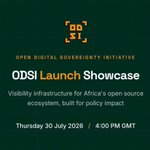
Open source in Africa is massive and innovative, but most people never see it.
ODSI is here to change that.
This space isn’t just for developers. If you write, teach, advocate, or shape policy — you belong here.
Thu 30 July, 2026 4PMGMT
Register: odsi.africa/launch

Identity is not enough in our current threat landscape. In an agentic world, you must govern delegation.
#AgenticAI
#DigitalIdentity
afrcyber.org/identity-archit…

59% of breaches last year involved a third party. Auditors want proof that every vendor session is tied to a real person, with MFA, and a kill switch. Third-party identity is your new perimeter.
#ThirdPartyIdentity afrcyber.org/closing-the-thi…

Your biggest cyber risk is no longer just technical. It is political. Foreign policy now travels through phishing emails, cloud outages and supply chains. Resilience means thinking like an analyst at the same time.
#Geopolitics
#CyberRisk
afrcyber.org/geopolitical-an…

AI security gaps are not in model weights. They are in logins, permissions and code review. 97% of organisations with AI incidents lacked access controls. Shadow AI breaches average $670k. Fix identity, inventory shadow AI, treat model output as untrusted.
#AISecurity
afrcyber.org/uncovering-ai-s…

We treat hacking as a cybersecurity issue. We treat fake news as a media issue. That is a mistake. Disinformation runs the same kill chain as malware. The target is just different: your reputation, not your server.
#Disinformation
afrcyber.org/disinformation-…

Is a digital ID on your phone the future or a threat? It promises greater security and privacy, but also risks surveillance and exclusion. The tech is here, but building trust is the real challenge.
#DigitalIdentity
afrcyber.org/can-we-finally-…

In Nov. 2022, ChatGPT was made available to the general public, and it quickly rose to popularity among those who were intrigued by the potential and capabilities of AI. The NL AI tool has made it easier for cyber-criminals to initiate cyberattacks. afrcyber.org/security-risks-…

LLMs are empowering cyber attackers with automated, hyper-realistic phishing and polymorphic malware against AI agents. Defenders respond with AI detection, secure-by-design practices, human oversight, and 24/7 monitoring to counter this evolving threat.
afrcyber.org/the-ai-powered-…

AI's rapid rise brings new security risks from autonomous agents and smarter attacks. With 'shadow AI' use growing internally, organisations must adopt zero-trust security, continuous monitoring, and defensive AI to navigate the evolving threat.
afrcyber.org/navigating-the-…

AI reshapes security: protect data itself, not just perimeters. Use encryption-in-use, minimise data, secure training pipelines, monitor model behaviour, and document for evolving regulations to stay resilient.
#DataSecurity
#AISecurity
afrcyber.org/future-proofing…

The severity of network vulnerabilities is alarming and organisations are overwhelmed. As modern networks become more nimble, diverse and big, the attack surface becomes more expansive and fierce.
#CyberRisk afrcyber.org/prioritising-ri…

The #DigitalInclusionWeek commences today, from October 2-6, 2023 powered by the @netinclusion. Join us in major African cities & countries as we build connected communities, make technology accessible and advocate for inclusivity in our current digital world. #DIW2023

October is Cybersecurity Awareness Month. Since knowledge is the first line of defense, join us throughout this month as we offer vendor-agnostic security insights to shore up our defenses and enable a digitally safe continent. #CybersecurityAwarenessMonth

We will be hosting the Digital Inclusion Week in Africa in partnership with the Africa Cybersecurity Alliance and its allied members. Join us from October 2–6, 2023. In its eighth edition, the 2023 theme is titled "Building Connected Communities."#DIW2023

There's a considerable amount of cybersecurity trainings offered by a retinue of African organisations, however, despite the plethora of learning options, there's a lack of coherency and holistic planning. In partnership with @AfricaCybersec2, we will be hosting #ACSC2023.

As a member of the Africa Cybersecurity Alliance, we unequivocally condemn the internet shutdown in #Senegal. The shutdown is a violation of fundamental rights to freedom of expression, access to information, and communication. #FreeSenegal

This is a laudable initiative from Nigeria's Ministry of Communications and Digital Economy. Blockchain has come to stay and it will revolutionise legacy industries. The Blockchain Policy provides the needed fulcrum to support innovation in the fourth industrial revolution.

PRESS STATEMENT
FEDERAL GOVERNMENT APPROVES NATIONAL BLOCKCHAIN POLICY FOR NIGERIA
The Federal Executive Council approved the National Blockchain Policy for Nigeria during its meeting today, the 3rd of May, 2023. This followed the presentation of a memo by the Honourable Minister of Communications and Digital Economy, Professor Isa Ali Ibrahim (Pantami). The process of developing the Policy involved robust stakeholder engagements across the public and private sectors.
According to PricewaterhouseCoopers (PwC), Blockchain Technologies could boost the global economy with US$1.76 trillion by 2030. The National Blockchain Policy for Nigeria is line with the National Digital Economy Policy and Strategy (NDEPS), which was unveiled and launched by President Muhammadu Buhari on the 28th of November, 2019. The Federal Ministry of Communications and Digital Economy developed the National Blockchain Policy for Nigeria on behalf of the Federal Government of Nigeria, in line with the 7th Pillar of the NDEPS, which focuses on Digital Society and Emerging Technologies.
The vision of the Policy is to create a Blockchain-powered economy that supports secure transactions, data sharing, and value exchange between people, businesses, and Government, thereby enhancing innovation, trust, growth, and prosperity for all. The implementation of the National Bloackchain Policy will have a positive effect on both the public and private sectors of the country.
Blockchain Technology has the potential to revolutionise many industries, from finance and healthcare to transportation and supply chain management. Blockchain Technology makes transactions more transparent, trustworthy, and efficient and it can result in considerable cost savings and better user experiences. Furthermore, Blockchain Technology can boost innovation, improve public services, create job opportunities, and drive economic growth.
These benefits have inspired governments around the world to explore ways to leverage this important technology. With the approval of the National Blockchain Policy, Nigeria joins the United Kingdom, Switzerland, Estonia, Singapore, United Arab Emirates, Denmark and other leading technology countries in adopting Blockchain Technology at the national level.
The activities of the Policy shall be coordinated by the National Information Technology Development Agency (NITDA), under the supervision of the Federal Ministry of Communications and Digital Economy. A multi-sectoral Steering Committee has also been approved to oversee the implementation of the Policy.
The Federal Executive Council has further directed relevant regulatory bodies to develop regulatory instruments for the deployment of Blockchain Technology across various sectors of the economy. These regulatory agencies include NITDA, the Central Bank of Nigeria (CBN), the National Universities Commission (NUC), the Securities and Exchange Commission (SEC) and the Nigerian Communications Commission (NCC), among others.
All other Federal and State Government institutions, as well as the private sector are urged to leverage Blockchain Technologies in education, health, security, agriculture and finance, among many other sectors. Deploying these applications will further support in the implementation of the National Digital Economy Policy and Strategy for a Digital Nigeria.
Dr Femi Adeluyi
Senior Technical Assistant (Research & Development) to the
Honourable Minister of Communications and Digital Economy
3th of May, 2023
