

I help sites rank on Google and get cited by ChatGPT. Rank Season: the workflows that rank, sent every Monday. What moved, what works, what pays. Free ↓
Joined August 2026
- Tweets8.7K
- Following3.9K
- Followers2.2K
- Likes4.6K


Pinned Tweet
most SEO news is noise. a few things actually move rankings and revenue each week
Rank Season sends just those every Monday: what moved in Google and AI search, the AI workflows that rank, and the plays that turn clicks into money
free. first issue drops soon, get on the list: rankseason.com

Google's advice to CMOs for AI search: skip the generic "Top 10 Things to Consider" article.
it's in a Think with Google guide by Brendon Kraham, a VP on Google's ads side. his example: a running store makes a deep dive video on why one customer's shoe collapsed instead. SEOs picked the line up this week, with the November core update still rolling.
my take: it's guidance, not a ranking rule. but a top 10 list anyone could write is the easiest page for an AI answer to replace.
the generic list check:
1. Search Console, Performance, Pages, filter URLs containing "best" or "top"
2. compare clicks since Nov 10 with the 10 days before. the update isn't done, so treat it as a first look
3. on any that fell, add one thing only you have: a test, a photo, a customer case
how many top 10 posts are on your blog?
2
4
197
.seo made ICANN's confirmed list, but you can't buy one yet. Google says a keyword in the TLD gives no ranking edge, so don't plan a move. would you get one?
1
61
Andrew Shotland Googled Vanguard's support number, called the one in the AI Overview, and reached a scammer.
he wrote it up on Search Engine Land (Nov 20). the fake agent even got "Bank of America" onto his caller ID. Vanguard and BofA had no record of the calls.
my take: if your brand has a support line, an AI answer can hand out a wrong number under your name. that's a search problem now, not just a fraud one.
the support number check:
1. Google "[your brand] customer service number" and "[your brand] phone"
2. compare every number in the AI Overview with your contact page
3. if one is wrong, click thumbs down, then Report a problem, and say what's wrong in the details
when did you last search your own support number?
2
4
206
your rank tracker says a keyword fell out of the top 10. three days later it's back. nothing on your site changed.
that pattern has a name now: poisoned SERPs. Nozzle's study says Google has been serving rank trackers normal looking pages with the results swapped since September. their data, not mine: a tracked site misses the top 10 on 63.7% of poisoned pages vs 2.6% before, and 45.1% get their usual sites back within three days.
Google hasn't confirmed any of it is on purpose.
the tracker vs Search Console check:
1. take the keyword that "dropped"
2. Search Console, Performance, filter that exact query, same dates
3. if clicks, impressions and position held, it's the tracker, not you
my take: a rank report is a hint now. Search Console is the record.
Rank Season is the free SEO newsletter I'm launching, one email every monday. pre-launch signups also get a spot in a link trading community. link in bio.
has a tracker scared you this month?
6
5
225
the same link on the same site can cost almost double depending on who you buy it from.
Placement API's November Backlink Price Index: across 68,283 domains sold by more than one marketplace at the same placement type, the priciest seller asked a median 96% more than the cheapest. at the 90th percentile, 440% more.
their data, not mine, and they sell placements themselves, so read it as vendor data.
the two seller check, before you pay for a placement:
1. look the domain up on at least 2 marketplaces
2. compare the same placement type, not a guest post vs a link insertion
3. check its organic traffic yourself. in the same index, sites with 100k+ monthly US visits had a median ask of $866 vs $129 under 1k
my take: DR is what gets listed. traffic is what you're paying for.
how many marketplaces do you check before you buy?
6
237
Google's desktop homepage now keeps your recent AI searches in a sidebar, rolling out globally per Google's Robby Stein. mark Nov 19 next to your AI impressions. seen it yet?
2
7
279
AI answers now hand out coupon codes, and the coupon site doesn't always get the click.
this week Glenn Gabe posted Google AI Overviews showing up for "coupon code" searches, some with the code right in the answer. Metehan Yesilyurt posted ChatGPT code cards with a copy button. Barry Schwartz rounded both up today.
for a store, whatever code the AI shows is now your offer, working or not.
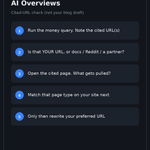
the coupon code check:
1. ask Google and ChatGPT "[your store] coupon code"
2. write down every code shown and test each one at checkout
3. if you sell on Google, list your live codes as Merchant Center promotions, each with an end date
affiliate coupon sites have it harder. as Metehan put it, their model is the click.
what code does ChatGPT show for your store?
1
4
234
Microsoft confirmed it on Nov 19: ads now show next to AI Overviews on Bing, in all markets except China.
no new campaign needed. Microsoft says they run through campaigns advertisers already have, including Performance Max and AI Max.
so on Bing, being cited in the AI Overview can now mean sharing that space with a paid ad.
the Bing AI Overview check:
1. search your 5 best Bing queries
2. note which show an AI Overview, if you're cited, and if an ad sits next to it
3. date the note Nov 19, so a later shift in Bing clicks has context
do you track Bing at all?
6
4
158
an SEO deleted a batch of a client's blog posts. Google AI impressions fell 62%. organic clicks went up 14%.
it's Luca Tagliaferro's case study on Search Engine Land (Nov 19), a London car hire client. his client, not mine, and he says he can't claim the removal caused the rise. other changes ran too, and clicks move with the season.
the part worth stealing: the blog got 87% of the site's AI impressions at a 0.45% organic CTR. the service pages ran at 2.1%.
my take: AI impressions measure exposure. they don't tell you which pages to keep.
the exposure vs clicks check:
1. Search Console, Generative AI performance report, Pages tab
2. Performance report, same pages, same dates
3. sort by AI impressions and check each top page's clicks and conversions before you keep, cut or rewrite it
Rank Season, my free monday SEO newsletter, hasn't sent issue one yet. sign up before it does and you get access to a link trading community. link in bio.
which page gets your most AI impressions?
3
6
268
most SEOs drop a video into a blog post and expect a video result. Search Console has a status for why that fails.
Video indexing report, reason: "Video isn't on a watch page". per Google's help, only videos on a watch page can be indexed, meaning a page whose main purpose is one video. a blog post where the video backs up the text doesn't count. neither does a product page with a video.
the watch page check:
1. open Video indexing and click "Video isn't on a watch page"
2. pick the videos you actually want found in search
3. give each one its own page with the video near the top, then link to it from the post
one more catch from the same page: Google indexes at most one video per page.
how many of your videos sit in that status?
41%. that's how many of its cited domains ChatGPT repeated when the same prompt ran twice in one day.
it's from Muck Rack's October "What Is AI Reading?" report (Oct 28). Gemini repeated 45%, Perplexity 94%. their line: one answer isn't a measurement.
this is their public study, not my data.
the two run check, before you report AI visibility:
1. run each prompt at least twice on the same day, in a fresh chat
2. count a domain as cited only if it shows up in both runs
3. report each AI separately. a 41% repeat rate and a 94% one shouldn't share a number
my take: a tracker that runs each ChatGPT prompt once a week can't tell a real drop from a reroll.
how many runs per prompt does your tracker do?
1
3
121
does AI name you, or just link you? in Kevin Indig's study with Semrush, 61.7% of AI domain appearances were citations with no brand mention. run your top prompt. named?
3
1
233
most SEOs read Search Console on typed searches only. it already splits out searches made with a photo.
Performance, Search type, "Web: multimodal". per Google's help that's Lens, Circle to Search, uploaded images and Chrome image search, kept apart from text-based.
and Google keeps adding image doors. today Barry Schwartz covered a Lens button in Google Images that opens an AI Overview or AI Mode follow-up (spotted by Damien Andell).
the photo search check:
1. Performance, Search type, pick Web: multimodal
2. open Pages, sort by clicks
3. keep the page filter, switch to Web: text-based and compare
catch: there's no Queries tab for it. Google says these searches mostly use images, so no query text.
my take: pages that win here are getting found by their photos. don't swap those for stock shots in a redesign.
which page tops your multimodal clicks?
1
3
176
ranking first got the domain cited in the AI Overview about 7 times in 10. pharma brand sites still got under half the citations their top spots would suggest.
performance.io and Semrush tracked 14,300+ US desktop pharma keywords from Aug 2022 to Jul 2026 (announced Nov 16):
- when an AI Overview showed, the domain ranking first was cited 68.8% of the time
- 83.8% of citations went to domains ranking in the top 10
- pharma brand sites held 9.2% of first place rankings but got 4.2% of AI Overview citations
their public study, not my data. they call it association, not cause, and they matched citations by domain, not URL.
my take: a rank report can't tell you if you're the source in the answer sitting above your link.
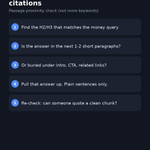
the citation gap check:
1. list 10 queries where you rank 1 to 3
2. search each one and note if an AI Overview shows and which sites it cites
3. where you rank but aren't cited, open the cited pages and find the question they answer that yours doesn't
how many of your top 3 rankings get you cited?
2
3
154
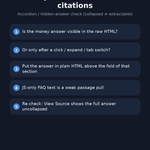
hiding your prices doesn't keep them out of AI answers. it hands the answer to someone else's page.
Kevin Indig and Siteline (David Kaufman) sent Claude agents to find pricing, integrations and security info for 100 B2B products, 5 runs per task. pricing is where they broke:
- pricing got answered from the vendor's own site 79% of the time, vs 93% for integrations and 92% for security
- no real price on the page: 45% of runs cited at least one third-party source
- a numeric price on the page: still 18%
- in pricing runs that hit an access error, fallback to other sites jumped to 77%, vs 17% without one
those third-party pages were mostly blogs and directories like G2, Capterra and Vendr.
their public study, not my data, and it's agent tests, not real buyers. Kevin's Q4 AI search meta-analysis on Search Engine Land (Nov 18) leans on it.
the pricing page check:
1. ask ChatGPT or Claude "find all pricing and plans for [your product]"
2. note which sites it cites. a directory showing your old prices is the real problem
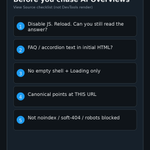
3. load your pricing page with JavaScript off. if the prices disappear, put them in the HTML as plain text
which site does AI quote for your prices?
Rank Season is a free SEO newsletter I'm putting together, out every monday once it launches. the first issue is still in the works, and people who join now get into a link trading community. link in bio
7
10
372
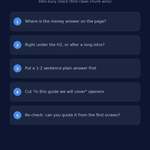
every page ChatGPT cited was one its own search had pulled first. that's the finding I'd build an AI visibility plan around.
two University of Toronto researchers (Mahe Chen, Nick Koudas, arXiv, Oct 2026) studied 158,099 AI answers to commercial questions, with 468,037 citations.
what they found:
- what ChatGPT's own search retrieved explained 32% of the citation differences between pages of a site. page properties explained 2.8%
- it rewrites the question into new sub-queries on every answer, and those rarely match Google's or Bing's results
- within one site, pages whose title and paragraphs match the questions people ask got cited more. FAQ blocks, schema, summary boxes and page speed only looked like they worked when comparing different sites
their public study, not my data.
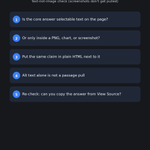
the question match check:
1. write down 5 questions a buyer asks before choosing you
2. find the page that should answer each one
3. read its title and first paragraph. if they don't answer the question in plain words, rewrite those before you add another FAQ block
my take: schema isn't useless, it just isn't what moved citations in this paper.
which of your pages answers its question in the title?
3
3
139
moving a hit site to a new domain for a fresh start? John Mueller: "A site move doesn't improve the site's overall quality." fix the pages first. what's pushing you to move?
1
1
63
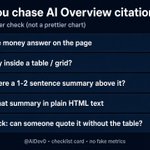
link count is the weakest number in most link reports, at least for showing up in AI Overviews.
Ahrefs studied 75K brands (May 2025) and checked what tracks with how often AI Overviews mention a brand:
- brand web mentions: 0.664
- brand anchors (your name in the link text): 0.527
- referring domains: 0.295
- number of backlinks: 0.218
that's their public study, not my data. it's correlation too, and big brands have more of everything.
my take: if your link report leads with count, it's grading the weakest signal on that list. the anchor is the cheap part to fix.
the brand anchor check:
1. Search Console > Links > Top linking text
2. count how many of the top 20 contain your brand name
3. on your next 5 placements, ask for your brand name plus the topic in the anchor, not "click here"
it's a sample, not every link, but it's free and it's Google's own list.
how many of your top 20 anchors say your brand?
8
6
324
$28 million in ransomware payments, and the way in was SEO.
the FBI's Nov 16 FLASH on Gootloader: as of October 2026 it found over 1,000 infected WordPress sites and 216 domains run by the Gootloader admin, linked to over $28 million in ransomware payments.
two details site owners miss:
- it went after low-competition phrases, like a jurisdiction-specific contract clause, so a lure page could rank without beating anyone big
- it filtered visitors by country, referrer, cookie or IP. so whoever checks the site may never see the bad pages
the hacked page check, today:
1. Search Console > Security issues. if Google found something, it shows there
2. search site:yourdomain with words you never publish about, like contract, agreement or template
3. per the FBI, the admin scanned WordPress sites for xmlrpc.php. if nothing you run needs XML-RPC, turn it off
ever found pages on your site you didn't publish?
5
6
235
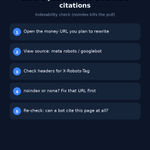
AI Overview citations just got easier to see on Google. for now.
Brodie Clark spotted it on Nov 17: AI Overviews now show three citation cards by default, with no fade on the lower ones, so the third source is fully visible without opening the overview. last month he reported the cards gone from desktop completely. Barry Schwartz at Search Engine Roundtable also saw a "Show all" button being tested.
no Google announcement that I can find, and these cards have flipped back and forth for months. treat it as a test you can measure, not a win.
the citation date check:
1. add a Search Console annotation on Nov 17
2. list 10 queries where you've seen an AI Overview cite you
3. compare their CTR for the 14 days before and after, same weekdays, Web search type (Google counts AI Overview traffic there)
4. CTR up with flat position: the visible card is a likely reason, not a proven one. CTR back down later: check the layout again before you blame content
do you know which of your queries show you as a citation?
if you want layout changes like this checked before you act on them, Rank Season is a free SEO newsletter that lands every monday. it isn't live yet, and early subscribers get into a link trading community. link in bio
6
8
310