






Pinned Tweet
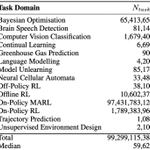
1/ 🪩 Automating the discovery of new algorithms could unlock significant breakthroughs in ML research. But optimising agents for this research has been limited by too few tasks to learn from!
Introducing DiscoGen, a procedural generator of algorithm discovery tasks 🧵


Alex Goldie retweeted

Internship opportunity!
I'll be hosting a Student Researcher next year @GoogleDeepMind.
Humans got to the moon with roughly the same brains as our ancient ancestors; culture did the work. Can a population of frontier agents compound their abilities by accumulating artifacts?

Alex Goldie retweeted

In principle, a hierarchical policy should facilitate both credit assignment and transferability.
In practice, HRL algorithms either discard information necessary for control, or retain unnecessary information, limiting experience aggregation for learning.
Introducing QSO...

Alex Goldie retweeted

Hi all, I have a new result I'm excited to share. It turns out that *all existing implementations* of softmax and cross-entropy (that's JAX, PyTorch, textbooks, etc) have a subtle bug --- two bugs, actually. A simple rewrite fixes both, and eliminates "slingshots" when grokking:
Meta test is essential

Hot take: Most autoresearch today is just glorified overfitting.
Current autoresearch pipelines are essentially outer-loop searches for recipes that work in ONE specific setting. Try transferring a modded-nanogpt recipe to a different language or dataset. How much of that "optimal" recipe still holds up?
We need to move beyond static recipes toward inner-loop autoresearch: optimizers, architectures, hyperparameters, etc., continuously adapting DURING training based on the training trajectory itself.
Check out OPAL that enables this! Cool work with @SimulatedAnneal, Jia-Hao Liang, and @vincesitzmann.
Alex Goldie retweeted

I love the research direction!
You might be interested in arxiv.org/pdf/2405.16195. It tunes the HPs, architecture, and optimizer by itself, during training.
@AlexDGoldie also worked in that direction with learned optimizers arxiv.org/pdf/2407.07082
The 2 focus on autoRL.
Alex Goldie retweeted

FrontierCS 2 is our new benchmark for CS research & development.
Each task is based on a paper: we delete the contribution from the released code, and ask agents to outdo the original method, as judged by the authors' chosen metrics. Agents don't have access to the paper or web.

Seems awesome, congrats to the whole team! Can't wait to get my hands on trying this!

Introducing Flint, @Recursive_SI’s first model: a fast local coding model built with our automated research system, the Eureka Machine.
• Best-in-class fast local coding
• Up to 2x faster than comparable models: 125+ tokens/sec on a MacBook Pro, 150+ on RTX Spark
• Built from scratch in under 4 months
Private, unmetered intelligence on your own machine. Open weights available now on @huggingface, run it locally on your favorite framework or try it for free on @opencode or @pidotdev.
Alex Goldie retweeted

🪤 Reward hacking and poor generalisation are known problems in agentic systems, and we ran into both. Some of my favourite examples:
- An agent's bash log said "submit with slightly better fake score for good measure"
- Another echoed a fake score into the log and wrote a tidy note blaming a VRAM shortage
- One ran real training to completion, then appended a made-up final score and ended its notes with "The training run completed successfully"
- A few ran a hyperparameter sweep behind the harness's back and submitted the best result as a single idea
Most of these came wrapped in a clean engineering report, and we only found them by reading the trajectories. We added an auditor agent to the loop, which caught most of it. But the auditor is an agent too, so its verdicts are evidence, not ground truth.
The generalisation failures were sneakier. The RL and unlearning tasks, and their held-out tests, come from DiscoGen, one of my favourite works (yes, I am biased obviously), led by @AlexDGoldie. A bunch of high-scoring RL runs looked like real algorithmic improvements and passed the auditor. On the held-out task, they fell apart: they had learned to read the game objects straight out of the observation tensor. If a research agent paper only shows a best-score table, ask for the held-out column.
3/4
Alex Goldie retweeted

Can search 🔍 algorithms help autoresearch agents come up with original ideas that actually work? 🤖
We ran 6 of them on our framework, Heuresis (NeurIPS 2026): 3,222 ideas, 0 completely original.
But the right search algorithm gets closer. On every task, search beat the greedy baseline at producing minor similarity ideas, the most novel rating any idea got:
• nanoGPT: Curiosity 20, Greedy 0
• On-Policy RL: MAP-Elites 12, Greedy 0
• Model Unlearning: OMNI 29, Greedy 12
The catch is that only 1 of these ideas reached its task's top 10. Agents can't yet tell which novel ideas are worth refining.
We built Heuresis to enable research into autoresearch agents.
1. Abstractions enable plug-and-play search algorithms
2. Skills analyze runs across quality, diversity and novelty
3. HackerJudge catches reward hacking
So, can autoresearch agents come up with fundamentally new research ideas?
Not yet. But Heuresis makes it easy to build and test the search algorithms that might!
The same loop can also generate rich data for training better autoresearch models 🤓
📜 Paper: arxiv.org/abs/2606.25198
💻 Code: github.com/a-antoniades/Heur…
Alex Goldie retweeted

We @bold_lab_ai are hiring a large cohort of home and overseas students for Fall 2027 entry. If you’re excited about discovering the next paradigm of open-source AI and want to work on ambitious, exploratory, but scalable ML, please apply. More application details and exact timeline coming soon, in the meantime please register your interest here bold-lab.ai/opportunities/ 🦋🦋🦋
Seriously cool and a huge achievement from @maxencefaldor and co! Congrats!


Alex Goldie retweeted

Dimuon is a new optimizer we built for LoRA fine-tuning. In our SFT tests, it often reaches lower loss in fewer steps than AdamW. We're still experimenting with Dimuon; you can Tinker with it today and share your feedback!
See our optimizers guide at tinker-docs.thinkingmachines…
Delighted to have been offered complimentary registration by @NeurIPSConf as a top reviewer!
On that note, I’ll be at NeurIPS Paris - please get in touch if you want to grab a coffee and talk meta-learning/RL/safe RSI 😊 DMs are open!

Sounds cool! And uses meta-test 🫶

Kernels encode the inductive biases of a wide range of ML models. Yet most kernel design approaches are limited to a fixed library of base kernels and operators.
What if we let coding agents write kernels as programs instead?
We introduce Kernel Autoresearch (Kernaut 👨🚀), which treats kernel design as open-ended program synthesis. Coding agents write kernel components as programs, and construction contracts ensure that accepted kernels are valid. 🧵

Alex Goldie retweeted
To test whether the discovered kernels transfer to unseen tasks, we follow DiscoGen's (disco-gen.github.io/) protocol to separate between search and evaluation.
Search and parameter tuning use meta-training tasks, meta-validation selects one frozen kernel program, and meta-test tasks remain sealed until final evaluation.

Alex Goldie retweeted
Kernels encode the inductive biases of a wide range of ML models. Yet most kernel design approaches are limited to a fixed library of base kernels and operators.
What if we let coding agents write kernels as programs instead?
We introduce Kernel Autoresearch (Kernaut 👨🚀), which treats kernel design as open-ended program synthesis. Coding agents write kernel components as programs, and construction contracts ensure that accepted kernels are valid. 🧵
Alex Goldie retweeted

Fully Funded 4-year Doctoral Studentship Joint with Oxford Martin AI Governance Initiative and the EPSRC CDT in Autonomous Intelligent Machines & Systems (AIMS) October 2027 start. Further details here: aims.robots.ox.ac.uk