

Right above the Moon 🌕!
Moon 🌕
Joined August 2025
- Tweets26K
- Following5K
- Followers1.4K
- Likes33.2K






Pinned Tweet
The curvature correction of a steep power-law wall
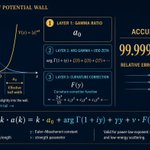
For a quantum particle confined by a steep wall V(x) = |x|^N, the reflection phase is known to leading order: the wall behaves like an exponential wall, with phase arg Γ(1+iy), where y = 2νka₀ and ν = 1/(N+2).
New result: the first correction beyond the exponential limit, caused by the wall's curvature, has the closed form
F(y) = y·[ (Re ψ(1+iy) + γ)² + ½·Re ψ′(1+iy) − π²/12 ]
where ψ is the digamma function. The full phase becomes
k·a(k) = k·a₀ + arg Γ(1+iy) + γy + ν·F(y) + O(ν²)
At low energy, F(y) = −(3/2)ζ(4)·y³ + [(5/2)ζ(6) + ζ(3)²]·y⁵ + …, which gives the energy-correction constant −2π⁴/15.
It is derived by perturbing the exponential wall with the linear ramp that appears under x = eᵘ, including the wave's amplitude change, and it matches exact numerics at 13 energies to 1.5×10⁻⁵. For N = π⁴, the ground-state energy is predicted with 99.9999962% accuracy.
— Ali Almuznai, independent researcher
Not yet peer-reviewed;
feedback
#QuantumMechanics #PowerLawPotential #MathematicalPhysics #DigammaFunction #ReflectionPhase #SteepWall #IndependentResearch #AliAlmuznai #GammaFunction #EnergyCorrection #π⁴Wall #QuantumCorrections #ExactAsymptotics #TheoreticalPhysics

MBS | Ali 🧭. retweeted
The curvature correction of a steep power-law wall
For a quantum particle confined by a steep wall V(x) = |x|^N, the reflection phase is known to leading order: the wall behaves like an exponential wall, with phase arg Γ(1+iy), where y = 2νka₀ and ν = 1/(N+2).
New result: the first correction beyond the exponential limit, caused by the wall's curvature, has the closed form
F(y) = y·[ (Re ψ(1+iy) + γ)² + ½·Re ψ′(1+iy) − π²/12 ]
where ψ is the digamma function. The full phase becomes
k·a(k) = k·a₀ + arg Γ(1+iy) + γy + ν·F(y) + O(ν²)
At low energy, F(y) = −(3/2)ζ(4)·y³ + [(5/2)ζ(6) + ζ(3)²]·y⁵ + …, which gives the energy-correction constant −2π⁴/15.
It is derived by perturbing the exponential wall with the linear ramp that appears under x = eᵘ, including the wave's amplitude change, and it matches exact numerics at 13 energies to 1.5×10⁻⁵. For N = π⁴, the ground-state energy is predicted with 99.9999962% accuracy.
— Ali Almuznai, independent researcher
Not yet peer-reviewed;
feedback
#QuantumMechanics #PowerLawPotential #MathematicalPhysics #DigammaFunction #ReflectionPhase #SteepWall #IndependentResearch #AliAlmuznai #GammaFunction #EnergyCorrection #π⁴Wall #QuantumCorrections #ExactAsymptotics #TheoreticalPhysics


MBS | Ali 🧭. retweeted
zenodo.org/records/24409271
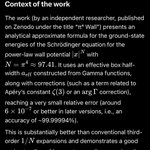
The π⁴ Wall: a steep power-law barrier (N = π⁴ ≈ 97.41) behaves almost like a perfect hard wall, described by a three-layer closed formula.
In QM: (1) the exact zero-energy Bessel solution gives an effective half-width a₀ ≈ 1.08428; (2) all odd zeta values sum to an exponential-wall phase arg Γ(1+iy); (3) a new curvature correction F(y), derived in closed form with digamma functions, starts with −2π⁴/15. Together they predict the ground state E₁ ≈ 2.098692 with 99.9999962% accuracy. Layers 1 and 2 match known soft-wall and exponential-mirror results; layer 3 appears new.
In gravity: a regular black hole with a de Sitter core and a Reissner–Nordström exterior, whose wall collapses to one number I∞ ≈ 1.33266, giving closed-form horizons and A_crit ≈ 2.252.
Toy models showing how soft walls reduce to a few numbers.
MBS | Ali 🧭. retweeted
zenodo.org/records/24409037
From a simple hunch to a closed formula: a steep quantum wall with exponent π⁴ (N ≈ 97.41) is captured by three clear layers.
1. Effective width a₀ ≈ 1.0843 from a Gamma-function ratio (the wall behaves like a box 8.4% wider)
2. arg Γ(1+iy) that unveils the ladder of odd zeta values ζ(3), ζ(5)…
3. Curvature correction F(y) whose leading term is −2π⁴/15
The full formula predicts the ground-state energy with 99.9999962% accuracy (~4 parts in 100 million). Roughly 940× better than the third-order 1/N series. The new piece is F(y).
#Pi4Wall #QuantumWall #ZetaFunction #MathematicalPhysics #ClosedForm #QuantumMechanics #IndependentResearch #PhysicsDiscovery


