
Ecosystem scientist
Queensland, Australia
Joined March 2012
- Tweets770
- Following299
- Followers292
- Likes2.6K




Alison Specht retweeted

Major milestone for #OpenData metrics: Digital Science & Make Data Count have released an open collection of connections between research data & papers.
Powered by @DSDimensions, the new resource offers a shared foundation for understanding how data is reused.
🔗 bit.ly/4yLmg4N

Alison Specht retweeted

📢 PhD opportunity at Monash University, Melbourne, Australia
🦋 We are looking for a motivated domestic/international PhD student to work on citizen science and insect conservation. Please share!
🌐 shawanchowdhurylab.com/
#PhD #Ecology #Conservation #CitizenScience #Insects
🤖 Made with AI

Alison Specht retweeted

Scientists studying ecological drought can now access the world's first globally-harmonized environmental datasets, thanks to a major milestone achieved by the Global Ecosystem Research Infrastructure (GERI). Access the datasets: buff.ly/CNjOzBB.

Alison Specht retweeted

A Norwegian neuroscientist spent 20 years proving that the act of writing by hand changes the human brain in ways typing physically cannot, and almost nobody outside her field has read the paper.
Her name is Audrey van der Meer.
She runs a brain research lab in Trondheim, and the paper that closed the argument was published in 2024 in a journal called Frontiers in Psychology. The finding is brutal enough that it should have changed every classroom on Earth.
The experiment was simple. She recruited 36 university students and put each one in a cap with 256 sensors pressed against their scalp to record brain activity. Words flashed on a screen one at a time.
Sometimes the students wrote the word by hand on a touchscreen using a digital pen, and sometimes they typed the same word on a keyboard. Every neural response was recorded for the full five seconds the word stayed on screen.
Then her team looked at the part of the data most researchers had ignored for years, which is how different parts of the brain were communicating with each other during the task.
When the students wrote by hand, the brain lit up everywhere at once.
The regions responsible for memory, sensory integration, and the encoding of new information were all firing together in a coordinated pattern that spread across the entire cortex. The whole network was awake and connected.
When the same students typed the same word, that pattern collapsed almost completely.
Most of the brain went quiet, and the connections between regions that had been alive seconds earlier were nowhere to be found on the EEG.
Same word, same brain, same person, and two completely different neurological events.
The reason turned out to be something nobody had really paid attention to before her work. Writing by hand is not one motion but a sequence of thousands of tiny micro-movements coordinated with your eyes in real time, where each letter is a different shape that requires the brain to solve a slightly different spatial problem.
Your fingers, wrist, vision, and the parts of your brain that track position in space are all working together to produce one letter, then the next, then the next.
Typing throws all of that away. Every key on a keyboard requires the exact same finger motion regardless of which letter you are pressing, which means the brain has almost nothing to integrate and almost no problem to solve.
Van der Meer said it plainly in her interviews.
Pressing the same key with the same finger over and over does not stimulate the brain in any meaningful way, and she pointed out something that should scare every parent who handed their kid an iPad.
Children who learn to read and write on tablets often cannot tell letters like b and d apart, because they have never physically felt with their bodies what it takes to actually produce those letters on a page.
A decade before her, two researchers at Princeton ran the same fight using a completely different method and ended up at the same answer. Pam Mueller and Daniel Oppenheimer tested 327 students across three experiments, where half took notes on laptops with the internet disabled and half took notes by hand, before testing everyone on what they actually understood from the lectures they had watched.
The handwriting group won by a wide margin on every question that required real understanding rather than surface recall.
The reason was hiding in the transcripts of what the two groups had actually written down.
The laptop students typed almost word for word, capturing more total content but processing almost none of it as they went, while the handwriting students physically could not write fast enough to transcribe a lecture in real time, which forced them to listen carefully, decide what actually mattered, and put it in their own words on the page.
That single act of choosing what to keep was the learning itself, and the keyboard had quietly skipped the choosing and skipped the learning along with it.
Two studies. Two countries. Same answer.
Handwriting makes the brain work. Typing lets it coast.
Every note you have ever typed instead of written went into your brain through a thinner pipe. Every meeting, every book highlight, every idea you captured on your phone instead of on paper was processed at half depth.
You did not forget those things because your memory is bad. You forgot them because typing never woke the part of the brain that would have made them stick.
The fix is the thing your grandmother already knew.
Pick up a pen. Write the thing down. The slower road is the faster one.

Alison Specht retweeted

📢 ILTER invites proposals to showcase the network’s collaboration and scientific importance. Projects should deliver a simple, standardised, ecologically meaningful dataset and encourage wide participation across ILTER sites.
Learn more: ilter.network/latest/call-fo…

Alison Specht retweeted

🔥 Join us Monday, Dec 8 for a free public talk with NCEAS researcher Cat Fong on the Wildfire Resilience Index, a new tool turning complex data into meaningful insight.
📍 Dargan’s, SB
🕡 6:30–8:00 PM
No ticket needed—arrive early!
More info: sbnature.org/calendar
Some excellent thought-provoking discussion to which all participants can contribute! Ownership of the process and desired outcomes!

🛰️ Join our hybrid event, co-hosted by TERN & @qcifltd at @IntDataWeek in Brisbane.
🗓️ 17 October 2025
Engage with global experts to explore crucial strategies for managing digital objects aligned with Sustainable Development Goals.
Sign up: buff.ly/n0CiE4a
#IDW2025

1
24
Alison Specht retweeted

Connect face-to-face with the global data and research community. Collaborate, share insights, and explore what’s next—live and on site.
We can’t wait to see you there
👉 idw2025.org/registration/
#DataPositiveChange #SciDataCon25 #RDAPlenary

Alison Specht retweeted

Join the #BelmontForum at #SRI2025! We're hosting sessions on transdisciplinary research, a type of science that brings together academia and the community to tackle global challenges. Register now and join the conversation. Come meet us in person at SRI 2025!
#ScienceForSociety


Alison Specht retweeted
How can you make the most out of the DataONE Network?
Join the DataONE Community Call on June 4 at 9 AM PT to hear what the network updates. Whether you're new or a long time contributor, you’re invited to connect and ask questions!
📌 Add to calendar: bit.ly/DataONECalendar

Alison Specht retweeted

The @SRIcongress lands in Chicago next month, where scientists, policy leaders, and innovators will exchange bold ideas, form global partnerships, and build pathways to real-world solutions. 🌍
🖐We've got five great reasons for you to attend SRI2025: ow.ly/pxMZ50VNeI4

ALT SRI2025 Sustainability Research and Innovation University of Illinois System
This will be an amazing conference, highly recommended! @Belmont_Forum @ShelleyStall

This year’s event features a dynamic lineup of bold thinkers and transformative change-makers, all focused on exploring pathways to sustainability and real-world solutions to our planet's most urgent challenges.


4
25
Alison Specht retweeted
📢 Calling all ecosystem #researchers! Abstract submissions are open for the TERN 2025 Science Symposium.
This forum is for sharing ecosystem #science research, technological development, #data system innovation, collaboration & action.
Learn more: tern.org.au/science-symposiu…



A novel scheme for rights management in data preservation and sharing. #openaccess article with @CODATANews doi.org/10.5334/dsj-2025-001 @PizzigattiPedro @kimpob742 @obrienmobb @mic_mw @smayuraguru @ShelleyStall @TERN_Aus
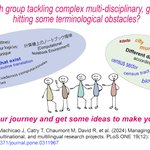
#PLOSONE: Managing linguistic obstacles in multidisciplinary, multinational, and multilingual research projec ... dx.plos.org/10.1371/journal.…
1
2
49

Alison Specht retweeted

### NEW FUNDING OPPORTUNITY ###
Global Joint Synthesis Call
"𝗜𝗻𝘁𝗲𝗿𝗮𝗰𝘁𝗶𝗼𝗻𝘀 𝗯𝗲𝘁𝘄𝗲𝗲𝗻 𝗕𝗶𝗼𝗱𝗶𝘃𝗲𝗿𝘀𝗶𝘁𝘆 𝗮𝗻𝗱 𝗖𝗹𝗶𝗺𝗮𝘁𝗲 𝗖𝗵𝗮𝗻𝗴𝗲"
➡️ Working groups
➡️ Postdocs
@several synthesis centres/initiatives🔥❤️😍
PLEASE RT!
idiv.de/research/sdiv/calls/
Alison Specht retweeted

Curious about the massive #extinction of #megafauna - eg #mammoth, #mastodon, #sabercats & #sloths - in recent #prehistory, as we show in a new synthesis, the pattern is strongly coupled to Homo sapiens & w/out any consistent link to #climatechange cambridge.org/core/journals/… 🦣🐘🦣
