

Agribusiness - development & commercial experience /middle path /big picture/ hiking/photography
New Delhi
Joined July 2009
- Tweets8.2K
- Following692
- Followers597
- Likes17.8K









My recent experience on "Economics of being a tenant farmer in India"
linkedin.com/pulse/economics…
#nitiaayog #farming
@WorldBankGroup
@AgriGoI @FAO @FAOeagriculture @FAOKnowledge
Birdwatching and Farming....the nuances
lnkd.in/p/geAZqaXv
21

Aleen Mukherjee retweeted

Folks! Exciting new opportunities in the IUCN SSC Chair’s office are open. Pl apply to drive.google.com/drive/folde… Location: anywhere in the world, Applications open for a month; hiring annually through a consultancy agreement but renewable through quadrennium 2026-29 @IUCNssc


Aleen Mukherjee retweeted

@aparanjape you can bring this to life....
Vigyan Nayak Maah” (Science Heroes Month)
The aim is to make scientists as visible and celebrated as cricketers and film stars.
We already have National Science Day on 28 Feb (C.V. Raman). Run the month from 29 Jan to 28 Feb so it builds up to that day.
30 Heroes, 1 per day: a balanced mix of
Vedic Science (Aryabhata, Sushruta)
modern (Raman, Ramanujan, J.C. Bose, Bhabha, Sarabhai, Kalam)
women (Janaki Ammal, Asima Chatterjee, Kamala Sohonie)
living teams (Chandrayaan, vaccine scientists)
Visibility everywhere: posters at railway stations, metros, bus stops, schools, petrol pumps and post offices. Add stamps and a daily hero on the front page of partner newspapers.
The daily story: each day gets 1 scientist, 1 discovery and 1 “why” question. It runs as a 60-second video, a radio spot and a school assembly read-out in 12+ languages.
Mass participation: home experiments, “Ask Why” contests, scientists visiting schools, and village science melas.
Cricketers and actors narrate the stories, Doordarshan and AIR carry daily slots, a hashtag runs on social media, and CSR partners sponsor posters and prizes.

This prize is quite a big deal in Physics! See the earlier winners.
Sadly, not seeing too much coverage about this mainstream media.
Barring a few exceptions, Indian media generally does a poor job of science and tech coverage (beyond the headlines), happening in our top research and education institutions.
The Bengali Durga Pujo is on another level. This elderly lady danced to drum beats fr almost 40mins...phew...
#DurgaPujaFestival2026
#DurgaPuja #Navaratri2026 #FestiveVibes #festival


1
94

Aleen Mukherjee retweeted

"13 crore names" is the number every TV debate on the Election Commission's SIR now starts from.
You get media to repeat that number ten times and it becomes the fact. Almost nobody has asked what is inside it...
@TheJaggi breaks it down. What the 13 crore actually contains:
- 2.8 crore listed as dead
- 6.3 crore flagged as possible permanent migrants
- 1 crore duplicate registrations
- ~3 crore simply absent from home when enumerators called
- Every one of these can be restored on appeal (except the dead..)
These numbers - the scale of them - is UNREMARKABLE at India's scale:
- Up to 1 crore Indians die every year
- The last SIR was 2002-04
- at least 10-12 crore voters have died since
- and most never came off the rolls (nobody files a deletion for the dead)
How about migrants?
- India's internal migrant population is around 45 crore
- 6.3 crore flagged as migrated is a fraction of that
- Wrongful deletions are probably under 50 lakh nationally
- half of one percent of a roll approaching 100 crore
The two mind traps doing the work:
FIRST
- Anchoring: the first big number sticks.
- Vinod Rai's Rs 1.76 lakh crore "presumptive loss" on 2008 telecom licences came with three lower estimates
-only the biggest survived
SECOND
- Loss aversion: a voter who fears deletion shouts louder than the 99% who were never touched
- Result: "millions and millions" disenfranchised (Justice Ujjal Bhuyan at Nalsar) and "90 lakh knocked out in Bengal to help the BJP" (Rohinton Nariman)
- neither claim came with a denominator
It's not like EC is all OK, they've also goofed up but not that badly:
- It never stress-tested its process for a country where every gross number is huge
- A once-in-two-decades purge was always going to throw up figures this size
- roll-cleaning has to be continuous
- The appeals route for wrongful exclusion has to be stronger than it is now
(Link below)

Beyond the Ritual, there is a Feeling!!
#navaratri #durga #durgapujaspecial❤️ #durgapuja #nationalgeographic #natgeoyourshot #natgeoindia


35
Aleen Mukherjee retweeted

The Capital Stack that will fund Regenerative Transition in Indian smallholding agriculture is a three storied building.

Nice read.
I will take liberty to add- main pivots on which Green Revolution delivered for India. One is Procurement the other is Bhakra...
What it means that if there is no assured offtake and main resouce/s for the change required is not there, the change is tough..

The Green Revolution full stack had public research + extension + irrigation + rural credit + input subsidies + procurement + MSP + markets. What would a regenerative revolution full stack look like?
Green Revolution did not succeed merely because scientists developed high-yielding varieties of wheat and rice. It succeeded because an entire enabling institutional and financial stack were constructed around those varieties: irrigation, fertiliser subsidies, agricultural universities, public extension, rural credit, procurement, Minimum Support Prices, regulated markets, storage and food distribution.
Financial system underpinning these work as a symphony.
Banks provide crop loans. Governments subsidise fertilizers and electricity. Public institutions finance irrigation. VC funds agri-tech startups. Agriculture Infrastructure Fund (AIF) finances warehouses, processing facilities and community farming assets.
Today, we are attempting to build an alternative with no clear view of the bigger picture. It has become norm to talk about it without necessarily going through the messy path of making it work.
When a farmer wants to regenerate her soil, reduce dependence on external inputs, diversify her crops and restore the ecological relationships within her farm, we have nothing to offer beyond a training programme, a paltry subsidy amount in few select states and a promise of premium prices three years down the line.
The farmer must continue to feed her family. Her children must go to school. The moneylender must be repaid. The crop must reach the market. The soil may take years to regenerate. Her creditors expect repayment much sooner.
The Capital Stack that will fund Regenerative Transition in Indian smallholding agriculture is a four storeyed building
On the ground floor are grants and public subsidies.
They finance activities whose benefits are widely distributed and whose commercial returns are insufficient or uncertain. These are investments in productive ecological and social infrastructure.
The first floor is catalytic capital, which absorbs risks that conventional lenders are unwilling to carry.
A farmer transitioning from a familiar production system faces yield uncertainty, changing labour requirements and unfamiliar market conditions. A guarantee, income-protection mechanism or appropriately designed concessional loan can make experimentation financially tolerable.
The second floor is is patient equity and blended capital.
This is where regenerative agripreneurs enter the picture. A bio-resource centre, regenerative input company, farmer-service enterprise or differentiated food brand may eventually become commercially viable, but it requires time to develop products, capabilities, customers and reliable revenues.
Third Floor is commercial capital.
Once an enterprise generates predictable cash flows, ordinary bank lending, supply-chain finance and market-rate investment can support its growth.
Would this work?

Aleen Mukherjee retweeted

Vulture Count 2026 — final call
Lists and counts have been coming in since 1 Sept, but more checklists are needed in the green "Opportunity States", below.
If you know birders in the green regions, please ask them to take part.
birdcount.in/event/wwf-india…
Help spread the word!

Aleen Mukherjee retweeted

🙏🇮🇳 I’m an Australian 🦘 maths historian and I’m tired of watching the West take the applause for ideas India already had.
Baudhāyana before Pythagoras.
Āryabhaṭa before Galileo.
Brahmagupta before the West even accepted zero as a number.
Madhava before Newton.
Pingala before Fibonacci.
Ramanujan etc.
Yet still the textbooks bow to Europe first.
India’s gurus and rishis were not a footnote. Their ideas were copied, thinned out, renamed, and then sold back to Indian children as “Western maths.”
So I’m asking Indians directly:
If you could attend a talk by any 🇮🇳 Indian mathematician, living or historical, who I’ve mentioned on my X, who would you choose and why?
Reply with the name.
Tag a student, a teacher, or a parent who still thinks maths began in Greece.
If this history was hidden from you in school, this post is for you.
RT so the next generation hears the real names first.
Jai Hind.
@jcrabtree

Aleen Mukherjee retweeted
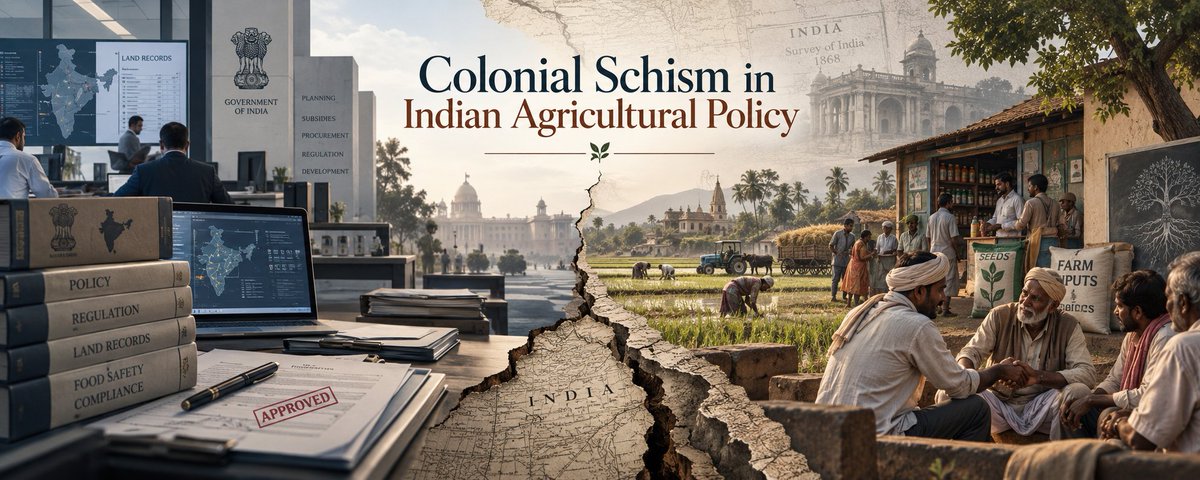
How premature imitation keeps widening the gap between the agriculture India regulates and the agriculture that feeds India
Q-Why do we worship heroes more than we value heroism?
In Public life, we often turn people into icons and then defend the icon instead of debating the ideas, actions and values.
Is hero worship a celebration of excellence, or does it sometimes prevent us from crtical thinking
36
Aleen Mukherjee retweeted

A truck fills 300 litres of diesel. The driver pays ₹30,924. The pump owner earns an estimated ₹782 in gross commission.
If UPI attracts 0.4% MDR + GST, ₹146 disappears. His margin shrinks by 18.66%.
Will he absorb the hit, or pass it to the customer, or ask for cash. Why would the trucker pay extra when cash costs nothing?
The same applies to the customer of the trucking company. Their transporation costs will go up by neary 0.5%. If they are buying goods with razor thin margin and tough competition, will they use cash or use UPI to pay each other?
That's how Cash will make its way back to the economy.

Aleen Mukherjee retweeted

India's top three banks made a profit of Rs 2.24 lakh crore in 2026-27.
The Reserve Bank of India's surplus transfer to the government was Rs 2.86 lakh crore.
India's banking regulator makes a lot of money. So given that subsidising the few thousand crores that it costs to run the UPI is small change, in whatever way it's done. Through the RBI or through the government.
Which is why the argument that the system can't continue to subsidise UPI is basically rubbish.

Ganapati Bappa Mourya..... migration season started.....and have healthy breakfast
#nature #IndiaAves


1
52