

"In God we trust. All others must bring data." Promoting sound energy policy through economic and reliability data...and common sense.
Everywhere
Joined July 2024
- Tweets286
- Following152
- Followers593
- Likes254




Always On Energy Research retweeted

20 years ago, Nicholas Stern wrongly predicted that climate change would cause immense economic losses from extreme weather events
Now, we know he was wrong
Ironically, but not surprisingly, The Guardian celebrates him for being right
rogerpielkejr.substack.com/p…

Always On Energy Research retweeted

RGGI acts like a carbon tax on power plants, and those costs ultimately get passed on to ratepayers.
Our new study finds RGGI could add $1.49 BILLION to New England wholesale electricity costs this year.
Natural-gas plants are already paying $17.18/MWh in RGGI costs, more than the $13.88/MWh cost of the natural gas itself.
And it’s about to get tighter.
Beginning in 2027, the RGGI base cap plunges 73% by 2033. With natural gas accounting for about 99% of New England’s RGGI-covered fossil generation, the question is becoming impossible to ignore:
If these plants are priced out of operation, what replaces them?
And Governor Maura Healey’s administration has a major role in where RGGI goes next. Her Department of Energy Resources Commissioner, Elizabeth Mahony, chairs the RGGI, Inc. Board of Directors Executive Committee.
Massachusetts is not a bystander. These are policy choices being made by our leaders as RGGI deliberately tightens the supply of carbon allowances, driving up the cost of the natural-gas generation New England still relies on.
Watch, then read the study at fiscalalliancefoundation.org….
Frightful for @xcelenergy customers: the utility rolls out $70B, 5-year capital plan focused on resources that don't work. Bills go up. Blackouts increase as reliability goes down. Meanwhile, its net income jumped 83% from a year ago. utilitydive.com/news/xcel-en… via @UtilityDive

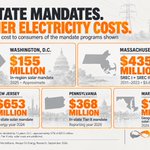
Wednesday's chart of the week proves that in-state solar mandates in just four states plus DC cost consumers nearly $1.8 billion. mailchi.mp/aoenergy/wednesda…

Always On Energy Research retweeted

Last month, I promised to check back in a month to see if the gap in gas prices between Washington and Idaho & Oregon would reflect the recent decline in the CO2 tax.
Indeed, the gap between WA and ID has declined by 20 cents per gallon - exactly as predicted. 1/2 #waleg


In 2024, supporters of the CO2 tax told @SeaTimesOpinion that if the tax was removed, gas prices might not go down. I argued that this made no sense and offered to bet.
Well, with such a large decline - 20 cents per gallon - we can see if the gap between Washington and neighboring states like Oregon and Idaho, gets smaller over the next month. It will take some time for prices to filter through the system, so let’s all meet back here in a month and see what happened. 3/3 #waleg


Always On Energy Research retweeted

With ballots sitting on your kitchen tables, it's a good time to repost this from @Jake_Fogleman. Coloradans deserve access to the most reliable and most affordable resource to heat their homes. YES on Amendment 82. YES on the Right to Natural Gas.


It's true. We did.

Don't say we didn't warn you.
The @SEIA hired @TimPawlenty and now a super PAC tied to the org is spending $250,000 to run ads on behalf of two Democrats running for Georgia PSC, on digital platforms and connected TV, like streaming services, per @CanaryMediaInc

Always On Energy Research retweeted

"Between 2019 and 2025, the price of electricity in D.C. rose by nearly 66 percent, more than double the 29 percent average national increase," @TheFrackingGuy and @mitchrolling of @AlwaysOnEnergy write. wapo.st/4ji389S

Always On Energy Research retweeted

Well I love the cartoon. And I applaud @RogerPielkeJr for continuing to fight the good fight. But I am so over this stuff. The climate wars and attacks on scientists that challenge the mainstream narrative continue, but may be muted during the Trump regime (I admit I have lost touch with what is going on in academia, but I suspect things haven't improved). Academia has suffered from the loss of myself, Pielke, others, not to mention the scientists that rejected the academic path or left very early on in their tenure.
While I will continue to set the record straight if I am asked (e.g. such as the DOE CWG), I've pretty much removed myself from the public debate on this topic (particularly after shutting down Climate Etc), apart from sporadic tweeting.
In the meantime, I am working in the private sector (Climate Forecast Applications Network) which allows me to bypass all the BS of peer reviewed journal publication, government grant applications, and generally playing the game to build academic prestige. Academics waste a colossal amount of time on that stuff.
Pielke is bypassing all that with his substack, sustaining his reputation and profile in the public debate. I have taken a different path. I am bypassing all that by doing client-driven research to help companies and governments understand and manage their extreme weather and climate change risks (timescales from days to decades). I have done some path breaking work in this regard, which is to the great benefit of my clients but unknown to the broader academic community.
So Michael Mann and the rest of that gang can go suck eggs, their path to irrelevance grows with every passing day. It's sad for academia and the education of the future generation of scientists. But the real action these days is in the private sector (e.g. the AI weather forecast models) and on social media.
rogerpielkejr.substack.com/p…

Always On Energy Research retweeted
.@politico admits nat gas heat is 50% cheaper than electric. And...U.S. leads the world in climate lawsuits. Climate cartel uses courts to advance policies it can't win thru legislation, while pursuing billions in damages to fund the next round.
politico.com/newsletters/pol…


Always On Energy Research retweeted
"Project Beacon, a proposed natural gas pipeline expansion, could (have) save(d) Massachusetts ratepayers an average of $367 million per winter, with savings soaring to $627 million during the coldest winters."
- @AlwaysOnEnergy
The Sierra Club and other groups oppose it.

Interstate pipeline construction has collapsed thanks to permitting delays and litigation. Digital critical infrastructure can't wait for the feds to fix it. Instead, Big Tech is going directly to states with abundant natural gas. mailchi.mp/aoenergy/wednesda…

Always On Energy Research retweeted
The Great Barrier Reef's obituary has been written again and again. But the patient didn't comply.
The five best years for coral cover in the monitoring record are the five most recent.
Yet while every setback generates headlines, recoveries receive far less attention.
From my latest newsletter:
preview.mailerlite.io/previe…
Sign up here: lomborg.com/newsletter

Always On Energy Research retweeted
I can answer why -- policy. It's intentional. The current commission should be tossed. @XcelEnergyCO doesn't deserve to serve Colorado.

If anyone is surprised by this headline, they haven’t been paying attention.
Colorado regulators have been investigating Xcel’s worsening reliability for two years. Now the #COPUC confirms outages remain well above historical levels, yet still can’t explain WHY they keep happening.
Meanwhile, customers keep paying more.
This is the bargain of the regulated monopoly: customers are denied competition in exchange for regulatory oversight meant to ensure reliable service at reasonable rates.
Unfortunately, customers get neither. Oversight is questionable, service isn't reliable or reasonably priced, and it will get worse.
Rates are rising. Reliability is falling. And after two years of investigation, regulators still don’t have an answer for the most basic question: Why?
Colorado consumers deserve an answer to an even bigger question: Why are we forced to remain captive customers of a monopoly system that isn’t delivering reliable, affordable electricity? denverpost.com/2026/09/26/xc…

Always On Energy Research retweeted
If anyone is surprised by this headline, they haven’t been paying attention.
Colorado regulators have been investigating Xcel’s worsening reliability for two years. Now the #COPUC confirms outages remain well above historical levels, yet still can’t explain WHY they keep happening.
Meanwhile, customers keep paying more.
This is the bargain of the regulated monopoly: customers are denied competition in exchange for regulatory oversight meant to ensure reliable service at reasonable rates.
Unfortunately, customers get neither. Oversight is questionable, service isn't reliable or reasonably priced, and it will get worse.
Rates are rising. Reliability is falling. And after two years of investigation, regulators still don’t have an answer for the most basic question: Why?
Colorado consumers deserve an answer to an even bigger question: Why are we forced to remain captive customers of a monopoly system that isn’t delivering reliable, affordable electricity? denverpost.com/2026/09/26/xc…
Always On Energy Research retweeted

An upgrade to natural gas pipeline could save us $367M per winter and be completed in just a few short years according to a study from @FiscalAlliance and @AlwaysOnEnergy Maura Healey has been less than enthusiastic and the climate nuts outright hostile to the idea. #mapoli
Always On Energy Research retweeted
Check out the latest study by @AlwaysOnEnergy calculating the benefits of the Project Beacon pipeline expansion!

Massachusetts ratepayers are paying some of the highest energy costs in the country. Our latest study says additional natural gas pipeline capacity could put real money back in their pockets.
The Fiscal Alliance Foundation’s new Project Beacon study estimates that expanding the Algonquin Gas Transmission system by 300 MMcf/d could save Massachusetts ratepayers an average of $367 million every winter.
For a typical gas-heated household, the numbers work out to an estimated $95 in annual winter savings against approximately $19 in costs, leaving the household about $76 ahead.
For commercial customers, the estimated savings are even larger: $792 per winter against an estimated $170 cost, for approximately $622 in net savings.
And the benefits become more significant when Massachusetts needs the energy most. The study found that additional pipeline capacity could reduce winter price spikes while also reducing the region’s use of more expensive fuel oil.
💰 $367 million in estimated savings per winter
🏠 $76 in net savings for a typical household
🏪 $622 in net savings for a typical commercial account
🔥 300 MMcf/d in additional firm natural gas capacity
🛢️ 8.4 million fewer gallons of fuel oil burned per winter
For years, Massachusetts has debated how to bring down energy costs while ensuring enough energy is available during the coldest days of the year.
Now there are numbers attached to one potential answer.
The question is: who will back the savings?
Always On Energy Research retweeted

California comes in second place in the nation for highest electricity prices in a report that draws fire from Gavin Newsom: sandiegouniontribune.com/202… @sdut @IERenergy @AlwaysOnEnergy @GovPressOffice
