

Washington State Native; Tech Sector Recruiter; Stock and Crypto Investor/Researcher. Using Ai to perform detailed research.
United States
Joined May 2023
- Tweets326
- Following280
- Followers111
- Likes51






We all are aware of the boom and bust predictions regarding AI. Who is correct? Is AI going to bust like the dot.com boom? The following article lays out a strong case that AI is here to stay and the growth is not going to slow down anytime soon. Review the article and let me know your own conclusion. How do you use AI in your daily life now versus twelve months ago?
19 charts that explain the state of AI open.substack.com/pub/unders…

2


BTC’s best day since February 2026 fueled by $1.4 billion short squeeze via @cryptoquant_com
cryptoquant.com/quicktake/6a…

21
Michael Naccarato retweeted

“Never seen anything like this in American soccer.” 🇺🇸
@RobStoneONFOX x @CarliLloyd x @clint_dempsey x @AlexiLalas
Michael Naccarato retweeted

🇺🇸🇮🇷 There's an important gap between what Trump posted last night and what CENTCOM actually announced this morning. And it matters a lot.
Trump said any ship that paid Iran a toll to transit the Strait would be pursued and intercepted in international waters. That's an act of war against third-party shipping. That's what sent markets into panic mode overnight.
CENTCOM said something different.
The blockade, which starts at 10am ET today, only applies to vessels entering or departing Iranian ports and coastal areas, including ports on the Arabian Gulf and Gulf of Oman. If your ship isn't going to or from Iran, CENTCOM says you have freedom of navigation through the Strait. Full stop.
So what is this actually?
It's a port blockade, not a full naval siege of the Strait. The US is cutting off Iran's ability to export anything by sea, oil, gas, goods, all of it, while technically leaving the Strait itself open to non-Iranian traffic.
That's a meaningful distinction. It's economic strangulation of Iran without triggering a full global shipping crisis on day one.
The strategic logic is clear. Iran's leverage in every negotiation has been the Strait, holding 20% of global oil supply hostage. The US is now saying: fine, keep threatening the Strait, but we're cutting off your ports regardless, and the rest of the world gets to keep moving.
It's maximum pressure without maximum escalation. For now.
The question is whether Iran reads it that way. Tehran has already said it will "retaliate against military vessels entering the strait." And the IRGC doesn't always wait for foreign ministry approval before pulling a trigger.
The ceasefire is technically still alive. The blockade starts in hours. And somewhere in the Gulf right now, both sides are deciding how far to push.


🇺🇸🇮🇷 The talks in Islamabad failed. Vance flew home. And within hours, CENTCOM announced the U.S. will blockade all exports from Iranian ports starting this morning.
All vessels. All nations. Arabian Gulf and Gulf of Oman. No exceptions.
Let's talk about what this actually means for your wallet, and everyone else's.
The Strait of Hormuz has been effectively closed since March 4. Iran shut it down when the war started. That already removed 27% of the world's seaborne crude oil trade from the market overnight.
Brent crude is sitting at $95 a barrel. Up 31% since February 28. US crude up 44%. And that was before today.
Now you're adding a U.S. counter-blockade on top.
There are an estimated 230 fully loaded oil tankers sitting inside the Gulf right now going nowhere. One energy analyst at Columbia put the shortage at 7 million barrels of crude and 4 million barrels of refined product per day not reaching markets. Every single day.
The knock-on effects are already visible. QatarEnergy declared force majeure on all LNG exports. Qatar supplies a massive share of Europe and Asia's gas. Restarting LNG liquefaction once it shuts down takes weeks, not days.
China, India, Japan and South Korea get 75% of their regional oil imports and 59% of their LNG through this corridor. Those are the four largest manufacturing economies on Earth.
If you're wondering why your energy bill, your groceries, your shipping costs are about to move, this is why.
And the threat doesn't stop at Hormuz. Iran's allies are openly floating shutting Bab al-Mandeb too, the other end of the Arabian Sea. If that closes alongside Hormuz, a full quarter of the world's energy supply is blocked simultaneously.
One Columbia analyst said it plainly this weekend: oil prices will stay elevated "into the end of 2026" regardless of when the war ends, because even after a deal the infrastructure damage alone will take months to repair.
This is a global supply shock in slow motion, and it just got a second act.


The Strait of Hormuz acts as a critical 21-mile-wide chokepoint handling roughly 20% of global oil, with Asian nations importing nearly 90% of this volume. Key exporters include Saudi Arabia (37.2%) and Iraq (22.8%), while China (37.7%) and India (14.7%) are the largest importers relying on this route. For a detailed breakdown of oil trade, view the chart at Visual Capitalist
visualcapitalist.com/charted… via @visualcap
#StraitOfHormuz #EnergySecurity

1
27
Take a look at this article! theepochtimes.com/article/us…

2
16
Michael Naccarato retweeted

Goldman Sachs confirms Hormuz oil flows have collapsed from 19.5 million barrels per day to 0.5 million. Net disruption after pipeline rerouting: 17.2 million barrels per day offline. Two independent vessel trackers recorded zero oil tankers crossing the Strait on 12 March. The largest energy chokepoint on Earth is not closed by a navy. It is closed by a spreadsheet.
Seven major P&I clubs cancelled war-risk coverage for the Persian Gulf effective 5th March under Solvency II protocols. Premiums for remaining voyage cover surged 300 to 1,000%, reaching 1% of hull value: $2 to $3 million per VLCC on a seven-day renewable basis. The $20 billion DFC reinsurance facility backed by Chubb has limited uptake because it excludes full P&I liability. Lloyd’s still offers single-voyage cover. Nobody is buying because the premium assumes the mines, and the mines are on the seabed.
The Strait is open. The insurance is not. And without insurance, no vessel moves.
While 19 million barrels per day sit stranded on either side of the chokepoint, one category of vessel continues transiting: Chinese shadow fleet tankers carrying Iranian crude settled in yuan through CIPS. Kpler confirms 11.7 to 16.5 million barrels have reached China since 28 February. These tankers do not carry Western insurance. They do not need Western insurance. They operate under Chinese state-backed coverage, Iranian IRGC safe passage, and yuan settlement through a payment system that processed $24.5 trillion in 2025 at 43% year-on-year growth. The only oil moving through Hormuz is oil that does not touch the dollar.
This is the moment the petrodollar system was designed to prevent.
In 1974, Saudi Arabia agreed to price oil exclusively in dollars in exchange for American military protection. That agreement created a world where every barrel required dollars, every central bank held dollar reserves because energy demanded them, and American financial hegemony rested on the simple proposition that oil equals dollars. For fifty-two years, the equation held. The 2026 war is breaking it not through policy but through physics: the insurance architecture that enabled dollar-denominated oil transit has collapsed, and the only transit still functioning operates in yuan.
The dollar’s share of global reserves has fallen from 71% in 2000 to 59% today. Yuan global payments remain at 2.89%. No single event kills the petrodollar. But the Goldman data reveals what the contrarians miss: the war has created a live demonstration of a post-dollar energy system operating at scale. Chinese tankers transit. Yuan settles. CIPS clears. Iranian oil reaches Chinese refineries at $9 to $12 below Brent while Western buyers pay $96.72. The system works. It is working now. And every day the Strait remains closed to dollar shipping is another day the alternative proves it does not need the original.
President Trump’s multinational warship call is the response: send navies, reopen the Strait, restore dollar-denominated traffic, and kill the yuan alternative before it scales. If the coalition succeeds, dollar pricing survives. If it fails or fragments, the war that was launched to destroy Iran’s nuclear programme will have accidentally created the conditions for the multipolar energy order the dollar was designed to prevent.
The IEA has released 400 million barrels of strategic reserves, the largest coordinated draw in history. It covers 23 days of the 17.2 million barrel daily shortfall. The war is sixteen days old. The reserves are finite. The insurance cancellations are not.
Nineteen million barrels per day reduced to half a million. Zero tankers on 12th March. Yuan tankers the only vessels moving. And the fifty-two-year-old system that priced every barrel in dollars is watching its replacement operate in real time through the waterway it can no longer transit.
Full analysis here - open.substack.com/pub/shanak…

Michael Naccarato retweeted

☕️ GM! Here are the most important events in #Crypto over the last 24 hours:
🌟Bitcoin Highlights
🔸$BTC holding ~$71,500 as markets brace for the FOMC meeting Monday-Tuesday (March 17-18). Dot plot is the key catalyst. A shift from one to two projected rate cuts for 2026 could spark a breakout.
🔸The 20 millionth #Bitcoin was mined this week. 95.2% of the 21M supply is now in circulation. Only ~1 million BTC left to be created over the next 114 years.
🔸Spot Bitcoin ETFs completed their first 5-day inflow streak of 2026, bringing in $767M for the week and $1.34B in March so far. On track for the first positive monthly flow since October.
🔸Crude oil briefly topped $100/barrel after Trump warned of strikes on Iran's Kharg Island. Oil has surged from ~$51 at the start of 2026 to above $99. The Iran war enters its third week with no de-escalation in sight.
🔸Jane Street, the HFT firm, has slowed crypto activity amid a lawsuit alleging insider trading tied to the LUNA collapse. A persistent pattern of 10 AM futures dumps reportedly stopped after the case made headlines.
📊Altcoin Updates
🔸BlackRock's staked #Ethereum ETF (ETHB) hit $100M AUM in its first week on Nasdaq. Meanwhile a whale withdrew 73,745 ETH from Kraken over 3 days and Trend Research borrowed 27,000 ETH ($57M) via Aave to deposit into Binance.
🔸Polymarket insider trading scandal: Argentine government officials accused of betting on inflation data before its public release. The prediction market is under scrutiny.
🔸DOJ's Scam Center Strike Force has seized over $580M in crypto from transnational criminals. Separately, a $327K USDT forfeiture tied to a romance fraud scheme was filed.
🔸Step Finance, once the "front page of Solana," is shutting down permanently after a $26M hack that compromised its treasury wallets in January.
🔸The Crypto Clarity Act remains stalled in the Senate. Ripple CEO puts odds of passage at 90% before April, but the March 1 deadline passed without action. Institutional money stays on the sidelines until Washington moves.
Michael Naccarato retweeted

Imagine the central bank decides the economy needs help.
So it creates $1 trillion.
Not by printing trucks full of cash, but by typing numbers into a computer.
That money doesn’t fall from the sky. It enters the financial system through banks and financial markets.
Banks suddenly have more reserves. Investors suddenly have more liquidity. And money starts looking for somewhere to go.
Some of it flows into stocks. Some into real estate. Some into venture capital, crypto, private equity, and speculation.
Asset prices start rising. Homes get more expensive. Stocks hit new highs. Investors feel wealthier.
But something important didn’t happen.
No new houses were built overnight. No companies suddenly became twice as profitable. No new productivity magically appeared.
What changed wasn’t the assets.
It was the amount of money chasing them.
When more money enters the system, the first place it usually shows up isn’t wages or consumer goods.
It shows up in asset prices.
Stocks. Housing. Land. Financial markets.
That’s one of the quiet forces shaping modern markets.
Liquidity moves first.
Prices follow.
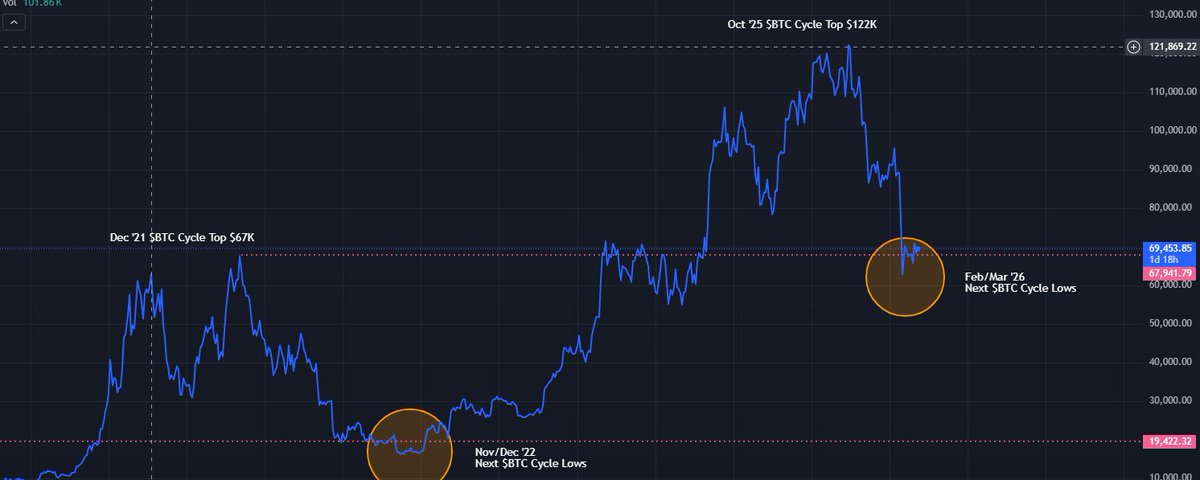
Finally, a long awaited win on a $BTC long. Sign up for $10,000 in rewards and enjoy zero-fee trading! greentreeone.com/en-US/regis…

20
Michael Naccarato retweeted

BREAKING: Bitcoin officially turns positive on the day, rising above $66,000.
Bitcoin is now trading ~$1,000 HIGHER than where it was when US and Israeli strikes launched on Iran last night.


Michael Naccarato retweeted

People almost always overestimate the length of a market move
They don’t sell in euphoria because they believe the pump will last forever
They don’t buy the dips because they believe the dump will last forever
Always sell greed, always buy fear
Patience, the time will come

