

The Anatomical Record publishes new discoveries in morphological aspects of molecular, cellular, systems, and evolutionary biology. Official @AnatomyOrg journal
Joined December 2011
- Tweets1.9K
- Following146
- Followers3.1K
- Likes992




Happy #FossilFriday! Meet Rewasaurus minori, a newly described Triassic dinosaur relative from India! Its unusual teeth offer clues to a diet of soft-bodied prey and plants. Turns out, this fossil is a real jaw-dropper!
Study by Sen et al.: doi.org/10.1002/ar.70366

AAA Journal is excited to announce an webinar on Friday Nov. 6th at 12pm ET. “Sea Serpents of Belgium: New perspectives on mosasaur anatomy and evolution from a historic sample”, presented by Henry Sharpe, a PhD student at Harvard.
Register Now at lnkd.in/e72GvE4D


Frogs aren’t just hopping to it — their bones are built for the job! A new study reveals how limb bone proportions change as frogs grow, linking skeletal structure to locomotion and habitat.
Study by Soliz & Tulli: doi.org/10.1002/ar.70381

The Anatomical Record retweeted

Had a fantastic trip to Wiley headquarters to represent @AnatRecord at the annual Wiley– American Association for Anatomy journal strategy meeting. It’s such a tremendous honor to be part of the AAA publishing “Team of Teams”, and I'm excited about the future of our journals – at Hoboken, NJ


Never look a gift turtle in the mouth! A new study of Kinosternon scorpioides reveals a mucus-rich oral cavity, diverse tongue papillae, and microscopic adaptations that may reflect its semi-aquatic, omnivorous lifestyle.
Study by Bezerra et al.: doi.org/10.1002/ar.70372

Happy #FossilFriday! A new study reveals the first dentary crest in Brasileodactylus araripensis, a Cretaceous pterosaur from Brazil. This highlights how growth and sex may have shaped pterosaur evolution and taxonomy.
Study by Nascimento et al.: doi.org/10.1002/ar.70364

A new study shows gannets and other diving birds have evolved reinforced neck vertebrae to withstand the high-impact plunge of a headfirst dive. Turns out, they’re not just winging it when it comes to evolution!
Study by Vandenberg et al.: doi.org/10.1002/ar.70369

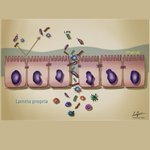
Alcohol use disorder can damage the gut’s epithelial barrier, promoting “leaky gut,” endotoxemia, and systemic inflammation. Research highlights zinc, glutamine, vitamin D, and probiotics as strategies to protect gut health.
Study by Mak & Shekhar: doi.org/10.1002/ar.70362

Happy #FossilFriday! Riama-gine what skulls can tell us about evolution! Comparing 6 Riama species shows variation in skulls, teeth, and sexual dimorphism. This shows the use of cranial anatomy for phylogenetics and evolution.
Study by Vega-Rangel et al.: doi.org/10.1002/ar.70367

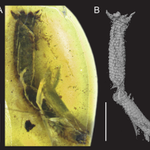
Stop, Drop and Run! A 99 million year old detached lizard tail preserved in amber proves that lizards have been dropping their tails as a distraction from predators since the Cretaceous. Soft tissue preservation shows that the muscles are actually very similar to lizards today!

Authors: Dolev Fabrikant, Apostolos Christopoulos, Ahmed Nasser, and Leonidas-Romanos Davranoglou
Image: Overview of amber piece and micro–computed tomography (micro-CT) renderings of the fossilized tail
Full #OpenAccess Paper: doi.org/10.26879/1706
We are excited to share our latest issue, featuring a variety of incredible papers! Issue Link: anatomypubs.onlinelibrary.wi…
The cover for this issue features a paper describing cranial fossils of proteid salamander Mioproteus wezei by Syromyatnikova: doi.org/10.1002/ar.70112

Happy #FossilFriday! Using high-res CT, researchers reveal the skull anatomy of Brazilian Pleistocene amphisbaenians, showing braincase structures and new features. Even they can’t worm (lizard) their way out of research! Study by Paiva et al.: doi.org/10.1002/ar.70349

More turtle research please(-iobaena)! Research on the fossil turtle Plesiobaena antiqua reveals variation in its skull/jaws. Micro-CT shows developmental changes and shifts toward hard prey, offering clues to baenid evolution. Study by Bellotti et al.: doi.org/10.1002/ar.70352

A pika from the past? Now that’s what we call pika-boo! New fossil skulls of Desmatolagus gobiensis from China place it as the most basal ochotonid, with juvenile fossils revealing a tooth-replacement pattern like modern hares.
Study by Zhang & Wang: doi.org/10.1002/ar.70351

When life gives you Lemonnieri, make Thoraxion! For #FossilFriday, we’re celebrating with a new study revisiting 50+ mosasaur specimens. This research supports Mosasaurus lemonnieri as a valid taxa, and identifies a new species!
Study by Sharpe et al.: doi.org/10.1002/ar.70338

We're pleased to share the scientific abstract volume from the American Association for Anatomy's 2026 Anatomy Connected conference held earlier this year:
anatomypubs.onlinelibrary.wi…
Congratulations to all the presenters! We hope to see everyone again next year in Cincinnati.

A fresh look at historic mosasaur fossils from Belgium! A new study by Sharpe et al. confirms Mosasaurus lemonnieri as a valid species, describes a new mosasaurine, Thoraxion tahlequahae & reveals new insights into mosasaur anatomy, variation & evolution
anatomypubs.onlinelibrary.wi…


We are excited to promote our recent Editor's Choice interview for this month! Be sure to check out this awesome article!
nitter.cf/WileyLifeSci/status/20…


What can unusual snake vertebrae reveal about evolution?
In the latest @AnatRecord Editor's Pick interview, Olaf Lizak discusses the inspiration behind two studies uncovering remarkable vertebral adaptations in snakes.
Read the interview: bit.ly/3UOpsO4

Spiderman? No it’s a Spidersnake! Micro-CT analysis of the holotype of Pseudocerastes urarachnoides reveals striking variation along its vertebral column, especially in the tail—but no bone beneath the spider-like appendages.
Study by Georgalis et al.: doi.org/10.1002/ar.70308
