
Undergrad and PhD student @PKU1898 LLM Agent | AI4Science | Generative Models | Continual Learning. Intern @ Tencent Hy agent team
Beijing, China
Joined May 2023
- Tweets113
- Following189
- Followers376
- Likes103






Pinned Tweet
Our thoughts for the next half of AutoResearch.
With this blog, we hope to help usher in the era of AI4Science 3.0:
1.0: Scientific foundation models. (e.g., AlphaFold)
2.0: Agentic tool use.
3.0: Agentic tool improvement.

Introducing Hyra 2.0, the next evolution of Hunyuan Research Agent. 💡
From solving problems to building reusable tools, models, and workflows that accelerate future discoveries.
Read our perspective on the next chapter of AutoResearch:
hy.tencent.com/research/hyra…


Haowei Lin retweeted

Today, we’re releasing the open weights for Hy4.
Our natively multimodal flagship MoE (770B total / 49B active, 1M context).
Alongside the Hy4 System Card with a comprehensive safety evaluation report.
➡️ Join the Hy team for a live AMA this Friday, 8–10 AM PT on r/LocalLLaMA—drop any questions about Hy models and chat with us directly!
GitHub: github.com/Tencent-Hunyuan/H…
Weights: huggingface.co/tencent/Hy4
GGUF:huggingface.co/AngelSlim/Hy4…
License: huggingface.co/tencent/Hy4/b…
System Card: hy.tencent.ai/Hy4_system_car…

Many people sent me this news today. But I want to say: This ability is already in Claude's system card (twice: Opus 5.5 and Fable/Mythos 5.2)!
😹 When I first read this, I was confused about whether training on sequences would be useful.


Claude was trained on protein sequences, at scale.
We gave 20 language models the start of little-studied bacterial proteins and asked for the next amino acids. Only the latest Claude models predict them. Not GPT, not Gemini, not seven open-weight models.

5
368
lol will consider adding this in CV: authored this task (github.com/harbor-framework/…) in TB4.1

Given that there are only 66 problems in TerminalBench v4.1 and literally every frontier lab tracks TerminalBench performance, at some point it will be more prestigious and impactful to have authored a TerminalBench problem than to get a paper accepted in Nature or Science
6
797
Haowei Lin retweeted

1/4 Astra's weight-space programming alone won't scale AI R&D. Yet with Hyra 2.0, we're building AI that builds SOTA models.
A new era: AI4AI → AI4AI4Science.
In biology, we use Hyra 2.0 to train HyInv + HyPLM-Flash from scratch—pushing the accuracy–speed Pareto frontier far beyond ProteinMPNN and the ESM series.
HyInv: a protein inverse-folding model with a SOTA scTM score and 57× the speed of ProteinMPNN.
HyPLM-Flash: matches or outperforms all other 650M protein language models, including ESM-2 and ESM C, and is the fastest among all.

Happy 1st birthday🎂, harbor & tb2.0
Terminal-Bench on 64 model cards, the most-cited benchmark at model launches!

Today, we’re announcing the next chapter of Terminal-Bench with two releases:
1. Harbor, a new package for running sandboxed agent rollouts at scale
2. Terminal-Bench 2.0, a harder version of Terminal-Bench with increased verification

7
171
Haowei Lin retweeted

Exciting news from Agent Arena: Hy4 by @TencentHunyuan just landed #14 overall. Currently proprietary, but once its weights are released it will tie with Kimi K3.1 Pro for #1 among open models!
Across +8.5K real-world, long-horizon agentic sessions from our global community of users, Hy4 delivers +4.7% net improvement and joins the Agent Arena Pareto frontier. At $0.55/task, Hy4 costs about 62% less than Kimi K3.1 Pro (Max) at $1.46/task, and the two models’ scores are within 1 percentage point.
This release is a +3.6 percentage pt improvement from Hy4 preview at #25 with +1.1%. In fact, Hy4 improved across all key signals:
- Confirmed Success (explicit “yes, that worked” from users): #11 with +8.7% (up from #16 with +4.9%)
- Praise vs Complaint (sentiment in user reactions): #18 with +3.8% (up from #24 with +1%)
- Steerability (responding to user corrections): #14 with +5.7% (up from #27 with +0.21%)
- Bash Reliability (successful shell commands): #20 with +6.2% (up from #41 with -3.1%)
Congrats to the @TencentHunyuan team on this release!


👋Hy4 is here, new with vision.
Firmly among the leading open models.
More productive everywhere: finance, frontend, game, officework, research…
Built responsibly, with cyber/biosecurity in mind.
Try it out and let us know!
🔗:hy.tencent.ai/research/hy4?l…

Haowei Lin retweeted

Tencent Hunyuan’s Hyra 2.0 is pushing AI research agents beyond solving scientific problems — toward building their own scientific models.
Two protein models developed by the agent:
🧬 HyInv — A 1.96M-parameter protein inverse folding model. Tencent reports 57× faster sequence generation than ProteinMPNN.
🧬 HyPLM-Flash — A 650M-parameter protein language model, trained on 726B tokens.
The bigger story is not just the models themselves. It's the shift from AI using existing scientific tools to AI developing reusable models, algorithms, and research workflows.
From solving scientific problems to building the tools for the next discovery.
This is what the next generation of AI for Science could look like.
🔗 hy.tencent.com/research/hyra…
🔬 Models, code & weights: github.com/Tencent-Hunyuan/h…
#AI4Science #ProteinDesign #AI4Protein

Introducing Hyra 2.0, the next evolution of Hunyuan Research Agent. 💡
From solving problems to building reusable tools, models, and workflows that accelerate future discoveries.
Read our perspective on the next chapter of AutoResearch:
hy.tencent.com/research/hyra…
Haowei Lin retweeted
Introducing Hyra 2.0, the next evolution of Hunyuan Research Agent. 💡
From solving problems to building reusable tools, models, and workflows that accelerate future discoveries.
Read our perspective on the next chapter of AutoResearch:
hy.tencent.com/research/hyra…
Haowei Lin retweeted

Robotics has spent years scaling demonstration data and model size. What happens when we scale EXPLORATION for robot agents?
We're incredibly excited to share RAX, an agentic robotics system that learns by scaling online exploration.
A coding agent connects directly to the robot’s perception and control APIs, learns from feedback, and builds programs that perceive, plan, and act. The model stays frozen. As exploration scales, the agent improves its programs and builds up reusable skills.
The results:
• ZERO teleoperation or action demonstrations on real robots—from insertion with 0.1 mm clearance and air-fryer manipulation to deformable objects and long-horizon mobile whole-body control.
• +37 percentage points on average over leading learned policies across five simulation benchmarks: RoboDojo, BEHAVIOR-1K, HumanoidArena, DexJoCo’s bimanual tasks, and LIBERO-Pro.
• One framework spanning single-arm, bimanual, dexterous, humanoid, and mobile robots, with new embodiments connected through APIs.
The craziest part: on each real-world embodiment, going from scratch to mastering the tasks took roughly two hours. No teleop. No model finetuning.
We’re open-sourcing the full framework AND every experiment session. We can’t wait to see what people build with it!
Project + sessions: robot-agent-exploration.com/
Paper: assets.robot-agent-explorati…
GitHub: N
Project fully led by @RunhanH and @xczhangxx who are absolutely awesome.
How it works, experiments, and robot videos below 🧵
(1/N)
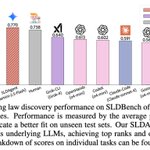
In Apr ’25, I discussed AI4AI as AI4Sci (“AI as science”) with my professor, using scaling law discovery (SLD) as an example.
Now AI4AI is hot.
SLDBench v2 is out:
arxiv.org/abs/2610.16297v1
More on SLD:
arxiv.org/pdf/2402.02314
arxiv.org/pdf/2507.21184
arxiv.org/pdf/2604.22753


Haowei Lin retweeted

Harbor Adapters and Harbor-Index
arxiv.org/pdf/2609.04298
1+year work, 120+contributors, 300+PRs, 10+ funding partners.

Our Harbor Adapters & Harbor-Index paper (the first version) is finally out: arxiv.org/abs/2609.04298

Some interesting math results just dropped... though not entirely surprising, given the current surge in math discoveries.
Hyra keeps pushing the frontier.
Since our last math update, four more advances have landed:
📐 3D Blaschke–Lebesgue: raised the universal lower bound for constant-width bodies from 0.380799w³ → 0.411040w³ (now 97.9% of the conjectured Meissner optimum).
∫ Beurling–Ahlfors: improved the best uniform (L^p) coefficient from 1.575 → 1.523958, moving closer to Iwaniec’s conjectured sharp bound.
± Partial Hadamard matrices: extended asymptotic counting from the cubic scale down to the near-quadratic regime.
[,] Operator commutators: improved the cost of approximating the identity from Tao’s O(log⁵(1/ε)) to O(log³), narrowing the gap toward the known logarithmic lower bound.
We are making open-source models better at solving open problems!
Check the results: github.com/Tencent-Hunyuan/h…

8
736
Haowei Lin retweeted
Hyra keeps pushing the frontier.
Since our last math update, four more advances have landed:
📐 3D Blaschke–Lebesgue: raised the universal lower bound for constant-width bodies from 0.380799w³ → 0.411040w³ (now 97.9% of the conjectured Meissner optimum).
∫ Beurling–Ahlfors: improved the best uniform (L^p) coefficient from 1.575 → 1.523958, moving closer to Iwaniec’s conjectured sharp bound.
± Partial Hadamard matrices: extended asymptotic counting from the cubic scale down to the near-quadratic regime.
[,] Operator commutators: improved the cost of approximating the identity from Tao’s O(log⁵(1/ε)) to O(log³), narrowing the gap toward the known logarithmic lower bound.
We are making open-source models better at solving open problems!
Check the results: github.com/Tencent-Hunyuan/h…
Haowei Lin retweeted

This is a nice simple construction, which answers a natural question.
The exposition is more complicated than it needs to be (especially for an expert in the area), so I wrote a short note giving my 'digestion' of this construction.
thomasbloom.org/notes/sumdif…
For a finite set of integers (A), how much faster can (|A+A|) grow than (|A-A|)?
A 1969 theorem gave an upper bound of 2 for the exponent. For more than 50 years, the best constructions barely exceeded 1.1.
With help from our research agent Hyra and the Hy3 model, we found an explicit construction showing that the optimal exponent is exactly 2.
A 50-year-old problem, solved.
Paper: arxiv.org/abs/2607.27199
Hyra blog: hy.tencent.ai/research/hyra
Formal proof: github.com/linhaowei1/sum-di…

Haowei Lin retweeted

This is insane. This is a VERY central problem in additive combinatorics and it’s been resolved via AI… wow
For a finite set of integers (A), how much faster can (|A+A|) grow than (|A-A|)?
A 1969 theorem gave an upper bound of 2 for the exponent. For more than 50 years, the best constructions barely exceeded 1.1.
With help from our research agent Hyra and the Hy3 model, we found an explicit construction showing that the optimal exponent is exactly 2.
A 50-year-old problem, solved.
Paper: arxiv.org/abs/2607.27199
Hyra blog: hy.tencent.ai/research/hyra
Formal proof: github.com/linhaowei1/sum-di…
Haowei Lin retweeted

I and @AndyLin2001 used 𝐇𝐲𝟑 to settle a combinatorics problem that had been open for half a century.
This isn't just one more AI-generated mathematical discovery -- it's a "Eureka moment" for an 𝐨𝐩𝐞𝐧-𝐰𝐞𝐢𝐠𝐡𝐭𝐬 𝐦𝐨𝐝𝐞𝐥.
How much larger can the sumset of a set of integers be than its difference set?
A classical result from 1969 showed that the exponent governing this gap is at most 2. But whether this bound was optimal remained open. More recently, Terence Tao and others explored AI-assisted approaches to improve the lower bound, but the results remained around 1.1.
Then 𝐇𝐲𝟑 produced an elegant construction achieving a lower bound of 2 -- matching the upper bound and completely resolving the problem.
For a finite set of integers (A), how much faster can (|A+A|) grow than (|A-A|)?
A 1969 theorem gave an upper bound of 2 for the exponent. For more than 50 years, the best constructions barely exceeded 1.1.
With help from our research agent Hyra and the Hy3 model, we found an explicit construction showing that the optimal exponent is exactly 2.
A 50-year-old problem, solved.
Paper: arxiv.org/abs/2607.27199
Hyra blog: hy.tencent.ai/research/hyra
Formal proof: github.com/linhaowei1/sum-di…
Haowei Lin retweeted

A 50-year-old math problem, solved with the help of Hyra and Hy3.
Huge credit to @AndyLin2001, who led this result, and to the whole team. Excited to be co-leading Hyra as we build AI4AI and AI4Science. We’re just getting started—and we’re hiring. Reach out if this mission resonates.
For a finite set of integers (A), how much faster can (|A+A|) grow than (|A-A|)?
A 1969 theorem gave an upper bound of 2 for the exponent. For more than 50 years, the best constructions barely exceeded 1.1.
With help from our research agent Hyra and the Hy3 model, we found an explicit construction showing that the optimal exponent is exactly 2.
A 50-year-old problem, solved.
Paper: arxiv.org/abs/2607.27199
Hyra blog: hy.tencent.ai/research/hyra
Formal proof: github.com/linhaowei1/sum-di…