

Associate Senior Lecturer @lunduniversity studying how the environment impacts evolution using field data, lab experiments, and theory
Lund, Sweden
Joined March 2020
- Tweets28
- Following342
- Followers267
- Likes2




Pinned Tweet
I am looking for a postdoc to join my group at @lunduniversity!
Apply if you’re interested in studying environmental effects on short-term #evolution and its #predictability in #TrinidadianGuppies!
Info & application here: lu.varbi.com/en/what:job/job…
Please RT

So excited to announce a #PhDposition in my new group at @lunduniversity! Apply if you’re interested in studying the ecology and evolution of phenotypic plasticity in #TrinidadianGuppies 🐟!
Info & applications here: lu.varbi.com/en/what:job/job…
Please RT!

Can a single #population of #hermaphroditic #animals contain #selfing, #outcrossing, and #mixedmating individuals? Yes, according to my new @royalsociety Open Science paper! #matingsystemevolution #snails #RSOS
doi.org/10.1098/rsos.230532
Thread below (1/7).

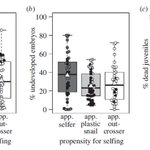
This and the reduced fitness of selfers cautiously suggest that studying the #heritability of #selfing propensities might be worthwhile in this population. Genetic #selfincompatibility mechanisms have only recently been discovered in animals (doi.org/10.1038/s41598-020-5…).
1
221
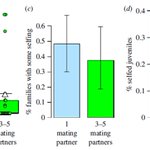
Finally, we show that #pairing individuals, and even observing female matings, does not prevent #selfing. Here, 44% of paired snails selfed, and 71% of snails that selfed after being paired copulated as a female. Assuming (near-)exclusive #outcrossing after pairing is thus risky.

1
175
Do #lifehistories evolve as a cohesive whole? My new @journal_evo paper suggests that, in Trinidadian guppies, they do not! It was a joy and an honour to work with David Reznick, Joseph Travis, @TomosPotter and Tim Coulson.
doi.org/10.1111/evo.14440
Thread below (1/12).

Dissimilar variance partitioning across traits underlying ecotypic variation has been found in other systems (e.g., a shrub: doi.org/10.1093/aob/mcaa020, Atlantic mollies: nature.com/articles/srep2296…), but further studies will need to assess its generality.

1
1
Overall, heterogeneity in traits’ plastic and genetic components may render ecotype formation slow and incremental. It would also mean that #AnthropogenicChange risks disrupting optimal life-history strategies if some traits do and others don’t respond to altered environments.
3