

High-quality, research-backed financial analysis and practical lessons for intelligent investors. No clickbait, just rigorous, actionable insights.
Joined December 2025
- Tweets924
- Following264
- Followers955
- Likes929





Pinned Tweet
Our goal is to provide useful and practical information for the intelligent investor.
1. We provide financial content based on in-depth, thorough research. You won’t find hundreds of investment theses here, only those in which we actually believe are worth investing.
2. You'll find useful lessons from some of the greatest investors, along with case studies on their investments, not just quotes.
3. We provide a rigorous analysis of the current investment landscape, based on reliable sources, not clickbait.
anomalyinvestments.substack.…

6
2,811
We just published our first 13F Cheat Sheet.
Every quarter, investment managers with over $100m under management have to disclose their positions in a 13F filing. We dissected the Q3 2026 filings of 84 superinvestors to find the trends and signals, and leave out the noise.
What stood out:
Health insurers: 10 sells, 0 buys.
Railroads: 6 sells, 0 buys, and five full exits.
Energy: six investors bought six different names.
And one sector where ten investors bought in the same quarter, several through brand new positions. We are researching it now.
What the 13F Cheat Sheet is, how it works and what is inside: anomalyinvestments.substack.…

97
Nick Sleep split companies into two groups.
Heavenly Opportunities behave well because they want to, like $COST.
Loonies or Crisis Actors only do the right thing when their backs are against the wall.
Add the Lindy effect, stating that for a business model, future life expectancy is proportional to current age. The first group is the one worth holding for decades.
3
383
Asseco Poland reported nine months to September.
Revenue +11.3%. Proprietary software and services +15.7%, third-party resale -1.9%, hardware -5.2% (very Constellation-like)
EBIT +36.3%. Margin 13.5% to 16.6%.
Free cash flow +67.5%.
Attributable net profit +44.8%.
Operating leverage of about 3x on the top line, driven entirely by mix migrating out of reselling boxes and into proprietary software. That is the right direction.
The negative is the quarter decelerated. Q3 revenue was +4.6% against +11.3% for the nine months. Proprietary software held up at +9.3%; everything else went backwards.
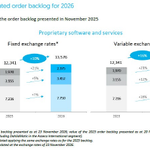
Backlog is the forward tell. 2026 proprietary software backlog +10% at constant FX. By segment, Asseco Poland +21%, Asseco International +9%, Formula Systems +7%. The Polish business is where it is happening, and it already earns a 25% EBIT margin against 12% and 10% for the other two.
$CSU.TO $TOI.V


25
1,181
Back in the early 2000s, a company called Georgica Plc fell more than 6% in a single day after an administration announcement for Riley Leisure Limited.
The company's own press release said Riley Leisure was not part of the Georgica group, yet the stock fell anyways.
Nick Sleep's line that nervous investors tend to shoot first and ask questions later, still applies today. Almost every single day.
119
The problem with $NFLX is structural. It has to compete directly with $DIS, $AAPL, $AMZN, $GOOGL, $SKYD, and $CMCSA for the same living room attention and subscription wallet.
As long as everyone raises prices and consumers absorb them, revenue growth looks attractive. The moment price increases hit a ceiling, subscriber growth becomes the main lever, and $NFLX’s share of TV usage has already flatlined around 7.8%.
YouTube $GOOGL is different. Besides having 14.2% of TV usage, nearly double Netflix and climbing it has an dd-first business model, that was built from day one on ad monetization, making paid subs pure upside
It also has zero real UGC competition. No one else is coming close to its creator ecosystem, and its marginal content cost is zero.


181
Dev Kantesaria having another heart attack

“We are monitoring the situation with FICO and their pricing schemes, and it is concerning,” he said.”
“FHFA Clears FICO 10T Scores for Fannie Mae and Freddie Mac”
bloomberg.com/news/articles/…

256
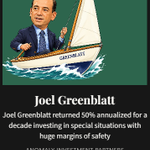
Joel Greenblatt's Gotham Capital compounded at about 50% a year from 1985 to 1995. $1 became $51.97. Then he handed outside capital back in 1995.
His definition of risk had nothing to do with beta. Risk is permanent loss of capital.
His rule: look down, not up. Work out what you can lose before asking what you can make.
122

How much of $FICO rides on one product?
Mortgage scores are about 47% of the Scores segment's operating profit, in a segment running at roughly 90% margins.
Two lines of sensitivity math decide the stock:
Every 10% on the mortgage score price is about $120m of revenue.
Every 10% of agency loans that move to VantageScore costs about $85m.
3
378
If we adjust $CSU.TO Constellation's last FCFA2S for IRGA and the abnormally large WC, last quarter's FCFA2S was about $717m, a 21% YoY increase.
LTM adjusted FCFA2S was $2.4b, or $115/share. With a mkt. cap of roughly $46b, FCFA2S/share yield is 5.3%.
Assuming FCFA2S/share compounds at 15% per annum, instead of the 20% of recent years, the yield on today's price reaches 8% in 3 years, 10.6% in 5, and 21% in 10
If 15-20% growth holds, some multiple expansion isn't outrageous. That would come on top.

Constellation Software $CSU.TO
Q3 FCFA2S dropped 16% as reported, but grew 21% excluding the IRGA charge and working capital movements.
The IRGA charge went from $16M to $117M, mostly because Asseco’s share price rose. Working capital absorbed $110M more than a year ago, as deferred revenue ran down faster after a heavy acquisition year.
Underlying cash generation actually grew in line with revenue (+19%).
The question is whether CSU should keep deducting a charge driven by a Polish IT company’s share price from its headline cash metric.

2
500
For those wondering why Howard Mark's Oaktree Capital doesn't show in Dataroma, the firm now publishes its 13F-HR/A through Brookfield.
You can find it here: sec.gov/Archives/edgar/data/…
The major movements were trimming $TRMD from 14% to 7.7%, and fully selling $GTX and $INDV
1
223
Back in 2003, when Estée Lauder cut near-term earnings to invest in its brands, the stock fell 15%. Nick Sleep saw long-term pricing power.
At Xerox, the market obsessed over a $6.4B misbooking under lease accounting while cash flow was untouched: customers kept paying.
Sleep bought the cash flow, not the latest data point.
2
159
The best way to improve as an investor is to study the masters. Nick Sleep is one of them.
We dissect iconic trades made by legendary investors, including Nick Sleep, walking through how they spotted the opportunity, built their conviction, and achieved the final results.
You can find us here:
anomalyinvestments.substack.…

46
After selling its North American businesses in 2021, FirstGroup didn't go shopping. Of about £2bn in net proceeds, about £1bn repaid debt, £336m went into pensions, and about £500m went back to shareholders in a tender offer.
Since then, it bought back £118m (2024), £92m (2025) and £50m (2026) of stock, and guided £100m for this year. At the £1.70 per share we entered, that is 11% of the company in one year.
1
106
We only publish a thesis when we put our money where our mouth is. This is one of them.
anomalyinvestments.substack.…

57
In 1992 General Dynamics ran a Dutch auction to buy back 30% of its shares at $72.25. The stock had already gone from $25 to $71, and executives held over $20m in paper gains from a stock plan.
Not one insider tendered a single share. Greenblatt took that as his signal. By the end of 1993, price plus cash distributions exceeded $140.
The guy was a beast.
1
135
In case you're interested, we broke down some of his investments during the 80s and 90s, the rationale behind them, the math, and the returns.
It's not light reading...
anomalyinvestments.substack.…

1
63
This is actually ridiculous.

$CSU Constellation Software CFO: Recent software acquisitions are delivering significant margin expansion, with Q1 acquisition margins improving from −16% to 27%.
"I mean I think I pointed out in Q1 that we had what was a negative 16% margins with that cohort of the Q1 acquisitions, like that cohort is now at 27%. And the same thing like the Q2 cohort went from 12% to 21%. So they are improving. It's just that we're making so many acquisitions that it's still a drag on our overall."


Bell-Park, a Japanese phone retailer, had over ¥20bn of cash, no debt, and hadn't meaningfully touched its share count in about eight years. The stock fell to 0.9x book.
Then it ran one self-tender and cancelled about 39% of its shares. ROE went from about 10% to 13.5% in fiscal 2025, and is now above 18%.
141
FICO committed $3.6B to buybacks over the last twelve months. Its free cash flow in that period was about $822m.
It raised over $4B of debt to fund the gap, buying at $1,000 to $1,300 a share. When we published, the stock was $790.
1
10
999
Constellation Software $CSU.TO
Q3 FCFA2S dropped 16% as reported, but grew 21% excluding the IRGA charge and working capital movements.
The IRGA charge went from $16M to $117M, mostly because Asseco’s share price rose. Working capital absorbed $110M more than a year ago, as deferred revenue ran down faster after a heavy acquisition year.
Underlying cash generation actually grew in line with revenue (+19%).
The question is whether CSU should keep deducting a charge driven by a Polish IT company’s share price from its headline cash metric.