
Host of the WTFinance podcast - Pothos - Flee Idleness
United Kingdom
Joined June 2021
- Tweets2.8K
- Following698
- Followers1.7K
- Likes6K



Pinned Tweet
Something fundamental has broken.
Not a policy failure. Not a market correction.
The scaffolding of the entire post-1945 order is dissolving in real time.
At Munich this year, Merz said the old world order "no longer exists." Macron agreed. Rubio confirmed it.
A thread 🧵
Anthony retweeted

Britain’s self-inflicted housebuilding crunch.
My latest column for @FT. The government blocks construction with tax & regulation, then commits public funds to offset the damage: as.ft.com/r/bc0fe711-a2ef-41…
With insights from @Ben_A_Hopkinson and Edward Donovan @CPSThinkTank

Anthony retweeted

🇫🇷 France's government SPENDING now equals roughly 57% of its entire economy...
That's higher than the levels shown here for the Soviet Union, communist Romania, Poland, and China.
• USSR at 50%
• Communist Romania at 42%
• Venezuela under Chávez at 38%
• Communist Poland at 36%
• China at 33%
Will France fall?
Source: @randgroup / Writer: Samuel

What Beijing has constructed is not merely an alliance but a set of options, economic, monetary, and military, that it can deploy selectively and deniably while the United States remains committed elsewhere. The countries watching this most carefully are not in Washington or Brussels. They are the middle powers: India, the Gulf states, Japan, Australia, and a Europe that is rapidly concluding that the old guarantee of American security may no longer be unconditional.
1
155
Anthony retweeted

This European politician spent most of his political career making energy in the EU among the costliest in the world
And now, to prevent people from turning to populists and extremists (not voting for him) — he's finally focused on making energy cheap
theguardian.com/world/live/2…

The deeper irony is that each of these individually rational decisions accelerates the very fragmentation they are designed to hedge against. This is precisely how international orders dissolve: not with a single dramatic rupture, but through a thousand sensible decisions that collectively produce a system nobody chose and nobody fully controls. The question facing every middle power is no longer whether the old order is ending. It is what they are willing to do, and what they are willing to give up, to shape what replaces it.
1
107
Anthony retweeted

The UK Is Paying More Than Ever to Steady a Straining Power Grid
The mounting bill reflects what the National Energy System Operator pays to balance supply and demand and keep the network operating smoothly. A large part of that involves managing constraints: paying wind farms in Scotland to switch off because there isn’t enough transmission capacity to carry their power south, and then paying far more for gas plants closer to major cities to fire up instead.
“These wind farms were built with very limited consideration of where that electricity would be consumed,” said Jason Mann, senior managing director at FTI Consulting. “Those costs are locked in for generations.”
Successive governments of both major political parties then subsidized a rapid expansion of wind generation without a comparable buildout of transmission infrastructure. The result is a growing gap between where electricity is generated and where it’s needed — and an increasingly costly job for NESO to bridge it. (Bloomberg)

Is the FED already providing covert QE into the markets?
I spoke to @nomiprins about the current economic challenges, the debt crisis, precious metals and more.
Watch here: youtu.be/ZOpfEhOTBw8

111
China, in effect, held down the price of everything for thirty years while accumulating the productive capacity, technology, and geopolitical leverage it needed to challenge the existing order. That process is now mature
1
88
The deindustrialisation of the American Midwest and the hollowing out of European manufacturing were not policy failures in Washington or Brussels. They were the arithmetic consequence of Western economies accommodating Chinese industrial policy. The U.S.’s response of encouraging household debt and fiscal deficits to prevent unemployment produced precisely the fiscal position it now finds so constraining.
1
1
116
Anthony retweeted

MUST READ: China state media op-ed on Chinese oil imports:
“… China's initiative to reduce imports exceeds the sum of strategic oil reserves released by other countries, effectively blocking the vicious circle of out-of-control global oil prices…”
www-news-cn.translate.goog/e…
Anthony retweeted

Bloomberg has drawn attention to China's extensive use of non US custodians --
"“The story here is that China has been much better at hiding its dollars than it’s been about getting out of the dollar,” said Brad Setser, a former US Treasury official
1/
bloomberg.com/news/articles/…

China not actually selling down US treasuries, while also buying more gold. What does this mean for the de dollaristion story?

Bloomberg: “Far from dumping its securities, they say, Chinese officials have instead just been moving them to non-US custodian banks in other countries, meaning they wouldn’t be registered to China in the Treasury data.”
This shouldn’t come as a surprise, as it’s been much-discussed on this forum, but it will nonetheless surprise many.
bloomberg.com/news/articles/…
1
103
“Tariffs, sanctions, export controls, subsidies, and embargoes are not anomalies or policy mistakes. They are instruments of grand strategy, as old as Machiavelli and Von Clausewitz. What has changed is that after a 30-year holiday from history, they are being deployed at scale again.”
1
97
“What we are living through is not a collection of separate crises. It is one crisis with multiple dimensions. The shift from economic policy to economic statecraft is the mechanism. The breakdown of U.S. hegemonic credibility is the proximate trigger. The unravelling of the post-1994 monetary non-system is the financial foundation giving way beneath everything else.”
1
101
"Sanctions are no longer an occasional instrument deployed for narrowly defined ends. Economic coercion has become the primary mode of strategic competition. The appeal is structural. Sanctions inflict damage without putting soldiers in harm’s way, and at a fraction of the fiscal cost of conventional military operations. For a hegemon facing constraints on both fronts, they are not just a tool. They are the path of least resistance."

2
99
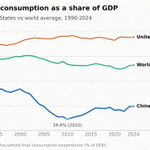
"Raising the consumption share of GDP is not a stimulus decision. It is a distribution decision. Household consumption is low, below 40% of GDP against a global norm around 55 and an American share near 70. This is because household income is low as a share of what China produces, and because insecurity forces much of that income into precautionary savings.
Changing it means raising wages faster than output, paying positive real deposit rates, granting migrant workers the urban welfare their taxes fund, forcing state enterprises to pay dividends to the treasury rather than reinvesting in capacity, and building the pension and healthcare systems that would let a household in Chengdu spend like a household in Osaka."

1
150
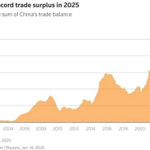
"What the home market cannot absorb must be sold abroad at any price. This is the mechanism by which China’s domestic deflation becomes the world’s problem, and the numbers have gone vertical. The $1.2 trillion goods surplus of 2025 was 20% larger than the year before; exports grew another 13% in the first half of 2026.
Brad Setser, the former Treasury official now at the Council on Foreign Relations, calculates that China’s manufacturing surplus now exceeds $2 trillion, above 2% of global GDP. This is larger than the peak surpluses of Germany and Japan combined, and since 2019 China’s export volumes have grown around 40% while its import volumes have grown just 1%. That is not trade. That is disposal."

3
139
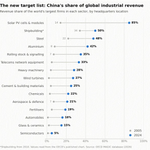
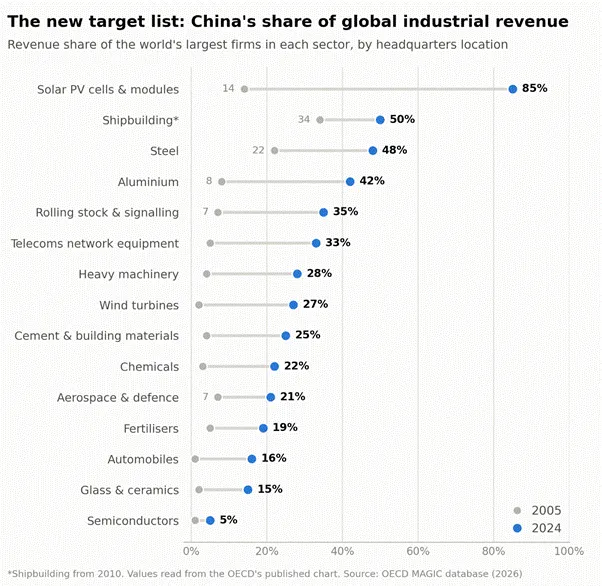
"Faced with the largest demand shock in its modern history, Beijing did not reach for the household. It reached for the factory. The credit that once flowed to developers was redirected wholesale into manufacturing, under the banner of “new quality productive forces”: electric vehicles, batteries, solar, shipbuilding, robotics, semiconductors. The results are, on their own terms, staggering.
China is now the world’s largest car exporter, builds around half the world’s ships, controls some four-fifths of solar manufacturing capacity, around three-quarters of battery capacity, and, as the DeepSeek moment of January 2025 announced, is closing the gap at the technological frontier. China’s share of global manufacturing, already around 30%, is projected by UNIDO to approach 45% by 2030."
Read the whole article here -
nitter.cf/AnthonyFatseas/status/…

China has destroyed $18 trillion of household wealth and posted the largest trade surpluses in history at the same time. That is not a paradox. It is the model. Part three of the series: why China cannot buy its way out.

1
80
For two years the world has run the most aggressive trade policy experiment in a century.
Record US tariffs. EU duties on Chinese EVs. Supply chains rerouted through Vietnam, Mexico and Hungary.
The imbalance it was all meant to correct got bigger. 🧵
1
178
The surplus is not in dispute anymore. The fight is over who pays to unwind it.
It closes through negotiated adjustment, the progressive closure of markets, or the writing down of debt.
1
60
Read the full article here -
nitter.cf/AnthonyFatseas/status/…
China has destroyed $18 trillion of household wealth and posted the largest trade surpluses in history at the same time. That is not a paradox. It is the model. Part three of the series: why China cannot buy its way out.
61