

I'm interested in humanity, but only anthropologically and biologically. Socially, not so much. 🇭🇹🇯🇲🇺🇲 YouTube: https://nitter.cf/t.co/SRcYL8ExPH
United States
Joined July 2023
- Tweets4.5K
- Following78
- Followers466
- Likes1.3K


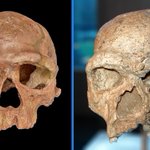


Photos of Pintubi 1, an African American skull, the Jebel Irhoud composite skull, Cro-Magnon 1, and a European skull. The Jebel Irhoud composite skull is comprised of the Jebel Irhoud 1 cranium, Jebel Irhoud 11 mandible, as well as a maxilla and teeth from other specimens.


Perhaps what you're inferring to have been a persistent OOA population was simply a Basal Eurasian lineage.

Aside from East Eurasian admix in Iran/CHG
all ancient West Asian DNA samples identified so far fall between SSA and European UP HG populations
To me this suggests that the ancient Out of Africa populations in West Asia did not die out

2
1
867
The TMRCA of E-M35 as a whole is only ~24 kya, and its formation date is only ~34 kya. E-M35 is a subclade of E-M215, which formed ~41 kya (alongside its brother, E-V38, which is SSA). Furthermore, all older subclades of E are African. E-M35 is too young to have been part of OOA.


10:) Finally, nothing here contradicts the deep African origin of haplogroup E ~65k. Both Natufians and Taforalt share a common E-M35 ancestor with an estimated origin ~33kya and TMRCA ~25kya. According to Haber,m for example, E-M35 may already have been outside Africa under out of Africa scenarios at a date older than that TMRCA.
In fact, many studies refer to a Levantine or Near Eastern background in the Taforalt population.
A haplogroup’s deep origin doesn't automatically imply autosomal North African admixture in Natufians.


Also, the Takarkori were not ANA. I've written a blog about them, with calculations produced via formal statistics tools to support my argument.
origin-of-the-species.blog/b…


I don't think it's complicated. IMO, H. heidelbergensis formed in Africa and spread to Eurasia. In Africa, it became sapiens; and in Eurasia, it became Neandersovan.

Herto Man looks like a hybrid of H. sapiens and H. bodoensis. So, he still proves that H. sapiens were in East Africa by ~160 kya. His robust brow ridges and facial size are bodoensis traits, while his overall skull shape and orthognathism are sapiens traits.

1st Image: Bodo cranium [~600 ka]
2nd & 3rd Images: Nduto cranium [~450 ka] & its virtual reconstruction
4th Image: Kabwe 1 [~300 ka]


1
6
1,015


