

Disciple of Evola. I post about Baltic mythology, history, and things I find interesting
Barad-dûr, Mordor
Joined September 2024
- Tweets2K
- Following47
- Followers1.2K
- Likes13.9K



Long before Scots sailed for America in numbers, they went to Lithuania. At the peak in the early 1600s, an estimated 5,000 to 7,000 lived in the Polish-Lithuanian Commonwealth.
Kėdainiai drew many of them. In 1627 Kristupas Radvila opened the town to settlers, and within two years Scots were teaching at the Reformed school. Merchants bought plots around the market square and built brick houses, shop below, family above. The town records are full of Andersons, Gordons, Cooks and Forbeses. In 1658 the mayor was a Scot, David Anderson.
The parish records survive, so we know how the Cook brothers' fight with George Anderson. The brothers had to apologise and pay for the brawl with a barrel of peas and some black woollen cloth. Anderson had to give the poor a cask of rye and a side of bacon for his part in it

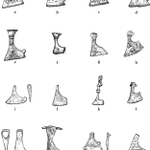
The Curonians buried their dead with miniature versions of just about everything from scythes to riding spurs. A single grave at Sāraji in western Latvia contained a little axe, a spur, a needle, a weaving blade and four tiny weaving tablets. Elsewhere, archaeologists have found miniature axes and scythes buried alongside their full-sized counterparts.
On the Lithuanian coast, some of the earliest pieces were carved from amber. Seventh- and eighth-century women’s graves at Palanga and Lazdininkai yielded little amber copies of the tablets used to weave sashes. The tablets were barely an inch across, each pierced at all four corners. At Laiviai, one grave held a set of four in silver. Another held a miniature clay pot with a spiral ring tucked inside. Miniature pots also turn up in Samogitian graves.
Similar finds are known elsewhere in Europe. A Viking Age grave on Gotland held a miniature spear, sword, shield, horse and chair, all hanging from a single ring. In Anglo-Saxon England, mourners sometimes placed tiny combs and grooming tools in cremation urns.


The greatest Lithuanian philosopher without doubt is Algis Uždavinys (1962–2010).
He trained as an art historian and became an internationally recognised scholar of ancient philosophy, Hermeticism and comparative religion. He followed the Traditionalists René Guénon, Frithjof Schuon and Ananda Coomaraswamy in holding that ancient religions contain genuine metaphysical knowledge.
The consensus story says Greek philosophy began as a rational break from mythology and religion. Uždavinys argued that it was a sacred discipline from the start, inseparable from ritual, initiation and the transformation of the soul.
He traced links between Egyptian religion, Pythagoreanism, Platonism, Neoplatonic theurgy, Hermeticism and Islamic Sufism and the metaphysical principles they share.
He died in 2010, aged 48

This is in my opinion, the best and most interesting book for anyone interested in occultism. It serves as an introduction to the Western ceremonial tradition for those unfamiliar with it, and does so through a rather humorous autobiography. Ceremonial magic, exorcisms, demons it has a bit of everything

2
16
559
A Teutonic knight once escaped being burnt alive at a Lithuanian king's funeral because he was missing an eye.
He had lost it in battle against the pagan Lithuanians, who took him prisoner. Their king grew fond of him, gave him gifts and made him a counsellor. When the king died, his nobles quarrelled over who had been his closest friend. They settled on the crusader. He would accompany the king into the next world. The dead king already sat on his horse in full armour, with the wood piled around him.
The knight said a prayer and thanked them for the honour. He had one concern. Their king had been a man of such perfection. Would it grieve his soul to spend the next life looking at a man with one eye? If they still thought him worthy, he was prepared to go.
The nobles agreed that a one-eyed man was hardly fit company for the king. They thanked the knight for his loyalty and sent him home. Another of the king's friends was burnt in his place.
Philippe de Mézières recorded the story in *Le Songe du Vieil Pèlerin* in 1389, saying the older knights of the Teutonic Order had told it to him


When the pagan Prussians met the crusaders, one of their chief concerns was that the newcomers appeared to eat grass like cattle.
Peter of Dusburg tells the story. After the Teutonic Knights built Balga Castle, the Sambians sent one of their elders to find out how the brothers lived. The knights knew why he had come. They welcomed him and showed him round their dining hall, sleeping quarters and church.
Back home, the elder reported that the brothers were much like the Sambians. They carried much the same weapons and had the same big, soft bellies. One habit worried him, though. Every night the brothers got out of bed and gathered in the chapel to worship their god.
Then there was the matter of dinner. The elder had seen the brothers eating cabbage. The Prussians, Peter says, did not eat it, and the elder had taken it for grass. “They eat grass like horses or mules,” he told the Sambians. “Who could resist them, if they can find food so easily even in the wilderness?”

I doubt we shall ever see another actor quite like Alain Delon. Hollywood never truly embraced him, omitting him even from its Oscars tribute. Hardly surprising, perhaps, given that Delon was unapologetically a man of the Right.
He sympathised with the anti-immigration French right, maintained a friendship with Jean-Marie Le Pen, he admired Waffen-SS officer Léon Degrelle, defended capital punishment and held deeply traditional views on marriage and family. Yet he was also an outspoken supporter of Ukraine.
A legend in every sense of the word


In western Lithuania, children who went into Stabgirė forest were told to leave something on the Devil’s Table. A few berries, mushrooms or flowers would do. This custom was still remembered in the twentieth century.
The stone table of Velnias (a being in Baltic mythology later identified with the Christian devil) lay near Vaitimėnai, on a low rise surrounded by marsh, along the shore of a former lake. It was a broad slab of red granite with two smaller stones beside it, known as the Devil’s Chairs. Local people called the place Velnių sostinė, “the capital of the devils”.
In 1994, locals recalled what their parents used to tell them. The velniai gathered there to dance and sometimes showed themselves to people. The mark on the tabletop, which others described as a horseshoe, was said to be a footprint one of them had left while dancing. Another tradition held that people who had lost something could go to the stone and find their missing possessions among the lichens.
Who received the children’s offerings? People said this was where Velnias passed back underground. Reading those accounts together, archaeologist Vykintas Vaitkevičius interpreted the stone as an altar at a forest sanctuary associated with Velnias and the world of the dead.
The forest’s name admits two readings. Stabgirė suggests stabų giria, “forest of idols”. Vaitkevičius also points to the western Baltic word stabis, meaning “stone”. The name may refer to the stones themselves


Not so long ago, the belief that you could feast with the laumės (forest beings akin to dryads) was still alive in Lithuania.
Lithuanian folklore preserves several names for sacred stones called “tables”, among them Dievo stalas (God’s Table), Velnio stalas (the Devil’s Table) and Laumių stalas (the Laumės’ Table). The one at Paindrė lay in the fields near Dusetos. Local people said the laumės once lit fires on the stone and cooked their own meals there.
At Sekminės (Pentecost), once the spring fieldwork was done, villagers brought food and drink to the stone. An account collected around 1935 says the women hitched up their skirts and danced around it. Balys Buračas wrote that young and old alike sang, ate and drank “to the health of the laumės”. They laid slices of bread and meat on the stone and poured beer and mead over it, asking the laumės to watch over their fields.
During one feast, someone knocked an open beer barrel off the stone. As it rolled away, beer poured from the bunghole. One man went to stop it, but an elder called out, “Leave it, that’s the laumės’ share!” So they let the whole barrel drain.
The stone survives. In 1973, drainage workers hauled it from the fields of Paindrė to nearby Davainiai. It now rests on its side beside the Dusetos–Užpaliai road and can no longer serve as a table.
Even Baltic pagans were arguing with young-earth creationists in 1413.
King Jogaila was in Samogitia preparing the locals for baptism. His Dominican preacher, speaking through an interpreter, went into some detail about the creation of the world and the fall of Adam. At this point one of the Samogitians interrupted.
“He tells us about the creation of the world as though he had seen it himself. But that cannot be. He is not that old.” Besides, the man added, some of their own elders were over a hundred, and none of them remembered it.
Jogaila told him to be quiet. The friar had never claimed to be there and that God had made the world 6,600 years ago. I doubt the king convinced him, but even a clever peasant had to relent

In Lithuania, Vytautas the Great is a national hero, though his biography is colourful enough for a Game of Thrones plot. For one thing, he once escaped from prison dressed as a woman.
In 1382, Vytautas and his father Kęstutis went to meet his cousin Jogaila for peace talks near Trakai. They had been promised safe conduct. Jogaila had them both arrested. Kęstutis was strangled at Krėva Castle, and Vytautas was later sent there under guard.
According to the Lithuanian chronicle, Vytautas’s wife Ona heard that her husband might be next. Two maids regularly came to her chamber to make the bed, and the guards were used to seeing them come and go. On Ona’s advice, Vytautas put on one maid’s clothes while she stayed behind. Then he walked out past the guards with the other.
From Krėva he made his way to his sister’s court in Masovia, then on to Prussia. There he sought refuge with the Teutonic Knights

Christian vows end at death. Lithuanian pagans kept theirs running longer, and a wife sometimes had to follow her husband into death.
In 1205, a Lithuanian force returning from a raid in Estonia was ambushed near Ropaži. Duke Žvelgaitis and many of his men were killed. Fifty of the women they left behind took their own lives. Henry of Livonia records the reason: they would “soon live with them in another life”

I used AI to try to recreate what Vytautas the Great might have looked like, based on the only photograph we have of his skull (hopefully we'll find it soon...).
And the meme checks out. He was a square-faced Chad


In 1429, when Sigismund of Luxembourg proposed crowning Vytautas the Great king of Lithuania, Vytautas turned to his cousin Jogaila, the king of Poland, and spoke to him in Lithuanian. How much would a Lithuanian today have understood?
They could at least have got his attention. According to linguist Bonifacas Stundžia, the name Vytautas sounded the same six centuries ago. His accent is a more interesting question. Linguist Jonas Palionis suggested that Vytautas may have spoken Dzūkian, a southern Lithuanian dialect. His reasoning was that Vytautas was probably born in Trakai, which Palionis placed in Dzūkian-speaking territory at the time. He thought the duke’s speech later in life may have mixed features from several dialects.
Even an ordinary remark about going to the bathhouse gives some idea of what would sound familiar. Stundžia suggests Vytautas might have said anas eit pirtiesp, “he’s walking towards the bathhouse”. A Lithuanian today would recognise pirtis, “bathhouse”. The surprise is the ending. Where a modern speaker would say pirties link, using a separate word for “towards”, Vytautas could have said it all in one word, pirtiesp.
As for what Vytautas actually said to his cousin that day, he urged Jogaila to take his time and consult his bishops and nobles before agreeing to the coronation. We know because Vytautas reminded him of the conversation in a letter a few weeks later. Even the words “but we said to you in Lithuanian” have come down to us in Latin

How do you pave a road through a Lithuanian swamp? Much of the work was done in winter. Once the marsh froze, the builders hauled stones onto the ice, cut openings and let the stones sink into place. They came back in later winters and added another layer, until the roadbed held.
The roads were named after what they were made of. A kūlgrinda was paved with stone (kūlis is “stone” in Samogitian), a medgrinda with timber. A žemgrinda was an earthen causeway, sometimes reinforced with logs and stones. At Alkupis the builders laid pine logs across the route, covered them with sand and finished the surface with two layers of stone.
Width varied. Some paths were barely 60 cm wide. Others ran 2 to 3 metres, enough for a cart, or for two riders to pass each other. At 4 to 6 metres two carts could pass, and we can assume that stretches like these were closer to a public road in medieval times than to a secret path. Sietuva was exceptionally broad. One stretch ran 250 metres, around 8 metres wide for most of it and up to 20 metres where it crossed the stream.
By the 19th century the Sietuva crossing appeared on maps as part of the road from Kaltinėnai to Tverai. A local account says the poet Dionizas Poška crossed it with three horses in the early 1800s. People from Požerė used it to reach church festivals in Tverai, and it stayed in local use into the 1950s. At the stream the water rose so high on the horses’ flanks that people raised the seats on their carts

One of the more ingenious features of pagan Baltic defences against the Crusaders was the kūlgrinda, a secret road hidden beneath the water of a swamp.
These were stone-paved passages, sometimes wide enough for horses and carts, allowing local warriors to move between fortifications or escape advancing armies. To an outsider, the road was practically invisible. A wrong step could send a man into deep bog mud.
During the 13th and 14th centuries, such passages formed part of the defensive infrastructure of Lithuania and Samogitia. Several kūlgrindos have survived to this day, particularly in western Lithuania, although many others have been lost or remain undiscovered.
One of the best-known examples is the Sietuva kūlgrinda. In 1903, archaeologist Ludwik Krzywicki investigated it and noticed something peculiar: rather than taking the shortest route across the swamp, it deliberately twisted through low-lying ground. He concluded that the builders wanted to make the road difficult for enemies to follow.
Three surviving stretches at Sietuva measure 250, 180 and 150 metres. They are thought to have formed part of a secret route connecting the fortresses of Medvėgalis, Paršpilis and Šiuraičiai
