
https://nitter.cf/t.co/nkbSIZxdiB
Joined June 2024
- Tweets4.1K
- Following152
- Followers256
- Likes218



Amidst all the remorseless restoration carnage it is a delight to come across art that is never touched; that is safely protected between the covers of books, as on the site Beautiful Bookplates - which offers nothing less than "One beautiful bookplate, every day".
@exlibrisperdiem

1
46
In ARTnews it is said:
"A painstaking nine-month restoration, recently finished, has found the monumental painting looking considerably more like the one El Greco envisioned..." That is a mis-statement: what survived was what El Greco painted, not what he imagined or intended to paint.
It would a welcome development if critics accompanied their accounts with matching format photographs showing the work before and after its "restoration."
artnews.com/art-news/news/el…

26
If we take a single quadrant of the El Greco painting (here the lower left), the extent of the tonal debilitation-through-cleaning becomes much clearer:

1
26
If we take a slice of the quadrant, the debilitation becomes clearer still...and if we examine a further detail in the top-right corner we can see that above the black haired man's head, three diagonal rays of light have disappeared and the light-ish cloud behind his head has changed. Why are such alterations either not noticed or not acknowledged by restorers, curators, funders or art critics?

1
18
SAME OLD RESTORATION GUFF. SAME OLD ART CRITICAL CREDULOUSNESS.
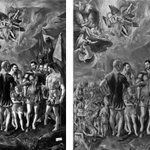
ARTnews reports that a nine-month restoration (supported by the Fundacion Callia and Spain’s Patrimonio Nacional) of El Greco's, "The Martyrdom of Saint Maurice and the Theban Legion" (1580–82) has "revealed vivid colors long hidden beneath centuries of varnish, dirt, and repainting". This echoes the claims made for Michelangelo's Sistine Chapel ceiling when restorers removed much of the artist's last stages of shading and proclaimed him a hitherto unsuspected brilliant colourist. The problem with restorations and their critical receptions is, in a nut shell, that curators, scholars and restorers believe that painters work with colours when in truth they work with a gamut of (relative) "values" - values which are comprised of both tone and colour. Thus, it should follow that if restorers were only removing dirt and discoloured varnishes, we should not only expect to see a more intense colours but also a greater and more intense range of tones, of lights and and darks. That did not happen on the Sistine Ceiling and it has not happened with this El Greco. Moreover, as with the Sistine Ceiling, features and distinct relationships - which were previously present under all the so-called dirt and discoloured varnish - should have emerged with greater vivacity. That has not happened - to the contrary the picture has been left tonally weakened - as can be seen below when we compare the pre- and post-restoration states of the painting in both colour and greyscale:

2
41
THE KEEPING OF EYES ON BALLS
With the British Library effectively stealing and hiring off for profit over a quarter of its publicly available reading spaces, a spotlight falls not just on its present director - officially titled Chief Executive - Dr Paul Bate, but also on its trustees and - guess what - it turns out that those trustees seem themselves to be uniquely remunerated at £9,130 p. a. As for their chair, Professor Dame Carol Black GBE FRCP FMed Sci, she receives £35,180 p. a. for what must be a part-time job - she being variously also chairs of the Centre for Ageing Better; the Centre for Homelessness Impact; and, a member of the Boards of the Institute for Employment Studies and an advisor to RAND Europe on health and work. Additionally, she has been the Independent Adviser to the UK government on combating the misuse of drugs since 2022.
It's Not Just the National Gallery that conceals its messes - the Financial Times discloses:
"The files reveal that Deutsche accidentally leaked President Donald Trump’s tax statement — and chose not to tell the White House; processed $582mn of suspicious payments linked to Jeffrey Epstein; paid a Qatari royal $80,000 a month for consulting while doing business with his relatives; and chafed at regulations while pledging to abide by them.
To borrow a phrase from one of Sewing’s lieutenants, it is an “absoluter Cluster-f?k”.
1
47
Its not just the National Gallery that messes up its pictures in the names of restoration and "conservation". Indeed, it is a near universal problem - as this well-illustrated ARTnews account reveals: artnews.com/art-news/news/el…
17


Wimbledon Fields writes:
"The famous bogus [British Museum Reading Room] 'echo' advice to tourists was coined by Gerrard Hoffnung in his 1958 Oxford Union address. It included:
'All London brothels display a blue lamp' & 'on entering a railway compartment, make sure to shake hands with all the passengers' amongst others."
In the New Statesman competition suggestion was made that while prostitution was legal in London prostitutes were only permitted to ply their trade on London buses - where they were required to introduce themselves by saying "Tickets please."
2
132
As a reminder of the National Gallery's longstanding and present technical defences of its not-Raphael "Madonna of the Pinks", consider the two earlier press exchanges below:


Following his pellucid demolition (below) of the National Gallery's supposedly scientific corroboration of its not-Raphael "Madonna of the Pinks", Jan Geshke now ices his own case:
"Let me quote a mail by Dr. Heinrich Piening, Head of Restauration at the Bavarian State Museums here:
'Hello Jan,
Those are quite a few hypotheses. I’ve looked into some of them in the meantime. Fascinating what people come up with, both in their experiments and their imagination.
I’ve worked with bismuth myself, using it in a historical technique. It was intended as a ground for lustre painting, as a cheap substitute for silver.
Otherwise, the stuff isn’t really suitable, certainly not as a grey pigment, since it cannot be ground into a paint and reacts with almost all binding media, especially oil. It develops a colour, which is certainly not something one would want.
Bismuth only makes sense when used as a reflector. Such areas would be impossible to overlook in an analytical examination, though certainly not in infrared reflectography.
That faint hint of grey is pure fantasy.'"

Please don't cancel the colour wheel:
hyperallergic.com/richard-po…

39
!n the 1970s the New Statesman invited readers to submit misleading advice to tourists. One suggested that tourists should visit the British Museum Reading Room "To test its famous echo". That hallowed space, where the military historian and one-time Black Dwarf editor, Douglas Gill had occupied the same chair as Karl Marx, was succeeded by the much larger public British Library. Who advised its present director - as Dalya Alberge reports - to "outsource its security workforce and hand over three of its [eleven] public reading rooms to be 'repurposed' as business spaces for hire - despite having reportedly received millions of pounds from the public purse to refurbish those spaces..."
theguardian.com/books/2026/n…

Whose National Gallery, would you suppose, offers spaces for hire on a promise: "Where creativity is found, connections are made and inspiration is at every corner. Host your event in one of the greatest art galleries in the world."
nationalgallery.org.uk/venue…
On Apollo's "Book of the Year" - a delicious account of what sounds like a boon to Holbein Studies:
"When Elizabeth Goldring published Nicholas Hilliard: Life of an Artist in 2019 she demonstrated that it was possible to write a cogent biography of an artist working in the 16th century despite the paucity of such personal sources as diaries or letters. When she undertook to write a life of Hans Holbein the Younger, she faced an even greater test. Holbein was born in Germany and his career took him from Switzerland to England. He seems never to have learned much English. Unlike Hilliard, who wrote a treatise on painting that contains intriguing autobiographical nuggets, no documents provide more than tantalising glimpses of Holbein’s personality. Anyone writing about him must also negotiate the complexities of religious identities in Reformation Europe and the treacherous intricacies of allegiance at the court of his major patron, Henry VIII. "Goldring rises superbly to these challenges. Her unfailingly elegant, sensitive and probing text assembles the scattered evidence – such as accounts of court festivities and records of lost paintings and drawings, as well as the surviving works of art – to create a compelling portrait in the round. As she emphasises, neither Holbein nor his patrons thought of him as an ‘artist’ in the modern sense: rather, he was a superbly talented craftsman, who could produce to order a design for a clock or a piece of jewellery as readily as he made the portraits for which he is famous. Goldring’s shrewd analysis of his paintings takes into account the most recent documentary and technical evidence in order to strip away the centuries of legend that have accrued around them, revealing the consummate technique and psychological insight that allowed Holbein to create a picture of his age with such uncanny immediacy. Produced by the Paul Mellon Centre to an exceptional standard, and with more than 250 colour illustrations, Holbein: Renaissance Master does justice to its subject with unprecedented beauty and completeness."
Michael Hall, former editor of Apollo.

Petronella Wyatt shows Eleanor Powell - "the greatest female tap dancer of all time, gives Fred Astaire a run for his money in the famous 'Begin the Beguine' number in 'Broadway Melody of 1940. Powell possessed such precision that even Astaire was nervous of dancing with her, admitting in private that she was arguably better than he was."
66