

biotechnology stock investor
USA
Joined January 2025
- Tweets2.4K
- Following76
- Followers1.4K
- Likes2.4K




Pinned Tweet
I aspire to identify stocks that can be purchased now and held for a year to achieve long term capital gains. I seek to identify stocks that will at least double in value. I encourage you to consider these stocks yet do your own research before investing.
$AQST Quarterly Earnings
Going into earning this week, keep in mind that existing product sales have been decreasing. "The consensus revenue estimate sits at $11.02 million, down from the $12.81 million reported in Q3 2025." There will be algorithms that focus on that. This could impact the stock price.
Informed investors know to keep their eyes on Anaphym, Libervant, and AQST-108. Those bring the opportunity for a massive increase in sales revenue.
Those same algorithms will be much more supportive next November when there is high revenue growth relative to Q3 2026.
$CRDF They likely post the quarterly next week.
I know we will all be looking for subtle clues in the text. Yet, I do not expect to find anything.
When they have a partnership in place, they will issue a PR. Until that happens, I expect no clues.
Yes, I think it is highly likely that they make some kind of deal by January. It would be nice to see that happen in November so the phase 3 could start early 2027.
Until late January, I encourage patience. It is not time to get anxious.
$COYA Neurofilament Light Chain (NfL)
There is nothing really exciting about this presentation at NEALS focusing on Neurofilament Light Chain (NfL). Yet, we do learn that "individuals participating in the ALSTARS Trial were grouped into three tiers - low, medium and high - allowing for a prospective stratification and balanced randomization across treatment arms."
In prior studies, NfL did not have a real strong relationship with outcomes for this treatment. But, it is a marker that the FDA has recognized in the past. Therefore, it has the potential to be helpful in the FDA approval process.
ir.coyatherapeutics.com/news…
$VKTX VANQUISH Results Timing
Both VANQUISH studies began in June 2025. The company has announced that the VANQUISH Extension Studies will commence in 1Q27. This means that the initial group of patients in the study will reach the end of the 78-week treatment period.
Both VANQUISH studies began in June 2025. 78 weeks from July 1, 2025 is December 29, 2026. So, initial dosing for the first groups was likely in early July. That group would reach the end of 78 weeks in early January 2027.
VANQUISH-1: Enrollment was completed in November 2025. The trial exceeded its initial target size by enrolling approximately 4,500 adult patients with obesity or overweight and at least one weight-related comorbidity.
So, my best guess is that the last cohort reaches the 78-week mark by June 2027. It is going to take months to confirm and analyze the data for this study. My best guess is that they do not announce the results until Obesity Week, November 8-11, 2027.
(Yes, they will know the results months prior to releasing them to the public. This will not delay the FDA submission. Releasing data at Obesity Week will garner more attention from both the medical community and the general public.)
VANQUISH-2: Enrollment was completed on March 26, 2026. So, the last group should reach the 78-week mark by November 2027. Maybe, these results get released at an early 2028 Diabetes Meeting.
Solid results in both studies should prompt a single NDA to the FDA in approximately March 2028. So, the drug could begin selling in significant numbers in 2029.
$BCTX Phase 3 Timing
Today's SEC filing still shows an interim analysis happening in 2026.

$KURA Next Quarterly?
There is a good chance that the quarterly call will be next week.
Bring on those new patient starts in 3Q numbers. Let's see the total number of prescriptions.
Maybe, we get some more info on the timing of the expected data releases.
$FATE ARTV Shutdown
$ARTV has shut down all programs including NK cell treatment for autoimmune disorders. They had two deaths and the "durability of clinical response did not meet the threshold the Company required to support continued development."
One death appears to related to chemo conditioning with Fludarabine. FATE is quite intentional in avoiding use of Fludarabine.
Any company that offers a Fludarabine-free treatment will have a distinct advantage.
investors.artivabio.com/News…
$ABEO Next Quarterly Soon
They have not announced the next quarterly, but it will likely be in a couple of weeks. Roughly, Wednesday, November 11.
It is all about those patent numbers for the last quarter and any partial numbers they report for the current quarter.
$AQST Upcoming Quarterly
There will likely be a quarterly call next week. Concerning the Anaphylm FDA review, I do not expect them to say much. We should get a vague statement that all seems to be progressing.
The most encouraging statement they could make is that they have a meeting scheduled with the FDA to discuss labeling. It seems too early for that. Three weeks from now, that statement is much more likely. Yet, my guess is they will only release that info at a quarterly. So, next news is probably approval early in 2027.
We should get:
-More talk about the sales and marketing plan for Anaphylm.
-Status of Anaphylm applications beyond the US. (Health Canada expected in Q4 2026. We are not expecting any licensing deals until later in the review process.)
-An overview of the Libervant out-licensing deal.
-An AQST-108 update. The status of the dose finding studies.
So, overall a fairly quiet quarterly. The late February 2027 quarterly could be really interesting.
(Be aware that there could be some stock price volatility triggered by computer algorithms responding to earnings. Informed investors know that earnings for current products is not the primary focus at this time.)
$IOVA Frontline Melanoma Timing
More great Frontline Melanoma news today. We have clarity about the potential timeline for getting NSCLC before the FDA (early 2027). The timeline is much more blurry for Frontline Melanoma.
The TILVANCE-301 phase 3 added the first patient in June 2023. It sure would great to see them fully enroll the last of the 670 participants in late 2027.
The TILVANCE-301 trial includes an early interim analysis based on ORR for a potential sBLA for frontline advanced melanoma. Presumably, it is going to take about 6 months post-treatment to capture the Confirmed ORR data.
So, my best guess it that we should look for that interim data release in mid-2028.
ir.iovance.com/news-releases…
$ELTX Interesting Data
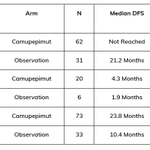
So, I own less than 5 shares of this stock, but I like to follow vaccine approaches to cancer treatment. The headline is they missed the primary disease-free survival (“DFS”) endpoint.
Yet, they provide the reasonable explanation that the treatment group had a higher proportion of ctDNA positive participants. A quick look at the table below shows that this makes a big difference. There is a huge difference in the outcome based on ctDNA status.
The chart also shows encouraging response to the vaccine intervention when they analyze by subgroups. They plan to stratify based on ctDNA in the phase 3.
I would run the phase 3 with exclusively the "No Prior Radiation" group. You go for your best shot at approval and then build off of that later.

$BCTX Today's New Data
"Recent studies have shown PD-L1 upregulation in Cancer Associated Macrophage-Like cells (CAMLs), which are giant phagocytic macrophages that engulf tumor before entering circulation, predicts ICI response."
Patients with consistently high or increasing PD-L1 on CAMLs after treatment tend to have the best outcomes.
So, the tumor is under attack. It fights back with checkpoints. When checkpoint levels go up, that tells us there is an active battle. The checkpoint defense is overcome by using immune checkpoint inhibitors.
In the study reported today:
"The analysis evaluated changes in programmed death-ligand 1 (“PD-L1”) expression on circulating cancer-associated macrophage-like cells (“CAMLs”)."
A key finding in the study released today was:
"At T2, approximately three months following initiation of immunotherapy, CAML PD-L1 was significantly associated with both PFS (HR=2.73; p=0.0028) and OS (HR=2.27; p=0.0420)."
So, we know that many participants in the phase 2 responded to treatment as measured by PFS and OS. From this blood test, we learn that treatment has prompted the immune system to attack the tumor and the tumor is trying to use its defenses to fight back.
One potential use of this finding is the blood test could be used to identify those who will live longer. You give this test at three months after treatment and predict what will happen with OS well in the future. With the improved versions of this therapy that are in the pipeline, this could provide early feedback about how well they are working.
It would be really helpful if that informed treatment in some way. What can be done to help those who are responding? Do they need another dose of an immune checkpoint inhibitor (ICI)? What can you do for those who are not responding?
Maybe, there is a way to approach the FDA and use this data to seek Accelerated Approval. This blood test could be determined to be a Surrogate Endpoint. They likely need more data to convince the FDA, but when they move this to other indications beyond breast cancer that could become an option.
2f04c740.delivery.rocketcdn.…
$TGTX Excellent News!
The safety is solid. They have achieved these results with relatively low levels of chemo conditioning and an off-the-shelf product - That is really important!
Efficacy will only get clearer and better as there is more data from the high dose cohorts. Efficacy appears good enough to proceed given low levels of chemo conditioning and an off-the-shelf product.
They need to run a few more subjects at the higher doses. Then, setup a meeting with the FDA to plan a registrational study.
Given other recent CAR-T autoimmune registrational studies, FDA will probably require under 50 participants. This is much closer to FDA approval than many are aware!
$EYPT $OCUL If EYPT was just going to shut down at this point and distribute the cash this would be viewed differently.
The issue is that they are going to spend most of that cash on the DME program. So, a buy here is a bet that you expect the DME program to succeed. If it fails, the company shuts down and is probably a complete loss.
So, you better take a really close look at the DME program. You also need to be aware of competition like $OCUL.

$EYPT trading at a ~$37M market cap while holding ~$118M in cash & short-term investments (as of 9/30).
That’s roughly 1/3 of cash (negative EV) after the wet AMD Phase 3 miss and 53% workforce cut. Market is pricing the remaining DME program (readout Q4 2027) at near zero.
You do the math
$OCUL $EYPT Diabetic Retinopathy
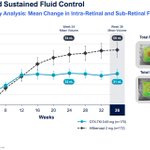
I decided to take a closer look at the EYPT Diabetic Macular Edema clinical trial data. It included about 27 participants. My review prompted some significant concerns.
The medication seems to not last much longer than Eylea. By week 24, the numbers do not look good. These values suggest that DURAVYU lacks the sustained release properties we have seen in AXPAXLI.
It was a risky move to take this to phase 3 with these kinds of initial results. That study is currently fully enrolled. Eyepoint is planning to release the results in the fourth quarter of 2027. Now, the future of the company rests on this trial.
eyepoint.bio/wp-content/uplo…
In their phase 3, OCUL decided to focus on Non-proliferative Diabetic Retinopathy (NPDR) which is an early stage of Diabetic Retinopathy (DR). With participants reduced from 930 to 620, we may get word of full enrollment soon.
OCUL could provide results in early 2028. They anticipate that this study can achieve a broad diabetic retinal disease label. The data from the trial that prompted the phase 3 looks solid. (I have provided 4 relevant charts below.) It is reasonable for OCUL to approach the phase 3 with confidence. The drug shows good efficacy and excellent sustained release over a year.
By focusing on the earliest stages of the disease, OCUL seems prepared to open a large new market. If they get a broad Diabetic Retinopathy label, that is huge. The early stage disease is the novel part, so applying this to later stage disease is not a big leap. By 2028, there should be a track record for AXPAXLI with Wet MD that provides further support.
It is also important to note that OCUL has once again shown great wisdom in identifying a subgroup of patients so they moderate patient variability. This care in research design increases the likelihood of a positive result.
Even if EYPT gets good results for this indication, OCUL appears to have the far superior product. EYPT would only beat OCUL to market by a few months. This prompts major concerns about the future of EYPT.


$CRDF Orphan Drug Designation for Onvansertib in Chronic Myelomonocytic Leukemia
This designation is a positive development. It represents some helpful recognition from the FDA.
Yes, it is still all about funding that phase 3 right now for mCRC. They need to get that on firm ground before taking the next steps with the outside investigator led trials.
investors.cardiffoncology.co…

$AQST When Do You Expect an FDA Decision?
The FDA has issued a PDUFA date for Anaphylm of March 16, 2027. Many are expecting a decision well in advance of that date. What is your best guess for the month we learn of the FDA decision?
8%December
17%January
38%February
38%March
24 votes • Final results$OCUL $KOD A Small Observation
I like to be attentive to subtle non verbal cues. One subtle but interesting moment at the Chardan's Heath Conference today. The analyst asks about $KOD. The analyst states, "Wall Street acted very favorably." What is interesting is the way he laughs as he says that.
My interpretation is that the analyst thinks the $KOD stock price rise after the study results is completely irrational. It is so irrational that the analyst can not help but laugh. He just can't bring himself to say those words with a strait face even though this is a serious fast-paced interview.
Pravin Dugal responds, "We don't consider them our competitors." The analyst gives a big exaggerated nod.
This analyst's nonverbal cues make a statement.
(Yes, Dugul artfully rips apart the $KOD study with just a few concise statements. Basically, implying - good luck getting this past the FDA. It took me a much higher word count to do the same. But, what is interesting here is how this analyst reveals his evaluation of $KOD.)