
The Swedish part of the ITEA ASSIST project. Tweets by Anders Eklund. Read more at https://nitter.cf/t.co/OIvj20XzlL and https://nitter.cf/t.co/ZZa7gxyYNa
Joined December 2021
- Tweets25
- Following27
- Followers16
- Likes1

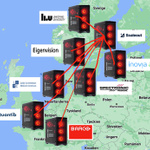




Today we passed an important milestone in the ASSIST project, by running a federated training of a brain tumor segmentation model between 3 Swedish cities (Linköping, Lund, Umeå). Welcome to the federation @TommyLofstedt and Attila Simkó

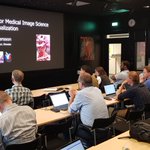
During May 23+24 ASSIST partners from Sweden, Belgium, Netherlands and Turkey met in Linköping to discuss progress and future directions of federated learning, synthetic images, treatment planning and several other topics.
Thanks to @LiU_CMIV for hosting us.


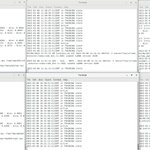
Running FEDn by @scaleoutsystem through Singularity on 6 computers for brain tumor segmentation

Synthetic brain tumor images and annotations created by a diffusion model. Looks better than images from GANs. By @MuhamadUsmanAkb

Does synthetic images and annotations from an ensemble of 10 GANs lead to better segmentation accuracy when testing on real images? Yes it seems so. Collaboration between LiU and Eigenvision. Training using BraTS 2020. Thanks to NSC and KAW for 27,000 GPU hours in October.

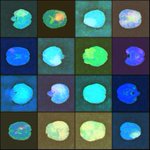
While training a diffusion model to generate synthetic images, @MuhamadUsmanAkb managed to generate som nice brain art

ASSIST Sweden retweeted

The largest #FederatedLearning study to date. 71 medical institutions across 6 continents. Stay tuned for more.
arxiv.org/abs/2204.10836
@CBICAannounce @FeTS_Challenge @PennRadiology @PennMedicine @SpyridonBakas

Due to the computational complexity of 3D deep learning, some researchers use a 2D CNN on each slice in a volume and then combine all slice predictions. @IulianE_Tampu showed that this can lead to inflated test accuracy.
arxiv.org/abs/2202.12267
Diffusion MRI is often noisy, but how do you evaluate different denoising methods? @ShreyasSF developed a noise metric to quantify the effect of for example using Patch2Self for denoising.
arxiv.org/abs/2203.01921


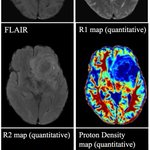
Many do research on brain tumor segmentation using deep learning. PhD student @IulianE_Tampu showed that using quantitative MR images can further improve the results, compared to using conventional MR images. Presented at ISMRM 2022.


How to best treat a brain tumor depends on the tumor grade, but to determine the tumor grade often requires a biopsy. Eleftheria Chatzitheodoridou did a master thesis on tumor grade classification from MR images, using deep learning.
liu.diva-portal.org/smash/re…
Researchers in ASSIST are taking advantage of the 480 Nvidia A100 cards in Sweden's supercomputer Berzelius, to train networks to synthesize realistic images. Thank you @KAWstiftelsen and NSC.

The ASSIST partners attended a workshop about federated learning arranged by @scaleoutsystem . Nodes in Sweden, Netherlands, Belgium and Turkey were used to train a 2D U-Net to perform brain tumor segmentation using the FL framework FEDn.


Linköping university and Eigenvision has collaborated regarding training segmentation networks with synthetic brain tumor images. Our results indicate that the main principle works but that more work is required, we will now look into using more recent GAN architectures.

Soon the partners in the ASSIST project will attend a workshop on federated learning arranged by Scaleout. Partners from different countries (Sweden, Belgium, Netherlands, Turkey) will contribute with nodes that train a segmentation network.
Looking forward to the Berzelius AI symposium, and especially the presentation by Jorge Cardoso on how federated learning is already being used between hospitals in the UK, similar to what we want to do in the ASSIST project.
nsc.liu.se/support/Events/be…
