
The Routledge book series in Audience Research. Inviting proposals for monographs & edited collections. Editor (& tweets by) @KirstySedgman
Joined April 2015
- Tweets948
- Following31
- Followers480
- Likes78



Elizabeth Swift points out that theatres and computers have a lot in common. They’re both illuminated rectangles that we’re meant to sit and stare at #ARITAconf

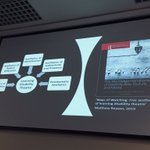
Now in the #aritaconf Ways of Engaging panel, where @matthewAreason is kicking us off with a paper about Theatres of Learning Disability. Using Kuppers framework to explain how disabled people are either painfully invisible or hyper-visible.

1
6
.@matthewAreason is interested in modes of watching - how to understand the productive disruptions to traditional models of spectatorship produced by learning disability theatre? #aritaconf – at Sheffield, England
1
1
Hoe Su Fern giving us more grist to the mill - that just cos audiences report feeling warm fuzzies towards the arts, this doesn’t necessarily mean they’ll actually attend #aritaconf

4
Jennifer Eigo: audiences from low-engaging social segments simply ARE NOT BENEFITING from public arts funding thru the Arts Council’s National Portfolio Orgs - funding that is given to NPOs (in part) to enable them to engage precisely those people! #aritaconf

(still teehee-ing about the segment Cummuterland Culturebuffs, which I’m guessing is a typo) #aritaconf – at Sheffield, England
1
2
Popular music sells out early; experimental & physical theatre sells late; art gallery visits tend to be a snap decision made on the day. Fab #aritaconf presentation on a fab Cultural Trends article by Sarah Price & @OliverMantell

Kathleen Gallagher & Anne Wessels talking theatre and youth. Theatre audience research may have looked to sociology for its methods, but not for analysis. #csar2019

1
4
Sociology reminds us that as audience researchers we're also here to learn the questions we could be asking, and to answer the questions respondents may have for us. One of their respondents asked: how will you listen to us? #csar2019
Next up, @KarenFricker2 & @LMichelleMac on 'The Emancipated Amateur", using Rancière's emancipated spectator to ask what an 'emancipated critical practice' might look like in theatre reviewing cultures (cc @churlishmeg, @BustingFree, @shakespeareanLK, @daisy5660) #csar2019
3
5
"On what basis do traditional theatre reviewers produce judgments of performances?". On the basis of the expert schoolmaster & ignorant pupil, @KarenFricker2 & @LMichelleMac argue. #csar2019
2
2
.@TheatreJenny has been focusing on an 'ethnographically-inspired, phenomenological' study of community-engaged performance. Her presentation is titled "The Work of Audiences". #csar2019
1
3
.@TheatreJenny will be drawing on @KirstySedgman's (it me!) 2018 article 'Audience Experience in an Anti-expert Age: A Survey of Theatre Audience Research':
cambridge.org/core/journals/… #csar2018
1
Now @queensjenn asking what happens when audiences become citizens? One way to think about participation is via the tension between obligations & rights. Civic structures strive to create a better world, but *also* to bring about better ways of making a better world. #csar2019
1
3
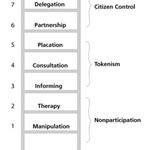
.@queensjenn considers Claire Bishop's challenge in her book Artificial Hells to Arnstein's Ladder (1969). For Bishop, 'more' participation does not necessarily = 'better' participation. #csar2019

1
1
Next @SycoraxPine on @BarbicanCentre's 2011 Lullaby. Critics could be heard muttering that £42 per ticket was daylight robbery for a theatre ticket (ah, how things change), yet one of the cheapest hotel rooms in London. #csar2019
"To fall asleep in the traditional theatre event is an expensive failure of spectatorship", @SycoraxPine says. So how then to understand a play like Lullaby, whose end-goal is the dissolution of consciousness? And how to handle the anxiety of this as a spectator? #csar2019
Now, Andy Houston on his project examining the role of theatre in “conciliation” projects with indigenous people (“reconciliation assumes that there was a good relationship to begin with”) #csar2019

1
4
Andy calls site-specific performance a 'sensorium': a performance of the found, "a place where sensory conditions can come under question - climate, smells, surfaces, etc". #csar2019
1
1
Now @melaniewilmink on audience ecologies, bringing participatory arts practices into our audience research discussions. #csar2019
1
2
.@melaniewilmink created an exhibition - a transitory space between interior/exterior, public/private - asking visitors how they might share the space with the architecture & other living beings in that place. #csar2019
1
1
Back after lunch, @larkspur20 tells us that doing audience research with museums is great - “they let you do anything you want”, & are also hungry to know more about visitors’ experiences. #csar2019

1
2
Moments of reflection - when researchers draw audiences' attention to their experience in the moment of performance - can be a powerful tool, @larkspur20 argues. #csar2019
1
1
@katejholmes & @BustingFree, someone has mentioned Erin Hurley’s work on deliberate mistakes purposefully introduced to circus! Fascinating... – at Toronto, Ontario
1
2
@TomCornford, do you know @danisnyderyoung? Dani has a book under review rn on whiteness & theatre audiences! Tom is currently thinking these ideas through too. – at Toronto, Ontario
1
1
Next up @newaudiencesold is interested in the assemblage of bodies in space - cites as her starting point @SaraNAhmed on the feeling of being “in the room”. #csar2019

Who gets to be in these spaces (and made to feel welcome), @newaudiencesold asks? And who doesn't? What are the stakes involved in that tension between "I" and "we": in the desire for community? #csar2019
Now @AstridBreel on her research into the aesthetic experience & decision-making processes of audiences at participatory performances, inc. @tassosstevens’ work with @agencyofconey. #csar2019

1
2
.@astridbreel uses the framework of 'demand characteristics' to understand the way in which the mutuality of cues in a social context influence both the experiment itself AND the work of the researcher. #csar2019
1
1
Kelsey Blair on sporting injuries as “liminal mini-dramas” with their own performative conventions #csar2019

1
What happens when spectators confront the spectacle of a body experiencing authentic injury? Audiences are rewarded for their appropriate demonstrations of support. (cc @DrBenLitherland) #csar2019
1
How to visualise the affective responses of the people I’ve interviewed, @scottmealey asked himself? This picture kinda sums it up. #csar2019

3
2
Scott has been studying anxiety in theatre audiences. Audience members often remember the first part of a performance, because that’s where anxiety tends to be processed - how to settle into theatrical form? How to navigate practitioners’ stylistic choices? #csar2019 – at Toronto, Ontario
1
1
From artistic practitioners to stage managers to ushers - everyone involved in theatre front of house is ALWAYS evaluating audience experience, @danisnyderyoung says - but this knowledge doesn't always make its way up the food chain to management. But what if? #csar2019
1
2
Working with @halcyontheatre, @danisnyderyoung asks - what if FoH employees could be trained to feed back on the audience experience? The big question: What stands out for you? #csar2019
1