

Places that look fake but are real. One a day, every fact sourced. Photos: free licenses, always credited. 🌍
Web𝕏4.0
Joined February 2022
- Tweets14.4K
- Following6.1K
- Followers954
- Likes634







Pinned Tweet
What you get here:
• Own data: I count what X talks about with its API (~400K English posts a day name an AI tool)
• AI tests: same task, several AIs, raw results
• Plain-English AI and platform rules, with sources
No hype, no price calls. Follow if that's useful.
1
95
Web𝕏4.0.eth 🩸🩸🩸 retweeted

Its time for Legacy as silence is over now !
The Design of our new showroom is ready.
Showroom at the National Road DN39 exit of Tuzla direction NIBIRU Resort.
Watch us, stay tuned now we are going full throttle as Christmas 🎄 is ahead of us, until then things needs to be making us all happy 😜♾🌐💯
BioTECH.srl
@BioTECHsrl (Telegram)
@BioTECHsrl here at X

The "stars" on this cave ceiling are alive.
Waitomo, New Zealand: they're glow-worms, the larvae of a fungus gnat. Each one hangs up to 70 sticky silk lines and uses its light to lure insects in.
Sources below 👇
1
28
Sources:
• Te Ara – Encyclopedia of New Zealand (NZ Ministry for Culture & Heritage): Glow-worms, teara.govt.nz/en/glow-worms
• Te Ara, 1966 Encyclopaedia of NZ: Glow-worm, teara.govt.nz/en/1966/glow-w… (up to 70 lines, up to 50 cm long; tens of thousands of larvae in the Waitomo Glow-worm Grotto)
Photos (Wikimedia Commons): Markrosenrosen CC BY-SA 4.0 · Michael Willison CC BY 2.5 · Mnolf CC BY-SA 3.0 · Donnie Ray Jones CC BY 2.0 · Pseudopanax at English Wikipedia PD. Map: Natural Earth. Video: CC BY-SA 4.0
16
About 40,000 stone columns stick out of the sea here.
Giant's Causeway, Northern Ireland: black basalt left by volcanic activity 50–60 million years ago. Legend says giants used it to stride across the sea to Scotland.
Sources below 👇


1
37
Sources:
• UNESCO World Heritage Centre: Giant's Causeway and Causeway Coast, whc.unesco.org/en/list/369 (some 40,000 basalt columns; volcanic activity 50–60 million years ago; giants legend)
Photos (Wikimedia Commons): P. Hughes CC BY 4.0. Map: Natural Earth. Image: CC BY 4.0

18
A man found the world's largest cave in 1990. Then he forgot where it was.
Hồ Khanh found Son Doong again in 2008. Inside: passages up to 200 m high and a jungle growing where the ceiling collapsed.
Sources below 👇
1
26
Sources:
• Limbert et al. 2016, "The discovery and exploration of Hang Son Doong", Boletín Geológico y Minero 127(1)
• Oxalis Adventure (only licensed operator): oxalisadventure.com/cave/son… (≈9 km, up to 200 m high, 38.5M m³, 200+ plant species)
• Guinness World Records 2013
Photos (Wikimedia Commons): Daniel Burka CC0 · Linhcandng CC BY-SA 3.0 · Dave Bunnell CC BY-SA 4.0 (x2) · Trantuanviet CC BY-SA 4.0. Map: Natural Earth. Video: CC BY-SA 4.0

11
NASA has used this place to calibrate satellites.
Salar de Uyuni, Bolivia: 10,582 km² of salt, about the size of Hawaii's Big Island, ~3,650 m up in the Andes. In the rainy season it turns into a mirror.
Sources below 👇
1
32
Sources:
• NASA Earth Observatory, "An Expanse of White in Bolivia" (size, ICESat/Envisat calibration)
• USGS EROS Cal/Val: Uyuni test site (3,650 m, flooding Nov–Mar)
• Fricker et al. 2005, GRL, doi:10.1029/2005GL023423
Media (Wikimedia Commons): Christopher Crouzet CC BY-SA 4.0 · Pedro Szekely CC BY 2.0 · video Poiana11 CC BY 4.0 · Diego Delso CC BY-SA 4.0 · SqueakyMarmot CC BY-SA 2.0. Map: Natural Earth. Video: CC BY-SA 4.0
49
These trees grow wild in only one place on Earth.
Socotra, in the Arabian Sea: 307 of its 825 plant species exist nowhere else. Cut a dragon's blood tree and it bleeds deep red resin.
Sources below 👇
1
28
Sources:
• UNESCO, Socotra Archipelago: whc.unesco.org/en/list/1263 (37% of 825 plant species, 90% of reptiles, 95% of land snails endemic)
• Kew POWO: Dracaena cinnabari, native range Socotra, IUCN Vulnerable
• Al-Fatimi 2018 (PMC6313928): red resin
Photos (Wikimedia Commons): valerian.guillot CC BY 2.0 · Alex38 CC BY 4.0 · Hardscarf CC BY-SA 4.0 · Rod Waddington CC BY-SA 4.0 (x2). Map: Natural Earth. Video: CC BY-SA 4.0

26
THE RECEIPTS
Nov 2017: Tesla unveiled the new Roadster. Production was promised for 2020.
Oct 15, 2026: Tesla showed it again. Elon Musk said it will enter production in 2028.
No new Roadster has been delivered yet.
Verdict on the 2020 promise: FALSE
1
36
Sources, case XNF-0005:
Then (2017 promise, full delay timeline): Electrek electrek.co/2026/10/13/tesla…
Now (2028, missed delivery dates): CNBC cnbc.com/2026/10/15/tesla-ro…
The 2028 date is now open case XNF-0027.

18
AI Hype Index: 102 (100 = a normal day). Without Grok: 104.
424,174 English posts named Grok, ChatGPT, Claude or Gemini in 24h.
ChatGPT +10.8%, Gemini +2.2%, Claude +1.1%, Grok -0.7%.
Fastest riser: DeepSeek, +37% in the last hour.
Top "is this true?" topic: tech & AI claims.

1
19
Method: X API recent counts, English, no reposts, 24h to Oct 21 21:00 UTC. Hype Index = last 24h ÷ avg per 24h over prior 143h × 100 (also without Grok). "Is this true?" topics = manual clustering of 50 sampled @grok asks, politics excluded. Keyword counts carry noise.
1
7
Grok gets tagged in ~209,000 English posts a day.
I counted 6 days with X's API (Oct 12-17, no reposts). Posts tagging each AI's X account:
Grok: 1,252,364
Claude: 10,178
Gemini app: 8,118
Perplexity's bot: 387
What people actually want from it 🧵

1
29
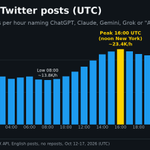
Bonus: when does AI Twitter post?
Across 2.56M English posts naming ChatGPT, Claude, Gemini, Grok or "AI agents" (same 6 days):
Busiest hour: 16:00 UTC (noon in New York), ~23.4K posts/h
Quietest: 08:00 UTC, ~13.8K/h
The peak hour has 1.7x the posts.

1
12