

Energy, critical minerals & global supply chains. Focus on strategic resources and macro trends. Covering Vaca Muerta and the Lithium Triangle.
Joined February 2026
- Tweets1.2K
- Following102
- Followers2.6K
- Likes1.4K





During the Q3 earnings call, YPF’s Marín highlighted that currently daily production in Vaca Muerta reached 252,330 bpd, already above the year-end target of 250,000 bpd.
Total oil production in Argentina reached 973,700 bpd in September, a 15.5% y/y jump, bringing it close to the 1 Mbpd milestone.
Q3's shale oil production averaged 224,000 bpd, 32% higher than in the third quarter of 2025.
In Q2, shale accounted for 80% of total oil output (now 86%), and Marín said that, excluding the assets being sold, about 95% would come from Vaca Muerta.
Capex totaled $1,3 billion (-4% q/q; +26% y/y), with 70% allocated to unconventional operations.
The oil company’s expansion plan includes filing three new projects under the RIGI regime, covering five blocks in the northern part of the Neuquén formation: Bajo del Toro, Bajo del Toro Norte, Narambuena, La Escalonada and Rincón de la Ceniza. The total estimated investment is $44 billion over 26 years, with 2,200 wells to be drilled.
YPF closed the third quarter of 2026 with one of the best financial results in its history, driven by growth in shale production, lower operating costs and higher international crude prices.
Argentina’s largest oil company reported an adjusted EBITDA of $2.5 billion (+84% y/y), the second-highest in its history, while net income was close to $1.2 billion.
$YPF


Q3'26 $VIST's revenue reached $1.23B, up 7% QoQ and 75% YoY. Realized oil prices averaged $84.2/bbl—30% higher YoY, but 6% lower than in 2Q26.
That sequential price decline partly offset the production growth. Lifting costs also increased to $4.7/boe as peso-denominated goods and services became more expensive amid a flat exchange rate. Adjusted EBITDA still rose 4% QoQ and 78% YoY to $841M, while the margin narrowed from 70% to 68%.
The standout was cash generation. Operating cash flow reached $773M, with $334M converted into free cash flow—a 43% conversion rate. Meanwhile, $VIST repaid approximately $60M of debt on a net principal basis and spent $55M on share repurchases
Net leverage declining to 1.12x, with quarter-end cash at $775M.
A hidden gem in the Neuquén basin.


$VIST Q3 2026: Argentina’s largest independent oil producer just posted a record quarter.
> Total production was 169,000 boe/d, up 33% from a year ago and a new record, while oil averaged 147,100 bbl/d (+34% y/y) and gas grew 29%.
> Exports accounted for 73% of the crude business, with overseas sales of 9.9 million barrels (+56% y/y) and $935 million in revenue from those operations.
> In the first nine months of the year, $VIST has exported more than 25 million barrels, with revenue above $2 billion.
> Lifting cost came in at $4.7 per barrel of oil equivalent (vs $4.4 a year ago), still a very competitive level versus other shale producers in the Neuquén Basin.
> Quarterly FCF was $334 million despite $460 million in capex, with operating cash flow reaching $773M.
$VIST 🔥🛢️
Austral Research retweeted

Brazil’s real ex-ante policy rate is back near 10%, the highest among major EMs and about 500bps above the estimated neutral rate. This is not the best setup for the growth outlook, especially as real GDP has been moderating since mid-2025

Austral Research retweeted
Gold tumbled more than 25% since the US Iran conflict escalated, breaking below $4000 p/oz for the first time across three months.
Rather than divesting, market participants continue channeling capital into gold ETFs, lifting aggregate holdings toward 102m ounces.
Buyers keep adding gold even as stocks tumble and institutions sell to cover margin calls, suggesting higher pressure is coming from forced selling rather than deteriorating fundamental demand, and leaving room for a rebound once the broader selloff eases.
$GLD $IAU $GDX $GDXJ

China is continuing to accumulate significant amounts of gold, with Chinese purchases through the London OTC market reaching 25 tonnes in August, 25% above the 20 tonnes officially reported by China's central bank.
China purchased 35 tonnes in July, 40 tonnes in June, and 48 tonnes in May, with estimated OTC purchases exceeding officially reported central bank purchases by 83 tonnes, or 128%, over the four-month period.
Meanwhile, global central banks are estimated to have purchased 79 tonnes of gold in August, roughly 365% above the pre-2022 monthly average of 17 tonnes.
#Gold $GLD $GDX $GDXJ

Austral Research retweeted
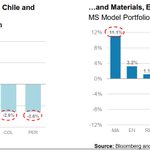
Morgan Stanley downgraded Brazil to Equal-weight, as a highly likely policy continuity scenario for the country increases pressure on fiscal risk.
> Brazil could face an increasingly challenging macroeconomic set-up: weaker currency, higher interest rates, and a slowing economy in need of an unlikely fiscal rebalancing.
> Despite the supportive global backdrop, MS expect sharp derisking to weigh on valuations.
> Why not UW Brazil?: Strong export story of Brazil, which together with the large banking sector, limit the downside of aggregate Brazilian earnings.
> Prefer to play the external side of the Brazilian
stock market, which has a lower cost of capital and its growth drivers are more linked to commodity prices than to domestic politics.
> Remain OW Chile and Argentina.
$EWZ $ARGT $ECH

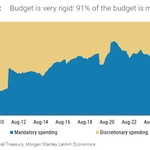
Brazil enters 2027 with rising debt, more than 91% of spending compulsory, limited room for further revenue-led adjustment, a spending rule increasingly weakened by exemptions, and a primary balance well below debt-stabilizing levels.
Measures announced during the election cycle are expected to add pressures, with a combined fiscal package implemented by the government since the beginning of the year exceeding BRL200bn (~2% of GDP).
#Brazil $EWZ

Gold tumbled more than 25% since the US Iran conflict escalated, breaking below $4000 p/oz for the first time across three months.
Rather than divesting, market participants continue channeling capital into gold ETFs, lifting aggregate holdings toward 102m ounces.
Buyers keep adding gold even as stocks tumble and institutions sell to cover margin calls, suggesting higher pressure is coming from forced selling rather than deteriorating fundamental demand, and leaving room for a rebound once the broader selloff eases.
$GLD $IAU $GDX $GDXJ
China is continuing to accumulate significant amounts of gold, with Chinese purchases through the London OTC market reaching 25 tonnes in August, 25% above the 20 tonnes officially reported by China's central bank.
China purchased 35 tonnes in July, 40 tonnes in June, and 48 tonnes in May, with estimated OTC purchases exceeding officially reported central bank purchases by 83 tonnes, or 128%, over the four-month period.
Meanwhile, global central banks are estimated to have purchased 79 tonnes of gold in August, roughly 365% above the pre-2022 monthly average of 17 tonnes.
#Gold $GLD $GDX $GDXJ
Morgan Stanley downgraded Brazil to Equal-weight, as a highly likely policy continuity scenario for the country increases pressure on fiscal risk.
> Brazil could face an increasingly challenging macroeconomic set-up: weaker currency, higher interest rates, and a slowing economy in need of an unlikely fiscal rebalancing.
> Despite the supportive global backdrop, MS expect sharp derisking to weigh on valuations.
> Why not UW Brazil?: Strong export story of Brazil, which together with the large banking sector, limit the downside of aggregate Brazilian earnings.
> Prefer to play the external side of the Brazilian
stock market, which has a lower cost of capital and its growth drivers are more linked to commodity prices than to domestic politics.
> Remain OW Chile and Argentina.
$EWZ $ARGT $ECH
Brazil enters 2027 with rising debt, more than 91% of spending compulsory, limited room for further revenue-led adjustment, a spending rule increasingly weakened by exemptions, and a primary balance well below debt-stabilizing levels.
Measures announced during the election cycle are expected to add pressures, with a combined fiscal package implemented by the government since the beginning of the year exceeding BRL200bn (~2% of GDP).
#Brazil $EWZ
Austral Research retweeted
Lula threw nearly 2% of Brazil’s GDP into the election campaign between direct fiscal and quasi-fiscal measures.
Let that sink in.

Brazil enters 2027 with rising debt, more than 91% of spending compulsory, limited room for further revenue-led adjustment, a spending rule increasingly weakened by exemptions, and a primary balance well below debt-stabilizing levels.
Measures announced during the election cycle are expected to add pressures, with a combined fiscal package implemented by the government since the beginning of the year exceeding BRL200bn (~2% of GDP).
#Brazil $EWZ
Lula threw nearly 2% of Brazil’s GDP into the election campaign between direct fiscal and quasi-fiscal measures.
Let that sink in.
Brazil enters 2027 with rising debt, more than 91% of spending compulsory, limited room for further revenue-led adjustment, a spending rule increasingly weakened by exemptions, and a primary balance well below debt-stabilizing levels.
Measures announced during the election cycle are expected to add pressures, with a combined fiscal package implemented by the government since the beginning of the year exceeding BRL200bn (~2% of GDP).
#Brazil $EWZ
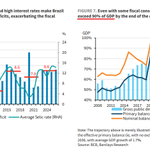
Lula will end his 3rd term with public finances in worse shape than he found them, with an average fiscal deficit of 8.6% (vs. prev 7%) of GDP over his term, debt on track to exceed 90% of GDP, while interest rates still running near decade highs.
Fiscal reform should be a key priority for the next administration, but any adjustment is more likely to come now from higher taxes than spending cuts, though a Congress more hostile to Lula could stand in the way and force him to negotiate.
Barclays estimate that a fiscal adjustment of around 3% of GDP would be needed just to stabilize debt growth.
#Brazil $EWZ


Austral Research retweeted
Lula will end his 3rd term with public finances in worse shape than he found them, with an average fiscal deficit of 8.6% (vs. prev 7%) of GDP over his term, debt on track to exceed 90% of GDP, while interest rates still running near decade highs.
Fiscal reform should be a key priority for the next administration, but any adjustment is more likely to come now from higher taxes than spending cuts, though a Congress more hostile to Lula could stand in the way and force him to negotiate.
Barclays estimate that a fiscal adjustment of around 3% of GDP would be needed just to stabilize debt growth.
#Brazil $EWZ
MS: Brazil’s 2026 election is fundamentally a fiscal-divergence story.
The candidates' economic programs imply materially different policy regimes: Lula proposes broad continuity with the current fiscal framework and a more active role for the state, while Flavio Bolsonaro favors tighter fiscal rules, administrative retrenchment, privatizations, and greater trade openness.
Execution, however, will depend not only on the presidency but on the composition of Congress and the gubernatorial map.
So far, state-level polling has been favoring centrist/center-right candidates for both Lower House and Senate seats; if sustained, this could imply a more constraining Congress for a Lula administration and a more supportive one for a Flavio Bolsonaro administration..
(...) The fiscal policy proposal of the next administration is key in shaping expectations for Brazil's macro outlook and matters disproportionately for asset prices, in our view. This is because, we argue, the urgency to do a fiscal adjustment is increasing. Brazil’s fiscal risk is not an immediate solvency problem; however, it has a debt-stabilization challenge increasingly intertwined with growth, interest rates, and structural budget rigidities.
$EWZ #BRL
Austral Research retweeted

Lula teve 11 MILHÕES DE VOTOS A MAIS do 1º para o segundo turno.
Flávio teve cerca de 3 MILHÕES DE VOTOS A MAIS do 1º para o segundo turno.
Acho que isso é algo INÉDITO no planeta! Matematicamente é quase impossível isso acontecer.
Por que digo isso? Porque com mais de 130 milhões de brasileiros, 47% escolheram Flávio e 45% Lula.
14 milhões de pessoas deveriam seguir um mesmo padrão, ou padrão parecido, mas o que aconteceu foi que dos 14 milhões que votaram em outro candidato ou não foram votar no 1º turno, foram:
21% em Flávio
79% em Lula
Mesmo que essa quantidade estivesse no NORDESTE, seguindo padrão do nordeste não seria isso tudo! O nordeste deu 65% para o Lula.
Foi MUITO ESTRANHO essa quantidade toda para Lula.

Austral Research retweeted
Lula will—for the first time—have to govern with a highly adverse Congress, with both chambers of Congress firmly controlled by the opposition.
This could complicate Lula’s fiscal agenda and leave him more politically vulnerable to potential impeachment proceedings.
#Brazil
Brazil’s election has moved to a runoff, but the Senate result may be just as important for investors and policymakers.
Flávio Bolsonaro led Lula 47.0% to 45.2% in the first round, with virtually all polling stations counted. Neither cleared 50%, so the two face each other again on October 25.
Bolsonaro's PL is projected to hold 28 of the Senate’s 81 seats: roughly 18 senators elected in 2022 remain in office, while the party added 10 seats in this year’s election, as two-thirds of the Senate’s 81 seats were contested on Sunday.
This matters because the Senate confirms Supreme Court justices, central-bank directors and ambassadors, and can also try Supreme Court justices in impeachment proceedings.
A more right-leaning Senate could therefore materially constrain or support the next administration.
For markets, the new Senate will help determine how much room the next government has to shape trade, tariffs, investment policy and institutional reforms.
$EWZ


Austral Research retweeted
Brace for impact. $EWZ -18% now in the overnight session, as we are heading for a historic bloodbath in the brazilian stock market tomorrow.


Austral Research retweeted

If $EWZ holds −22%, it will be the 2nd-worst day in the ETF's history, behind only COVID.
Here are the biggest one-day drops of 10 crises since 2000, and how far each one fell:

Brace for impact. $EWZ -18% now in the overnight session, as we are heading for a historic bloodbath in the brazilian stock market tomorrow.