
CS PhD Student at Stanford
US
Joined April 2016
- Tweets60
- Following79
- Followers900
- Likes234




Pinned Tweet
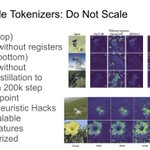
1/ The tokenizer is a new scaling axis!
We introduce an approach for diffusable representation learning that's principled, scalable, and works when DINO/LeJEPA collapse.
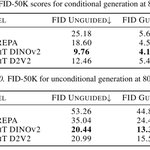
We get joint tokenizer+diffusion scaling laws and it's compute-optimal vs raw diffusion
w/ @drfeifei @GordonWetzstein @jcjohnss @ericryanchan @vincesitzmann @KyleSargentAI
Thread, Paper, and Blogpost below
Alan Baade retweeted

Another new scaling axis? How many are we at now?😵💫
In all seriousness, this is a very cool piece of work, and as far as I can tell, a completely novel way to create representations whose inner products capture mutual information. Check out the blog post: alanbaade.github.io/repr/

1/ The tokenizer is a new scaling axis!
We introduce an approach for diffusable representation learning that's principled, scalable, and works when DINO/LeJEPA collapse.
We get joint tokenizer+diffusion scaling laws and it's compute-optimal vs raw diffusion
w/ @drfeifei @GordonWetzstein @jcjohnss @ericryanchan @vincesitzmann @KyleSargentAI
Thread, Paper, and Blogpost below
Alan Baade retweeted

Really insightful work — congratulations Alan @BaadeAlan and team!
Exciting to see more exploration in this direction.
We've also been curious about related questions (studying different scaling laws) through our work ––
ALIT (looped tokenizer), KARL (single-pass adaptive tokenizer), and UNITE (generative tokenization).
Lots to learn from this work! 🙌
1/ The tokenizer is a new scaling axis!
We introduce an approach for diffusable representation learning that's principled, scalable, and works when DINO/LeJEPA collapse.
We get joint tokenizer+diffusion scaling laws and it's compute-optimal vs raw diffusion
w/ @drfeifei @GordonWetzstein @jcjohnss @ericryanchan @vincesitzmann @KyleSargentAI
Thread, Paper, and Blogpost below
Alan Baade retweeted

Excited to share @BaadeAlan's latest work: a new approach to representation learning designed specifically for generative modeling!
Semantic representations like DINO have become remarkably effective tokenizers for image and video generation. But DINO was never designed for this task. Its success in generative modeling is almost accidental. What if we learned representations specifically to make generation easier?
1/ The tokenizer is a new scaling axis!
We introduce an approach for diffusable representation learning that's principled, scalable, and works when DINO/LeJEPA collapse.
We get joint tokenizer+diffusion scaling laws and it's compute-optimal vs raw diffusion
w/ @drfeifei @GordonWetzstein @jcjohnss @ericryanchan @vincesitzmann @KyleSargentAI
Thread, Paper, and Blogpost below
TL;DR: We have
* Same theory as contrastive learning without negatives, batch statistics, or non-masking augmentations
* Tokenizer encoder scaling laws
* Compute optimal performance versus raw diffusion
I think representation learning is pre-paradigmatic. Hopefully, this is a real step forward.
Arxiv: arxiv.org/abs/2610.20533
Blog: alanbaade.github.io/repr/
Code: github.com/AlanBaade/repr

I'll be at ICML to present Latent Forcing!
Come stop by the poster on Tuesday at 2:00 PM KST, Hall A #3507
Reach out if you want to chat about the future of generative models!
What's the right space to diffuse in: Raw Data or Latents?
Why not both!
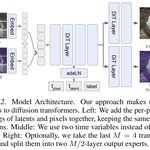
In Latent Forcing, we order a joint diffusion trajectory to reveal Latents before Pixels, leading to improved convergence while being lossless at encoding and end-to-end at inference.
w/ @drfeifei+...
1/n

Alan Baade retweeted

1/ Introducing GPIC: a Giant Permissive Image Corpus and benchmark for visual generation!
🚀100M VLM-captioned image-text pairs for training
📊1M image-text pairs for benchmarking
🖼️~28 trillion pixels
🤗Centrally Hosted
✅Fully permissive for research + commercial use
Dataset, benchmark and models🧵👇
Co-led with @KyleSargentAI

Alan Baade retweeted

Two months ago, I vaguely posted a number: 0.9 FID, one-step, pixel space.
Now it is 0.75, and can be even lower.
Many wonder how.
I thought it might end as a small FID prank: simple and deliberate.
It started with one question: can FID be optimized directly, and what does it reveal?
Introducing FD-loss.

I love this result
It shows that a robot foundation model ought to be a model trained to understand the world that happens to be able to perform robot tasks. Not just action behavior cloning from teleop/umi data to fit a demo.
For this, the DVA approach is the clear direction.

