

Positive, educational conversation about being human. Notes and ideas from https://nitter.cf/t.co/QqqKzuG35Q.
Joined October 2026
- Tweets149
- Following114
- Followers1
- Likes174






Pinned Tweet
Welcome to Being a Human: positive, educational notes on body, mind, nature, and a life well lived.
New ideas and real, cited quotes here most days. The free letter goes deeper: beingahuman.net/newsletter

1
137
Your brain is about 2% of your body weight, but it uses about 20% of your body's energy.
Your kidneys filter about 150 quarts of blood a day. Your heart is about the size of your fist. And all of it works without you having to think about it.
1
1
4
Tap through the body one part at a time, with a cool fact and a safe thing to try: beingahuman.net/body-explore…

2
That first image, released in 2019, showed the black hole at the center of galaxy M87, about 55 million light-years away. Radio telescopes around the world worked together as one Earth-sized dish to capture it.

The doughnut shape of the Event Horizon Telescope’s first image of a black hole has come under fire, but an independent check showed that it – and general relativity – still stands newscientist.com/article/259…

1
7
Voyager 1 launched in 1977, and on Nov. 18 it will be so far away that a radio signal, moving at the speed of light, needs about a full day to reach it. It is still sending data home.

Nearly 50 years after launch, NASA's Voyager 1 probe will pass the one light-day mark on Nov. 18, a symbolic milestone for the agency's longest-running mission. Scientists reflect on the Voyager program's legacy and what comes next.
Read more here: live-science.visitlink.me/6_…

1
2
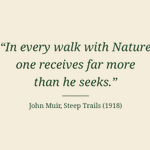
"In every walk with Nature one receives far more than he seeks."
John Muir, Steep Trails (1918)
He wrote it in 1877, after a short climb turned into a trail covered in wildflowers he never went looking for. The best part of a walk is often the part you didn't plan.

1
6
Your nose takes turns. Through the day, the left and right sides switch which one is a little more open. It's called the nasal cycle, and most people only notice it when they have a cold.
Your nose also cleans, warms and moistens every breath before it reaches your lungs.
1
1
11
What the nose does with each breath, and when it's worth asking a doctor: beingahuman.net/nasal-breath…
8
"Heaven is under our feet as well as over our heads."
Henry David Thoreau, Walden (1854), "The Pond in Winter"
He wrote it after cutting through a foot of snow and a foot of ice to get water, then looking down into "the quiet parlor of the fishes."
1
8
One line from a great book, every day: beingahuman.net/quote-room
3
Mercury is closest to the Sun, but Venus is the hottest planet. Its thick carbon dioxide atmosphere traps heat, keeping the surface around 900 degrees F (475 degrees C), hot enough to melt lead.

Pull yourself out of bed in early dawn tomorrow and look east-southeast. It may be cold out, but the hottest planets in the solar system await you there. And before it gets too bright, can you make out Spica, one of the hottest bright stars?
buff.ly/Mj2Q5P4
#stargazing

1
8
Giant weta live only in New Zealand. With no native land mammals except bats, they came to fill the night-foraging role that mice and rats play elsewhere, which is why some biologists call them "invertebrate mice."

Meet the giant wētā. Members of the genus Deinacrida, these critters are among the largest insects on Earth! In fact, individuals can reach weights of 1.2 oz (35 g)—making them heavier than some mice!

ALT A photo of a giant wētā in a human hand. The animal resembles an enormous grasshopper. It has long antennae and a bulky, brownish body.
1
4
Why do snowflakes have six arms? When water freezes, its molecules lock into a six-sided pattern, and a growing ice crystal sprouts an arm from each corner.
In 1885, Vermont farmer Wilson Bentley took the first photo of a single snowflake. He went on to photograph over 5,000.
1
7
The oldest known bits of Earth are zircon grains from Western Australia's Jack Hills, about 4.4 billion years old. Crystals smaller than a grain of sand still hold clues to our planet's first oceans.

Tiny, ancient crystals called zircons offer clues in the geological drama of liquid water’s arrival on Earth. Chemicals trapped inside zircons point to the presence of water and carbon dioxide shortly after the planet was a fuming sea of magma. quantamagazine.org/the-sun-w…

1
6
A male northern mockingbird can learn around 200 songs in its lifetime. The ones singing late into the night are usually unmated males, still trying to impress.

The northern mockingbird is a mimic master - able to copy the songs of dozens of other birds - plus car alarms, frogs and even ringtones! Found across much of the U.S., these birds defend territory year-round and guard winter food sources. USFWS photo by Anna Weyers Blades

ALT Gray bird perched on a green bush branch with a blurred forest background.
1
3
"Those who contemplate the beauty of the earth find reserves of strength that will endure as long as life lasts."
Rachel Carson, The Sense of Wonder
A slow look at the sky, a tree or the tide is never wasted time.

1
4
Quick quiz: Which planet in our solar system has the shortest day?
0%Mercury
0%Earth
0%Jupiter
0%Neptune
0 votes • Final results 1
1
12
Jupiter. It spins once about every 10 hours (9 hours 56 minutes), the fastest of any planet, even though it is the biggest. Source: science.nasa.gov/jupiter/jup…

10

