



Bert Brace retweeted

Penn State announced 47 academic programs, including 11 at University Park, have been recommended for closure, according to a press release.
psucollegian.com/news/admini…


We Are Penn State

John Urschel started 13 games on the offensive line for the Baltimore Ravens.
Then he read one study and retired at 26.
Today he is an assistant professor of mathematics at MIT.
Urschel was a fifth round pick in 2014 out of Penn State. Guard and center. 40 games, 13 starts, a real NFL career by any honest measure. Most fifth rounders never get on the field at all.
But the football was always the second thing.
He got his bachelor's and his master's in math at Penn State in a single year, 2012 to 2013. While playing Division I football. He co-authored a paper on graph theory as an undergraduate that is now known in the field as the Urschel-Zikatanov theorem.
In 2013 he won the William V. Campbell Trophy, which people call the academic Heisman.
So he was doing both. In January 2016, while he was still an active NFL lineman, he enrolled in the PhD program in applied mathematics at MIT.
Practice in Baltimore. Coursework in Cambridge. Straight A's in his first four doctoral courses.
Then came the hit.
In training camp in 2015 Urschel took a concussion. And what scared him was not the headache.
It was that for a while afterward, he could not do math the way he used to. The one thing that was actually his, the thing football was supposed to be the hobby next to, got slower.
He came back. He played the 2016 season.
And then in July 2017 the JAMA study came out. Researchers had examined the brains of 111 deceased NFL players and found signs of CTE in 110 of them.
110 of 111.
Two days later, Urschel retired. He was 26 years old.
"This was actually a serious, serious concern of mine," he said.
Think about what that actually costs. He was on a rookie deal with starts on tape and years of earnings in front of him. He traded all of it for a graduate student stipend and a desk.
Then he went and finished the thing.
He earned his PhD from MIT in 2021 under Michel Goemans. His dissertation was titled Graphs, Principal Minors, and Eigenvalue Problems. Spectral graph theory and numerical linear algebra, which is the kind of math that quietly runs underneath machine learning and network analysis.
In the fall of 2023, MIT hired him onto the faculty.
The former Baltimore Ravens offensive lineman is now on the other side of the desk at one of the best math departments on the planet.
He wrote a book with his wife Louisa Thomas called Mind and Matter: A Life in Math and Football. Forbes put him on the 30 Under 30 list in science. Dartmouth gave him an honorary doctorate in 2024.
And when he talks about what he actually wants for people, he does not talk about football or even about proofs.
"Being capable of thinking quantitatively, it's the single most important thing."
Here is the honest counterpoint.
Urschel got to make that choice because he had an elite fallback. Most NFL players do not have an MIT acceptance letter waiting when the brain scans get scary. For most guys, walking away at 26 means walking away into nothing. That is the real story of CTE in the league and it is a lot grimmer than this one.
But it does not make what he did smaller.
He was 26, healthy, starting, and getting paid. He read the number 110 out of 111, decided his brain was the asset, and went and used it.
He kept the thing the game was most likely to take.
For more stories like this, follow us on any platform @thesportsontap

3
226
Bert Brace retweeted

Procter & Gamble made soap. In 1911 they took an ingredient they had developed for soap, put it in a tin, and sold it to American women as food.
The ingredient was cottonseed oil. Cotton seed was what the mill threw away. It rotted in heaps by the roadside. The raw seed poisons pigs. The oil comes out red, bitter and stinking, and its other buyers made roofing tar and explosives.
P&G bought the mills, hardened the oil with hydrogen gas to make cheaper soap, and noticed that what came out of the vat looked exactly like lard.
So they called it Crisco, and they called it pure. Modern. Clean. Nothing like the dirty old butter and lard your mother used.
They gave away cookbooks with Crisco in every recipe. They found a rabbi to announce that the Hebrew race had been waiting 4,000 years for it.
Crisco launched in 1911. The first heart attack in the American medical literature was described in 1912.
Over the next 40 years Americans ate less and less butter, more and more of what was in P&G's tin, and heart disease became the biggest killer in the country.
Butter had an alibi. What P&G needed was somebody official to ignore it.
In 1948 the American Heart Association was a small club of doctors with no money. P&G's hit radio show ran a contest for them. Listeners posted in $1.75 million, and the club became the national authority on the human heart overnight.
In 1960 P&G launched Crisco Oil.
In 1961 the American Heart Association told the nation to swap butter for vegetable oil.
That advice is still on your doctor's wall.
Years later it came out that hardening the oil made trans fats, and trans fats were killing people. The industry pinned everything on that one word, changed the recipe, and declared margarine safe.
It was never only the trans fat. When doctors in Sydney moved heart patients off butter and onto plain safflower oil, more of them died. When Minnesota ran the biggest trial of all, on corn oil, the old people on the oil died faster. That result went into a basement for 40 years.
The problem is the oil. It is an industrial fat, washed out of seeds with a petrol solvent, bleached, and deodorised so you cannot smell what it is. It goes rancid in the bottle, in the fryer and in you, and it sits in your body fat for years. Americans now carry more than twice as much of it as their grandparents did.
P&G sold Crisco in 2002 and walked away.
The American Heart Association still sells its red tick to bottles of seed oil, for a fee.
Butter is cream, shaken. It has never once needed a radio show.



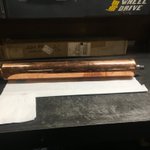
Copper greens mower roller


🔥UN FIL DE CUIVRE ÉLIMINE TOUTE LA MOISISSURE DÉFINITIVEMENT🔥
Pourquoi cette science est-elle interdite ?
Il existe un fil de cuivre dans les quincailleries qui coûte moins de 5 $, et lorsqu'il est placé près d'une surface exposée à l'humidité, il élimine toutes les espèces de moisissures avec lesquelles il entre en contact, et interrompt la repousse de manière permanente.
Pas pendant des semaines ou des mois, mais DÉFINITIVEMENT.
L'Agence de protection de l'environnement des États-Unis (EPA) l'a confirmé.
L'EPA a enregistré le cuivre comme le seul matériau de surface solide de l'histoire à avoir une certification antimicrobienne pour les allégations de santé publique.
275 alliages de cuivre ont réussi les protocoles les plus stricts. Chacun d'eux a éliminé 99,9 % des organismes dangereux en 2 heures de contact.
L'acier inoxydable, le matériau utilisé dans presque tous les bâtiments modernes, n'a rien éliminé... 0 % après 28 jours.
Cette science n'est pas nouvelle, elle a plus de 4000 ans, et elle a été lentement et systématiquement remplacée par une industrie qui a besoin que vous continuiez à acheter des bouteilles chaque mois.
Voici l'histoire du fongicide naturel le plus puissant au monde, et pourquoi une industrie de 2,2 milliards de dollars a besoin que vous n'appreniez jamais son fonctionnement.
45 millions de nouveaux bâtiments aux États-Unis présentent des niveaux insalubres de moisissures qui se développent à l'intérieur des murs. Ce chiffre provient d'une étude publiée dans la revue Indoor Air.
Les mêmes chercheurs ont découvert que 21 % de tous les cas d'asthme en Amérique sont causés par l'exposition aux moisissures et à l'humidité à l'intérieur des maisons. Il ne s'agit pas d'allergies saisonnières, mais du type d'asthme qui amène les enfants aux urgences chaque année.
Le CDC et l'Organisation Mondiale de la Santé confirment ces résultats.
Vivre dans un bâtiment avec des moisissures augmente de manière mesurable le risque de développer des maladies respiratoires. La véritable solution n'est pas de s'asseoir derrière une caisse enregistreuse, mais de se trouver à l'intérieur des murs de tout bâtiment qui a encore une plomberie en cuivre.
Cette vidéo n'est que le début de ce que l'industrie du nettoyage a dissimulé.
Retournons en 1882... Les vignobles de Bordeaux, en France.
Un botaniste français, Pierre-Marie Alexis Millardet, se promenait dans un vignoble qui était ravagé par une maladie fongique appelée oïdium, qui dévastait les vignobles français depuis 1870.
L'ensemble de l'industrie du vin était en train de s'effondrer. Millardet étudiait la maladie lorsqu'il a remarqué quelque chose : les vignes les plus proches de la route étaient parfaitement saines.
Toutes les autres vignes du champ étaient infectées et mourantes, recouvertes d'une croissance fongique blanche, mais celles qui étaient les plus proches de la route prospéraient.
Un exploitant de vignoble a expliqué qu'ils avaient pulvérisé ces vignes le long de la route avec un mélange de sulfate de cuivre et de chaux, non pas pour combattre les maladies, mais pour rendre les raisins amers et laids, afin que les gens qui passaient ne les volent pas.
Le cuivre avait éliminé le champignon tout le temps.
Millardet a passé les 3 années suivantes dans des études formelles, et en 1885, il a publié ses découvertes et a annoncé au monde qu'il avait découvert un remède contre la moisissure qui détruisait les vignobles.
Ce mélange était connu sous le nom de MÉLANGE DE BORDEAUX, le premier fongicide jamais utilisé à l'échelle commerciale, dans le monde entier.
Il a si bien fonctionné qu'il a non seulement sauvé le vin français, mais aussi les récoltes de pommes de terre irlandaises, les plantations de bananes en Amérique latine et les orchidées sur tous les continents.
Un seul composé est devenu la découverte la plus importante de l'histoire de la protection des aliments contre la destruction fongique.
4
174
Bert Brace retweeted

“Everybody wants to save the Earth; nobody wants to help Mom do the dishes.”
- P.J. O'Rourke
This famous quote points to a common flaw in human nature: our tendency to become inspired by grand, heroic causes while overlooking the small, practical responsibilities directly in front of us. People can easily rally around enormous, abstract goals like saving the planet because they feel noble, exciting, and meaningful.
Yet true character and kindness are often revealed through the ordinary, repetitive moments of everyday life. Washing the dishes or helping a family member may seem insignificant, but these quiet acts require effort without recognition, applause, or public attention.
Ultimately, the quote offers a humorous but pointed reminder that making the world a better place often begins with simple acts of responsibility and genuine kindness within our own homes.

Bert Brace retweeted
Nobody washed wool, and that is the part that sounds wrong now.
The jumper hung out for a morning and came back in. The blankets came off the bed in May, went over the line in the sun for a day, and sat in the airing cupboard until October, and plenty of them went ten years without ever meeting water. A gansey went out on a boat for a fortnight and was hung on a nail.
Say that in 2026 and people look at you.
Wool takes moisture into the core of the fibre instead of leaving it on the surface, about a third of its own weight before it even feels damp, and the keratin locks up the compounds that make a smell and declines to hand them back. Bacteria need water sitting on a surface. There isn't one. Hang it in cold air overnight and everything leaves.
Polyester does the reverse on every count. It pushes water away and it loves oil, so your own grease sits on the outside of the fibre with the bacteria on top of it. That is why a gym top stinks after forty minutes, and stinks again coming out of a hot wash, and why the sports trade now sells you an antibacterial treatment to fix a problem it caused by choosing the fibre.
Babies slept in wool, under wool, in a freezing bedroom, with not a gram of flame retardant in the room. Wool needs a far higher temperature to catch than any synthetic, it will not melt onto skin, and it has a habit of smothering itself. In 1972 America made flame resistance a legal requirement in children's sleepwear. The industry did not switch to wool. It kept the cheap synthetic and sprayed it with a chemical called Tris, and five years later Tris came off children's pyjamas over concerns it caused cancer.
The safe option was standing on a hillside the whole time, growing itself back every summer.
This is the fibre the country was built on. By the eighteenth century woollen cloth was over half of everything Britain sold abroad, and the Speaker of the House of Lords still sits on a sack of it, put there in the fourteenth century so Parliament could not forget where the money came from.
Terylene was invented in Accrington in 1941. Acrylic followed in the fifties. Then in 1979 an American mill knitted polyester into something fluffy and called it fleece, which is the cheekiest act of naming in the history of cloth.
By 2022 a British fleece was worth under 75p a kilo and the farmer saw about 26p of it. Shearing costs him roughly £1.50 a sheep, and he has to do it whether anyone wants the wool or not, because an unshorn sheep gets flystrike and dies badly. He pays to take the coat off and then cannot give it away. Farmers have been photographed burning a thousand fleeces in a heap, because the bonfire is cheaper than the lorry to the depot.
Every wash of the stuff that replaced it sends hundreds of thousands of plastic fibres down the drain, through the treatment works, into the water, into the fish, back round to you.
The fibre that never needed washing lost to the fibre that has to be washed constantly and poisons the water every time it is.
The flocks are there, the graders are there, the mills are still turning. The only thing missing is demand, and you are holding a piece of that.
Old wool blankets sit in every charity shop in the country for about a fiver, and the old ones are the good ones. Buy two, and put them on the bed in October.
Then leave the jumper unwashed, hang it out the window overnight in the frost, and put your face in it in the morning.

Bert Brace retweeted

Amelia’s……..great coffee, tea, scones❤️ instagram.com/reel/DcHLrXAsJ…


It is so easy to offer wildlife habitat areas within your own property.

One of the easiest places to add wildlife habitat is along the boundary you currently mow and trim the hardest.
A defined strip of taller vegetation along a fence line, hedge or low-traffic boundary can provide cover, seeds, insects and overwintering habitat that closely clipped turf doesn't.
Ground beetles shelter in the thatch. Birds hunt where lawn meets longer grass because that's where insects concentrate. The structural diversity alone adds value that flat turf can't provide.
Start by mowing less in one strip. But don't assume a thriving native meadow will appear on its own. An unmowed strip in many suburban yards will be colonized by whatever is already in the seed bank: often turfgrass, nonnative weeds or invasives.
Watch what comes up, remove invasive plants early, and consider adding native grasses and wildflowers suited to your region and soil.
Keep a narrow mowed border around the planting. That small design choice makes the area read as intentional habitat rather than an abandoned patch of lawn. If the neighbors ask, "I'm growing it for the beetles" is a complete sentence.
The unmowed fence line won't solve everything. But it costs almost nothing, requires only that you put the trimmer down, and adds something that the rest of the yard, no matter how well planted, can't quite replicate: an edge where things move, hunt, and hide.


1
2
206
👍

61 life lessons I wish I knew years ago:
1 lost money can be found; lost time is lost forever
2 to learn, unlearn, relearn and then change yourself is a superpower
3 you are not your job
4 networking is about giving
5 the best teacher is your last mistake
6 good manners is as important as good education
7 do not take your good health for granted
8 be a better friend and value relationships
9 if you are waiting for a title to lead, you are not ready to lead
10 a work sponsor is more important than a mentor
11 a good story is data with a soul
12 stop worrying about what others think of you
13 if you want an easier life, work on harder problems
14 best teachers are life long students
15 imposter syndrome is real, and a good thing
16 fight against a sense of entitlement
17 half the battle is showing up
18 love and cherish your parents by giving them your time
19 success is not accidental
20 the best views are there for those who love the climb
21 lucky people work harder
22 takers may end up with more, but givers sleep better at night
23 memorizing is not learning
24 it is okay to look back, just don’t stare
25 knowing is not acting - I can > IQ
26 straight roads do not make great drivers
27 good listeners hear the unsaid (listen with your eyes)
28 be the person that you want to follow
29 do not limit your contribution to a job description 30 take care of your parents - the best gift that you can give yourself
31 customer service is not a department
32 in the long run, the optimists create the future
33 never ruin an apology with excuses
34 salary is for expenses. equity is wealth - do not rent your time.
35 do not take a caring boss, joyful work or steady income for granted
36 as you get older, you love your parents more
37 challenge assumptions, starting with your own
38 we learn more from disagreements
39 best gift you can give yourself is quality time with parents
40 the older you get the less you care about what others think of you
41 be a good person but do not waste time trying to prove it
42 be comfortable with saying ‘I don’t know’ - there are no experts of tomorrow
43 being self-aware is a key to learning and growth; know yourself
44 first, invest in yourself, then help others win
45 if the answer is no, do not say maybe or yes
46 Don’t just translate, write something new and original; write for yourself - writing improves your thinking
47 It’s more important to do the right thing than to win an argument
48 do not buy your children what you never had, teach them what you never knew
49 begin with the end in mind
50 to make progress on your to-do list, you must also keep a to-don’t list
51 leave everything and everyone better than you found them
52 be kind and polite to everyone
53 Here’s how luck finds you:
—Work harder than expected
—Stay teachable
—Give without expecting a get
—Read and write more
—Show up on time
—Focus on your customers
—Develop good manners
—Be humble
—Be kind and generous
—Surround yourself with smarter people
54 The bosses we remember:
—provided us a safe space to grow
—opened career doors
—defended us when we needed it
—recognized and rewarded us
—developed us as leaders
—inspired us to stretch higher
—led by example
—told us our work mattered
—forgave us when we made mistakes
55 The older you get, the more quiet you become. Life humbles you so deeply as you age. You realize how much nonsense you’ve wasted time on.
56 Hire based on high rate of learning and good judgment
57 straight lines do not make great drivers
58 stand in the middle of the road for too long and you may get hit from both sides - be decisive
59 if you do not know the answer, it is okay to say 'I don't know, but I will find out'
60 do not follow or admire mean people - be the person that you would want to follow
61 the decisions you made 5-10 years ago shaped where you are today; decisions you make now will shape where you’ll be in 5-10 years

208
And why cannot the number 1 Turf school in the world have a facility like this…. We Are

Auburn's $15M practice facility has greens designed for every situation. 🔥
Watch the full tour: glfdig.st/2BFE50Z7O9s
217
Bert Brace retweeted

Farmers are rediscovering something nature understood long before modern agriculture:
The cheapest pesticide in the world is often a strip of flowers. 🌼🌾
When wildflower strips are planted not only around the edge of a field, but woven directly through the crop itself, the entire biology of the field changes.
Ladybirds arrive.
Lacewings settle in.
Hoverflies patrol the canopy.
Parasitic wasps begin hunting between the rows.
These insects are not pests — they are predators of pests.
They feed on aphids, caterpillars, whiteflies, mites, and leaf beetles continuously, every single day, without fuel, without machinery, and without chemical residue.
In controlled field trials, carefully selected flower strips reduced leaf-beetle populations by 40–50%, while crop damage dropped by nearly 60% — often below the economic threshold where pesticide spraying was even considered necessary.
The flowers are not decoration.
They are infrastructure.
A flowering strip becomes a living reservoir of beneficial insects, keeping natural enemies inside the field instead of hoping they arrive from elsewhere.
For decades we engineered stronger chemicals to kill the insects eating our crops, while overlooking the insects already designed to do the same work for the price of seed.
Most advanced agricultural technology is simply restoring the ecology we removed.

Simple.. a Homeowner can do the same…
Farmers have figured out that the cheapest pesticide is a strip of flowers.
When you plant wildflowers through a crop field, not just around the edge but in strips running through the middle, you get ladybugs, lacewings, hoverflies, and parasitic wasps living in the field instead of visiting it.
They eat the aphids, the caterpillars, and the mites for free, all summer long.
In controlled trials, fields with tailored flower strips had leaf-beetle numbers 40 to 50% lower and crop damage cut by around 60%, enough to drop below the threshold where spraying was even considered worth it.
The flowers attract a standing army to our fields.
We spent decades engineering chemicals to kill the insects eating the crop, when the insects that eat those insects would have worked for the price of seed.

2
136


