

Assisting UK and Irish independent bookmakers in the procurement and operation of new technology.
United Kingdom
Joined June 2018
- Tweets308
- Following194
- Followers229
- Likes65






Bookmakers Technology Consortium retweeted
The self-appointed Gambling Policy Commission | Velvet Glove, Iron Fist velvetgloveironfist.blogspot…

Bookmakers Technology Consortium retweeted
Gambling’s share of UK household spending is back to pre-Lottery levels. Excluding the Lottery it’s 0.54%, the lowest since the ONS series began in 1985. The public health approach says harm tracks total consumption. If so, harm should be falling too. Is it?

Bookmakers Technology Consortium retweeted

Gambling is not evil, and a Restore Britain Government will reduce taxes on the industry.
Adults should be free to make their own choices about how they spend their own money - a wild thing for a political party to say, I know.
Britain has a successful gambling industry that supports local economies all over the country.
In my constituency alone we have horse racing, a greyhound stadium, plenty of arcades and more.
We should be encouraging responsible operators to thrive, not taxing them into dust.
Problem gambling is an issue and should be properly addressed. But punishing an entire industry, costing thousands of jobs, for the actions of a very small number is not the answer.
Restore Britain will back British gambling.
Bookmakers Technology Consortium retweeted
Nope. Countless pointless reforms like affordability checks and regulated market ggy down 10% since 2017/2018 peak.

Bookmakers Technology Consortium retweeted

This letter to the Chancellor on a Category B MGD rise misses key facts:
• It doesn't protect bingo. Bingo halls rely on these machines, and Rank says a third of its venues could close.
• Betting shops close first and arcades survive. The Guardian reached the same conclusion.
• Revenue is disputed: EY's modelling shows a net loss to the Treasury once closures are counted.
• There's no evidence higher duty reduces harm. The 40% online rate hasn't curbed online casino.
• And not a word on racing, which would lose £92m a year.


Bookmakers Technology Consortium retweeted
Derek Webb's target is arcades and their machines. Doubling MGD does the opposite: betting shops close first and arcades take the high street.
If the aim is fewer slots venues, the tools are licensing and machine rules, not a tax that closes the bookmaker.
labourlist.org/2026/10/a-mor…

Bookmakers Technology Consortium retweeted
A regulator that worked for punters would protect customer funds, set standards for withdrawals and ID checks, back minimum bet liability, give ordinary punters a seat at the table and publish its evidence. The Gambling Commission has done none of these.
The Gambling Commission was created by the Gambling Act 2005 and took over in 2007. Its job is defined by three licensing objectives: keep crime out of gambling, ensure gambling is conducted fairly and openly, and protect children and vulnerable people. Nearly two decades on, it is worth asking a simple question. What has it done for the people who actually bet?
The honest answer is very little, and a good deal of harm.
It does not protect your money
If you deposit with a licensed British bookmaker, the Commission does not require your money to be protected if the firm goes bust. Operators only have to tell you how protected it is, and “not protected” is a perfectly legal answer. There is no compensation scheme like the FSCS that covers bank savings.
Football Index showed what this means. When it collapsed in March 2021, customers lost roughly £100m. The independent Sheehan review found the Commission had failed to understand the product it was licensing and acted too slowly when warning signs appeared. Nobody at the Commission lost their job, and no punter got their money back from the regulator. Licences can be suspended overnight, as BresBet and Bet St George found in August 2026, and once an operator surrenders its licence, the Commission’s leverage over it largely disappears. The punter is left as an unsecured creditor.
It does not help you get paid
The Commission does not resolve disputes between punters and bookmakers. It will not order an operator to pay you. It sends you to an ADR service that judges the case against the bookmaker’s own terms and conditions.
Meanwhile, the Commission’s own enforcement has made getting paid harder. It has fined operators tens of millions for failures on anti-money laundering and social responsibility checks. The predictable result is that bookmakers protect themselves by demanding photo ID, payslips and bank statements, very often at the point you try to withdraw. The Commission has set no limit on what operators can ask for or how long they can hold your funds while they decide.
It has refused to act on restrictions
Ask any half decent punter what the biggest problem with British bookmaking is and they will tell you: getting a bet on. Accounts are cut to pennies or closed simply for looking like they will not lose fast enough. The Commission’s position is that this is a commercial matter. It has proposed no minimum bet liability and no requirement for operators to be transparent about how and why they restrict. For a regulator whose objectives include gambling being conducted “fairly and openly”, that is a remarkable gap.
It ignored punters when they told it what they thought
In early 2021 the Commission surveyed 12,125 people on affordability checks. 77% said bookmakers should not be required to assess affordability, and only 14% said they would provide information for a check.
The Commission did not publish the results. They only came out in June 2024 after a freedom of information request, and by then the policy was already going ahead.
Punters are not in the room
The Commission takes formal advice from three expert groups, covering academia and public health, digital technology, and lived experience of gambling harm. To sit on the Lived Experience Advisory Panel, you need personal experience of gambling harm, either your own or someone close to you. There is no equivalent panel for the millions of people who bet without a problem.
In September 2023 the chair of the Culture, Media and Sport Committee, Caroline Dinenage, asked whether the panel should include people who gamble safely. The Commission’s position is that it hears from other consumers through surveys and research. The one large survey of regular punters it ran, it kept hidden for three years.
It dismissed the black market
When the industry warned that friction in the licensed market would push customers to unlicensed sites, the Commission’s leadership, including chief executive Andrew Rhodes, said the claims were overstated. Its own survey had already shown that most punters would refuse checks. Those punters still bet. They do it somewhere with no licence, no ADR, no ID rules and no recourse at all.
Punters pay the cost, and it hasn’t worked
The Commission’s rules are designed around a small minority of gamblers who have a problem, and the rest of us are treated as if we were part of it. Millions of people bet within their means, on racing, football or anything else, and they now face document requests, financial checks and friction at every step. Their experience barely features in the Commission’s thinking.
That trade-off might be defensible if it reduced problem gambling. It has not. On the measures used for years, the Health Survey for England and the Commission’s own telephone surveys, problem gambling sat at roughly 0.3% to 0.5% of adults. It did not move after the £2 FOBT stake cut in 2019, the credit card ban in 2020, or the online game design rules in 2021.
In 2023 the Commission replaced those measures with a new survey that produces a rate of about 2.5%, and says the new figure cannot be compared with the old ones. The result is that there is now no consistent baseline to test whether any of its policies have worked, while the larger headline number is quoted to justify more restrictions. The majority carry the cost, and there is no measurable benefit for the minority.
It has grown while focusing on the wrong things
None of this is for lack of resources. In March 2010 the Commission had 222 employees, and its employee costs for 2009/10 were £8.98m. By March 2025 it employed 416 staff, and staff costs had risen to £27.8m. Headcount has almost doubled and the pay bill has more than tripled in cash terms, even allowing for the Commission taking over the National Lottery in 2013.
Total operating costs for 2024-25 rose 49% to £60.3m. Legal fees from litigation over the fourth National Lottery licence competition accounted for £14.2m of that, with £13.4m spent defending claims from the losing bidder. More staff and more money have gone into compliance enforcement, consultations and litigation. Customer fund protection, withdrawal standards and account restrictions have received none of it.
Were we better off without it?
Before 2007, casinos, bingo and machines were overseen by the Gaming Board, and betting was licensed locally. Punters were not asked for bank statements to back a horse. There were no affordability checks, no buried surveys, and no regulator claiming to act in our interests while doing nothing on the issues that affect us most.
Punters were better off before the Gambling Commission existed. It has spent eighteen years growing its own budget and regulating punters instead of protecting them.


Bookmakers Technology Consortium retweeted
The Gambling Commission's £5m Grosvenor settlement contains a detail every punter should read.
One customer won ~£260k in a short period, then lost ~£250k over 12 days.
On those numbers he's still around £10k up.
The GC lists this as a failure. Its finding: staff let customers' wealth or "winning position" justify light-touch safer gambling checks. Being a winner, in other words, is no reason to ease off.
Now put that next to Vivaro. There the GC said winnings from another bookmaker can't be accepted as source of funds without further checks.
So a winning punter's money is suspect when he deposits it. And when he loses it back, that's treated as harm, even if he's still ahead.
Win, and you're an AML risk. Lose your winnings back, and you're a safer gambling case.
No one has banned winners. But they’ve built a system where serving one is a compliance liability on both counts.
Then we wonder why bookmakers restrict winning accounts, and why serious punters drift to the black market.

Three nation-wide casino operators are to pay £5 million after a Gambling Commission investigation revealed anti-money laundering and social responsibility failures.
To read more about this, visit our website 💻 orlo.uk/qUBna

ALT A Gambling Commission graphic stating: Three land-based casino operators to pay £5million for regulatory failures.

Bookmakers Technology Consortium retweeted

A closed bookmaker does not mean an open bakery, however much you might wish it were so. My piece for the @spectator spectator.com/article/why-do…

Bookmakers Technology Consortium retweeted
This is why the anti-gambling lobby is desperate to get rid of 'aim to permit'. It explicitly dismisses moral objections as a reason to prevent betting shops and amusement arcades from opening.

Bookmakers Technology Consortium retweeted
Won't someone please do something about the proliferation of betting shops and amusement arcades?


Bookmakers Technology Consortium retweeted

The problem is gambling policy has too often been determined by sentiment rather than facts. It started with what was called a precautionary cut to B2 stakes and carried on from there. Issue is exacerbated by little to no review of impact post changes. It is death by 1000 cuts.
Bookmakers Technology Consortium retweeted
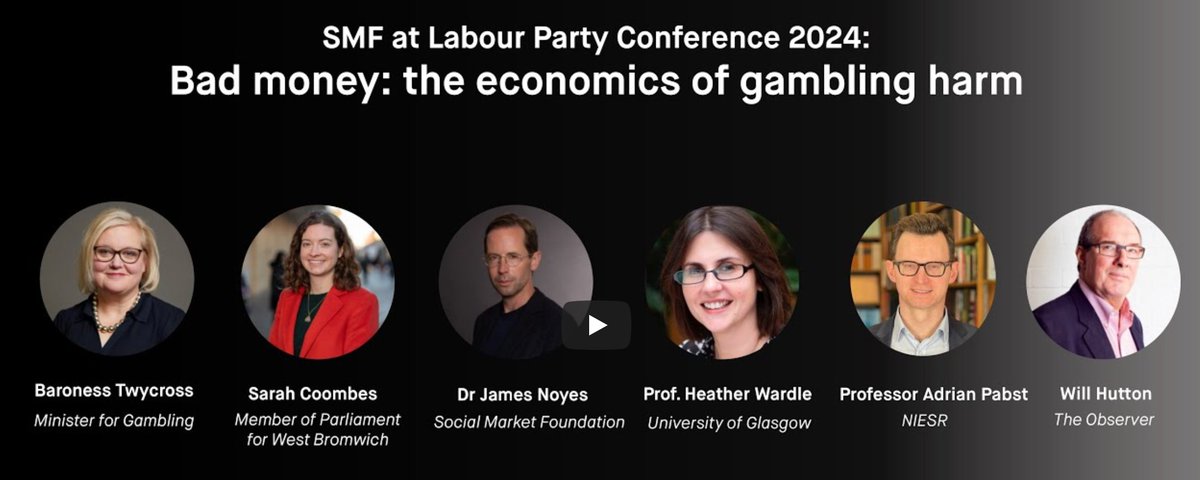
The debate around whether organisation and people such as the Social Market Foundation, James Noyes or Matt Zarb-Cousin are anti-gambling often gets stuck on language. They insist they are not against gambling itself, only against harm. But the real issue has nothing to do with what they claim about themselves. It is the population level policy framework they promote. This is the public health approach.
Public health thinking is built for activities that society wishes to reduce. It is the logic used to lower smoking rates, alcohol misuse and unhealthy consumption. It is not designed for activities society wishes to preserve or regulate proportionately. When this model is applied to gambling, the goal subtly shifts from helping individuals to lowering the total amount of gambling taking place in society. That shift is what turns well-intentioned policies into broad, population-wide restrictions. They inevitably apply to every gambler, regardless of whether they show signs of risk.
The influence of this model is so strong that even organisations within the gambling industry sometimes drift into it. When the Betting and Gaming Council endorses affordability checks and blanket stake limits on online slots, it is not supporting targeted intervention for vulnerable people. It is accepting the public health framing in which all gambling is viewed as a risk that must be reduced. This may be strategic or defensive, but it feeds the same ideology that undermines the regulated market in the long run. Instead of advocating targeted, data-driven interventions that protect those who need support, the BGC too often backs measures that fall on every customer without distinction. That alignment with public health thinking is unlikely to end well for the industry or for racing.
The difference between public health restrictions and genuine consumer protection becomes obvious when you compare the tools each uses. A public health approach demands affordability checks for every customer. Consumer protection focuses on behaviour and intervenes only when someone shows genuine risk markers, such as chasing losses or sudden spikes in activity. Public health insists on universal stake limits or mandatory deposit caps for all adults. Consumer protection allows people to spend their own money as they choose but uses timely prompts or warnings when someone gambles heavily or for long periods. Public health seeks bans on bonuses, incentives and promotions across the entire market. Consumer protection respects adulthood and choice but allows customers to opt out of promotional material or block offers if they find them unhelpful.
These contrasts reveal the core truth. Public health policies treat all gambling as a societal problem. Consumer-protection policies focus only on those who are actually vulnerable. Public health reduces freedom for everyone. Consumer protection supports the small number of people who need help while preserving the freedom of the vast majority who gamble responsibly. The logic of the public health model is unmistakably anti-gambling because its purpose is to reduce gambling participation across the population rather than manage harm at an individual level.
This is exactly the logic promoted by the Social Market Foundation, Noyes and Zarb-Cousin. Their proposals consistently include universal affordability checks, population-wide limits and regulatory or tax measures based on the perceived harmfulness of specific products. These are not targeted interventions by any reasonable definition. They are broad restrictions that reduce gambling activity across the board and shrink the regulated market. Whether intentionally or not, their policies move in the direction of less regulated gambling, fewer products and less participation.
Everyone supports helping people who experience genuine harm. Targeted behavioural monitoring, personalised interventions, voluntary limits, advanced risk modelling and self-exclusion tools allow operators and regulators to support those who need help without restricting the freedom of millions who do not. None of this requires a public health ideology. It simply requires good systems, good data and a proportionate regulatory environment.
The public health approach goes far beyond this. It places gambling in the same category as tobacco and alcohol and assumes that the safest society is one in which people gamble less. Once you accept that framing, the trajectory becomes predictable. Advertising tightens. Access declines. Limits fall. Friction increases. Costs rise. Consumer choice narrows. Participation in the regulated market falls. You do not need to call it prohibition for it to have the same long-term effect.
There is another important point. You cannot have a public health approach aimed at online casino without that same logic eventually consuming sports betting and racing. Public health frameworks do not stay confined to one product because the underlying theory makes no distinction between them. If the claim is that harm is linked to gambling as an activity and that reducing participation reduces harm, then every form of gambling becomes a target. First casino/slots, then in-play betting, then sports wagering, then racing. Once you accept the premise, the scope expands automatically.
In reality, gambling products are intertwined. They share the same accounts, the same operators, the same customer journeys and often the same individuals. Someone who plays a £2 slot game may also place a weekend accumulator or bet on a horse in the Grand National. The regulated market is a single ecosystem. Public health ideology cannot be confined to one corner of it because it treats participation itself as the problem. Eventually it spreads to all products because it is built to reduce the activity as a whole.
The public health approach will not eliminate gambling. But it could eliminate regulated gambling. When mainstream, licensed, supervised gambling becomes too restricted, too inconvenient or too unappealing, people migrate to unregulated alternatives where there ia no oversight and no protection. Gambling continues. Only safety collapses. This is the great irony of the public health model: in trying to reduce harm, it pushes people toward environments where harm is more likely.
This is why the public health approach is inherently anti-gambling. And this is why the organisations and campaigners who promote it, including the SMF, Noyes and Zarb-Cousin, sit on the anti-gambling side of the debate whether they acknowledge the label or not. Their framework can lead to only one destination. It shrinks regulated gambling for everyone, including the millions who enjoy it safely.
The question then becomes whether racing, gamblers and bookmakers should collaborate with those who promote the public health approach to gambling regulation. Cooperation may sound constructive, but the underlying aims are incompatible. Public health seeks to reduce gambling participation. Racing, bookmakers and bettors depend on gambling participation to survive. There is no stable middle ground because the tools used to reduce gambling at a population level inevitably weaken the regulated market that supports racing and the wider ecosystem.
Partnership is only possible when both sides share at least one common objective. Public-health advocates do not share an objective with racing, operators or recreational bettors. Their desired direction of travel is less gambling, fewer opportunities to gamble and a smaller industry footprint. Racing seeks a healthy betting ecosystem that can sustain the sport. Operators want an environment where responsible adults can spend their own money without excessive friction. Bettors simply want the freedom to gamble as they always have.
Trying to align these positions is like trying to align the interests of alcohol producers with groups committed to reducing alcohol consumption in society. One side exists to sustain the activity. The other exists to reduce it. However polite the language, the underlying goals do not align.
None of this means harm should be ignored. It means only that harm should be addressed through targeted, evidence-based interventions rather than through a public health ideology that treats gambling itself as the problem. Targeted intervention preserves freedom while protecting those who need help. Public health undermines freedom in pursuit of reduced participation.
If racing, bookmakers or bettors choose to work with public-health advocates, they should do so with a clear understanding of what that alignment means. It means working with a framework designed to shrink the regulated market. It means accepting future rounds of restriction, not just on casino and sports betting, but eventually racing as well. And it means allowing the fundamental premise of the debate to shift from managing harm to reducing gambling as a whole.
That is why the gambling sector, and racing in particular, must be clear about the difference between protecting vulnerable individuals and accepting a public health ideology. One strengthens the regulated market by ensuring it functions responsibly. The other steadily erodes it. Racing, bettors and bookmakers must decide which of those two paths they prefer to walk.
Bookmakers Technology Consortium retweeted
After the government’s tax increases on gambling, the anti-gambling movement moved immediately to its next objective. Within days, five London councils demanded that gambling advertising be removed from the Underground. They argued that gambling is a public health emergency. They used last week’s tax win as a springboard for a new campaign. The movement is organised, relentless and already planning its next stage.
By contrast the gambling and racing industries appear to be at war. This pattern is not new. It mirrors what happened to alcohol in the decades before Prohibition. The alcohol industry fractured internally, and each fracture strengthened the temperance movement. Brewers argued beer was safe and wholesome while whiskey was dangerous. Distillers said the real problem was saloons. Saloons blamed the distillers. Each sector tried to redirect moral pressure onto another, believing that by giving the temperance movement a victory elsewhere they could secure safety for themselves.
The temperance movement saw these divisions as gifts. When brewers claimed whiskey was dangerous, campaigners repeated those words in state legislatures. When distillers framed saloons as corrupt, campaigners used that framing to shut saloons down. Every concession reinforced the core temperance message that alcohol was a threat requiring political intervention. Once that message became established, the movement did not stop at spirits or retailers. It expanded until it had enough power to impose national Prohibition. The internal alliances that were meant to protect individual sectors ended up destroying the entire industry.
A similar pattern is now unfolding in gambling. In 2019, the maximum stake on Fixed Odds Betting Terminals was reduced to £2. Adult gaming centres and seaside arcade operators supported this because FOBTs threatened their businesses. Councils, researchers and campaigners joined them, creating a coalition that succeeded. But once that coalition tasted a major victory, it did not stay focused on machines. It moved immediately toward online gambling, and then toward adult gaming centres themselves.
By 2020, affordability checks were being pushed onto online customers. The same campaigners who had fought FOBTs argued that online gambling was even more harmful. The government adopted the logic. Online operators became the new target. At that point advertising pressure increased. Then came fresh tax campaigns. Each victory built the legitimacy of the public health framing. And every part of the industry that supported restrictions on a rival helped strengthen the same movement that would later target it.
The racing sector joined this dynamic recently. Elements of racing argued during the tax debate that online casinos were uniquely dangerous and that racing should be protected. Anti-gambling campaigners sowed the seed of this argument because it aligned perfectly with their view that online gambling is the core of modern harm. Together they created political space for a carve-out that kept racing’s betting tax at 15% while raising online casino tax from 21% to 40% and raising other online betting tax to 25%.
The carve-out looks like a victory for racing, just as brewers once thought their alliances against spirits were victories. But it strengthened the wider argument that gambling harm can be tackled through aggressive fiscal policy. That logic does not stop at casinos and online sports betting. It will cost racing because racing cannot survive in a shrinking ecosystem. High taxes on online products will reduce marketing spend, reduce customer flow and reduce funding across the sport. There is now a tax imbalance between online and high street gambling. Campaigners will eventually say this must be addressed, leading to the mass closure of betting shops, further hurting racing.
Another front has opened against adult gaming centres. Campaigners now target 'aim to permit' licensing, arguing that AGCs are spreading too quickly across high streets. Some operators who own betting shops support these calls because AGCs compete for retail customers. The pattern repeats. A part of the industry thinks it can gain by supporting restrictions on a rival. The wider movement uses their support to expand its influence.
Throughout this period, the gambling industry has tried to appease the anti-gambling lobby rather than defend the right of punters to spend their money as they wish. It accepted affordability checks. It accepted increasingly restrictive advertising rules. It accepted stake cuts. It has tacitly accepted a public health framing designed by its opponents. Each time it accepted these measures believing it would reduce political hostility. The opposite has happened. The movement has grown more determined, more coordinated and more confident.
The history of alcohol shows why this is dangerous. Once the temperance movement secured early wins, demand for alcohol did not disappear. It changed shape. Prohibition did something the reformers did not understand. It increased the consumption of the highest-potency alcohol. Beer drinking collapsed because beer was bulky and difficult to smuggle. Whiskey and spirits became dominant because they were compact, easy to transport and far more profitable per unit. The illicit market always optimises for intensity. As a result, overall harm increased. People consumed stronger alcohol in unsafe environments. The attempt to reduce harm produced the opposite effect.
The same shift is now happening in gambling. As regulations create friction in the legal online market and as affordability checks push customers away from licensed sites, more people migrate toward offshore operators. These sites are the modern equivalent of bootleg spirits. They are high intensity, high margin, unrestricted and anonymous. They have none of restrictions the anti-gambling lobby want. No affordability checks, no spending caps and no advertising rules. They fill the space created when legal supply becomes constrained. Just as Prohibition increased the appetite for potent alcohol, modern restrictions risk increasing the volume of high-intensity, unregulated online gambling that pays no tax. Harm increases, not decreases, because consumers move into environments with no safeguards.
The latest calls against gambling advertising are part of this same continuum. It is the next step after FOBTs, affordability checks and tax campaigns. The alliances that formed around each measure have strengthened the anti-gambling movement’s framing that gambling is a public health crisis. Once that framing is in place, every part of the industry becomes vulnerable. No carve-out lasts. No internal alliance protects the long term. The prohibitionist logic eventually turns on everyone.
If the gambling and racing industries want a future, they must finally learn the lesson that the alcohol industry learned too late. You cannot buy safety by sacrificing your neighbour. You cannot appease a movement that believes the entire category must be restricted. Every concession strengthens the movement, and every attempt to redirect pressure onto another sector brings the pressure back with more force.
The history of alcohol shows that once a prohibitionist movement gains momentum, it never stops at the first target. It continues until it reaches its logical conclusion. The gambling and racing industries are now repeating the same mistakes, and unless they change course, they are heading toward the same destination.
Bookmakers Technology Consortium retweeted
Your attempt to silence people because you think “the budget is set” will not work. It remains essential that those who genuinely understand the gambling market set out the consequences of your tax proposals with complete clarity. The implications are not abstract. They affect jobs, tax revenue, racing’s funding model, levels of gambling harm, and the size of the black market. These outcomes are measurable, predictable, and have been explained repeatedly by people who work in and use the gambling industry every day.
You have had ample time to revisit or withdraw your report before the budget. You have been shown clear evidence that higher point of consumption taxes in a mature, internationally competitive market push consumers offshore, reduce the regulated share of wagering, weaken product offering, and shrink the tax base. You have been told repeatedly that racing does not rely only on levy, but also on media rights, both of which fall sharply when regulated turnover and shop footfall decline. Betting shops remain a major employer and local economic contributor, and their margins are already tight. Additional taxation accelerates closures.
It is not only the industry that has pointed this out. Gamblers themselves have warned that increasing costs will push them toward offshore operators with zero consumer protection. Treatment providers have explained that harm rises when activity moves into markets with no oversight or intervention systems.
There is no ambiguity left. If extra tax policies are adopted, responsibility for the consequences lies with those who promoted them. Job losses will be traceable. Reduced tax receipts will be visible. Damage to racing’s levy and media-rights income will be quantifiable. Growth of the black market will be the predictable result of ignoring evidence.
Your “duty to differentiate” proposals combined with the SMF’s Theo Bertram ideas on machine gaming duty are public record. Warnings from dozens of people through articles, TV and social media are also on record. Claiming you lacked information or were misled will not work.
This is the final opportunity to acknowledge the real-world impact before decisions are locked in. If you proceed, and your policies are adopted, the outcomes are yours to own.
