

Financial markets research| Cycles | Elliott Waves | TA |Join my Slice Room @BraVoCycles for real-time action: https://nitter.cf/t.co/z8Iemsr92x
Virginia, USA
Joined February 2024
- Tweets9.8K
- Following281
- Followers20.7K
- Likes4.8K

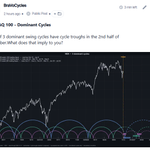

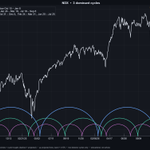


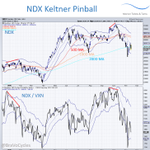
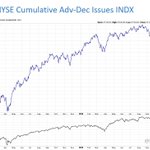

State of the stock market. Grab my free 40-chart eBook, "Stock Market Outlook." Download it here 👇
bravocycles-newsletter-marke…

57
My 2024 Bitcoin 4-Year Cycle Forecast
- At the end of 2024 I predicted that Bitcoin would peak in Oct’25 and that the next significant cycle trough will be in late 2026 or early 2027.
- The peak forecast played out with one week accuracy.
- We are now in late 2026 and expecting that cycle trough and a price low of significance; Bitcoin is getting there.
- Where you following me then?
$BTC $BTCUSD $GBTC

State of the stock market. Grab my free 40-chart eBook, "Stock Market Outlook." Download it here 👇
bravocycles-newsletter-marke…
421

State of the stock market. Grab my free 40-chart eBook, "Stock Market Outlook." Download it here 👇
bravocycles-newsletter-marke…
593
Cycles tell you when. FLD targets tell you where. Elliott Waves tell you what the move is.
I run all three live, about 10 updates a day, plus live chat where you can ask me directly.
That’s the @BraVoCycles Live Room on Slice. @SliceApp Link in the bio & reply 👇


State of the stock market. Grab my free 40-chart eBook, "Stock Market Outlook." Download it here 👇
bravocycles-newsletter-marke…
474
In 2024, I called Bitcoin’s peak for October 2025.
Now BTC is below $69K after Nvidia’s CEO exit rattled risk assets. Where’s the cycle trough? 👇
Free: Bitcoin cycles
Pro: + semis, crypto, gold, silver
bravocycles-newsletter-marke…

1
1,206
BraVoCycles Newsletter retweeted
History of US Stock Market crashes (bear markets).
For entertaiment during the Holiday week, not a hiden market timing messdage.

BraVoCycles Newsletter retweeted
Breaking: The Wall Street Journal has reported extensively on Nvidia’s aggressive financing and massive supplier commitments.
- Huge supplier orders/commitments: Nvidia’s purchase commitments to suppliers jumped to $279 billion in its latest quarter (from $119 billion the prior quarter). Most of this was to lock in memory and other components for AI chips and systems so it could meet demand. The company has used its balance sheet to secure supply, but WSJ noted the risks if demand slows—these large obligations could amplify pain in a downturn. Some of the agreements may be cancelable or adjustable before firm orders, though disclosure on the exact escape clauses has been limited. Source: Tradingview
- Customer financing and guarantees (“circular” financing): Nvidia has been providing large financial backstops and guarantees so customers (including less creditworthy ones, smaller cloud providers, and AI labs) can buy its chips. Notable examples include a major residual-value/lease guarantee tied to an OpenAI-related Ohio data-center project (discussions around $250 billion were scaled back; the signed amount was lower, in the $105–125 billion range depending on the exact reporting) and participation in a broader ~$500 billion financing partnership with Wall Street firms (Apollo, BlackRock, Blackstone, Brookfield, Goldman Sachs, KKR) that aims to create asset-backed pools for AI infrastructure. Nvidia has also offered revenue-sharing deals and other credit support in exchange for chip sales. Huang publicly pushed back on the “circular financing” label. Source: WSJ
- Internal tensions and the “avalanche” warning: In an August meeting, Huang reportedly described the vast committed supply of wafers and memory as coming at the company “like an avalanche.” He criticized CFO Colette Kress (now interim CEO) as “a deer in the headlights” and a “reporting CFO” while questioning whether the aggressive dealmaking (including deals involving his son-in-law) had gone too far. Kress had raised concerns about risk, valuation of guarantees, and returns, and helped scale back some commitments. Some financing arrangements were later paused for more scrutiny. Source: Archive
BraVoCycles Newsletter retweeted
Breaking: Nvidia may be considering a change in leadership, with Arm Chief Executive Officer Rene Haas reportedly among the potential candidates.
The Financial Times reports that Nvidia's board has approached Haas as it evaluates possible successors to Jensen Huang. No offer has been made, and Haas is one of several individuals under consideration.
Haas spent seven years at Nvidia before joining Arm in 2013. He became Arm's chief executive officer in 2022. Other reported candidates include AMD Chief Executive Officer Lisa Su, Apple executive Johny Srouji, and several Nvidia executives.
Following the report, Arm shares fell more than five percent, while Nvidia shares declined approximately two percent.
How could a leadership change shape Nvidia's future?
Breaking: The Wall Street Journal has reported extensively on Nvidia’s aggressive financing and massive supplier commitments.
- Huge supplier orders/commitments: Nvidia’s purchase commitments to suppliers jumped to $279 billion in its latest quarter (from $119 billion the prior quarter). Most of this was to lock in memory and other components for AI chips and systems so it could meet demand. The company has used its balance sheet to secure supply, but WSJ noted the risks if demand slows—these large obligations could amplify pain in a downturn. Some of the agreements may be cancelable or adjustable before firm orders, though disclosure on the exact escape clauses has been limited. Source: Tradingview
- Customer financing and guarantees (“circular” financing): Nvidia has been providing large financial backstops and guarantees so customers (including less creditworthy ones, smaller cloud providers, and AI labs) can buy its chips. Notable examples include a major residual-value/lease guarantee tied to an OpenAI-related Ohio data-center project (discussions around $250 billion were scaled back; the signed amount was lower, in the $105–125 billion range depending on the exact reporting) and participation in a broader ~$500 billion financing partnership with Wall Street firms (Apollo, BlackRock, Blackstone, Brookfield, Goldman Sachs, KKR) that aims to create asset-backed pools for AI infrastructure. Nvidia has also offered revenue-sharing deals and other credit support in exchange for chip sales. Huang publicly pushed back on the “circular financing” label. Source: WSJ
- Internal tensions and the “avalanche” warning: In an August meeting, Huang reportedly described the vast committed supply of wafers and memory as coming at the company “like an avalanche.” He criticized CFO Colette Kress (now interim CEO) as “a deer in the headlights” and a “reporting CFO” while questioning whether the aggressive dealmaking (including deals involving his son-in-law) had gone too far. Kress had raised concerns about risk, valuation of guarantees, and returns, and helped scale back some commitments. Some financing arrangements were later paused for more scrutiny. Source: Archive
Breaking: Nvidia may be considering a change in leadership, with Arm Chief Executive Officer Rene Haas reportedly among the potential candidates.
The Financial Times reports that Nvidia's board has approached Haas as it evaluates possible successors to Jensen Huang. No offer has been made, and Haas is one of several individuals under consideration.
Haas spent seven years at Nvidia before joining Arm in 2013. He became Arm's chief executive officer in 2022. Other reported candidates include AMD Chief Executive Officer Lisa Su, Apple executive Johny Srouji, and several Nvidia executives.
Following the report, Arm shares fell more than five percent, while Nvidia shares declined approximately two percent.
How could a leadership change shape Nvidia's future?