

25 years of trading experience | Crypto + Macro +AI. 100% researched content. No bullshit. Capital preservation before capital multiplication.
Process before prediction.
Joined July 2022
- Tweets4.8K
- Following292
- Followers3K
- Likes8.1K







Pinned Tweet
No marketing. No paid narratives.
Not a promoter. Not a guru. Not a fund.
I write about power, capital flows, and crypto infrastructure as global systems rewire.
No hype. No signals. Just first principles.
3
26
13,182
I LOVE THE BLOODBATH, ESPECIALLY AT THESE $TAO PRICES.
ADDING MORE WITH ZERO TREMBLE, ZERO HESITATION, AND ABSOLUTELY NO FEAR.
WHILE OTHERS PANIC, I'M CELEBRATING THE OPPORTUNITY.
THE BIGGER THE DISCOUNT, THE BIGGER THE CONVICTION.

By the time you understand the power of Decentralized AI, $TAO will already be trading at $6,500 per token.


The strength $TAO is showing in this bloodbath market tells you one thing:
$6,500 might actually be the bear case.
BullBrezza | Macro & Crypto retweeted
Two kidneys. Zero $TAO .
Some people really don't understand asset allocation.
BullBrezza | Macro & Crypto retweeted

Robotics on Bittensor is making its way onto real factory floors.
@openroboto just signed its first commercial pilot with a manufacturer in Hungary, bringing its data collection hardware into a real industrial environment.

We've signed our first commercial robotics data pilot with Vulcan Shield Hungary, one of the largest advanced material manufacturing complex in Europe.
Starting at a production workstation in Békéscsaba, we'll combine real-world data and simulation to work toward a robot model trained for a specific factory task.
$TAO - The answer to your broken life and the beginning of your financial freedom.

An AI can write a business plan much faster than a customer can prove it works.
Thats a limit worth remembering when people project software speed onto the whole economy.
Some answers require a sale, a clinical result, a physical experiment or months of operating data. more generated analysis doesnt replace that feedback.
I think the next valuable research tools will help us design better tests and learn from what happens, including when the original idea fails.
168
Once you truly understand what $TAO is building, you stop asking, “Do I own enough?”
You start wondering whether owning enough is even possible.
1
272
AI can help you build the wrong business much faster. Execution is becoming cheap; conviction is not.
A working product still needs a customer with a problem worth paying to solve. Faster development does not establish demand, cost discipline, or a reason to exist.
When execution gets cheaper, the questions you ask before starting carry more weight. Pre-consensus work moves upstream: challenge the demand, the costs, the reason to build-before another feature ships.
Cheap production is an observation about capability. It is not a signal about allocation. The market still decides what deserves capital, attention, and repetition.
I would want my AI to pressure-test the premise, not just accelerate the output. Speed without a validated problem is just a faster path to the wrong place.
In macro, crypto, and building alike: abundance of execution changes where value collects. It does not erase the need to allocate it well. Signal first. Consensus later.
1
216
Even if AI makes intelligence cheap, two people can still want the same beachfront home. Computation scales. Location does not.
Cheap production changes what we pay for. It does not dissolve conflict over who gets access to scarce things-energy, ownership, attention, enforceable claims.
Abundance is not the absence of allocation. It is a migration of scarcity. Value collects in new places: trust, coordination, rights, physical access, and the ability to verify.
So I find money disappearing much harder to accept than products getting cheaper. Cheap goods are an observation about production. Money is an observation about coordination and claims.
In macro and crypto alike, the pre-consensus question is not “what got cheaper?” It is “where did scarcity move, and who controls the gate?”
Abundance changes where value collects. It does not erase the need to allocate it. Signal first. Consensus later.
1
5
368
Putting a house onchain does not put a buyer on the other side. A token is a claim, not a counterparty.
Tokenization makes a claim easier to divide, record, and transfer. That is real. But transferability is not liquidity-it is only the precondition.
Actual liquidity still requires three harder things: credible valuation, enforceable rights, and someone willing to buy at your price. The ledger records ownership; it does not manufacture demand.
This is where pre-consensus opportunity hides. Issuing tokens is the visible event. The durable signal is the machinery underneath: linking token to asset, servicing ongoing obligations, and making ownership useful enough that people keep showing up.
A market is not a database. It is a repeated willingness to transact. I want to observe who maintains that willingness after the mint.
The opportunity is much bigger than issuance. It is continuity: credible marks, enforceable claims, real exits. Signal first. Consensus later.
3
179
Two kidneys. Zero $TAO .
Some people really don't understand asset allocation.
A private investment can lose value without printing a red candle. Silence is not stability-it is an unpriced interval.
Between funding rounds, valuation is an observation, not a trade. It tells you what terms someone accepted then, not what a buyer would pay now.
That silence has two faces: it can protect focus on building the business, and it can hide how far the economics have deteriorated. The same absence of signal is both shelter and fog.
Owner discipline means asking: when was it valued, by whom, on what assumptions, and with what rights? A mark is a claim about the future wearing a number.
Pre-consensus thinking requires exit awareness. An asset you cannot sell is not priced by the market; it is priced by your need. Liquidity is a parameter, not a virtue.
In private rounds and illiquid crypto alike, mark-to-model is not mark-to-market.
I like thinking like an owner-but I want to know whether I can actually get out before I confuse a quiet mark with a safe one.
2
164
A small multiple is not a signal. It is an observation waiting for context.
10x revenue can quietly be 100x earnings. $100m sales, $10m net profit, $1bn valuation-same purchase, two stories.
One measures scale. The other measures what survives contact with costs, competition, and time.
Revenue is potential energy. Profit is what actually reaches the system.
The gap between them is the hard part: pricing power, retention, margins, reinvestment, dilution, durability.
Growth can justify a rich price. But calling something cheap on sales skips the conversion problem-how much revenue becomes durable profit, and how much gets consumed by the machinery of getting there.
Pre-consensus work is not finding the smallest-looking multiple.
It is understanding which multiple is doing the real describing.
I want to know what the revenue becomes before I treat the multiple as a bargain. Signal first. Consensus later.
179
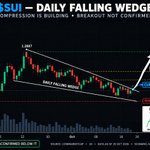
Most people will call the $SUI bottom after the breakout.
The chart is giving us the decision levels now:
Support: $0.86–$0.91
First reclaim: $1.05
Confirmation: $1.29
Above $1.29 → $1.50, $1.61, $1.93, then $2.40 till $14.
Below $0.64, the macro-bottom thesis fails.
