

Tiny but Mighty Miner 💪 DEFI ⬣
Worldwide
Joined September 2013
- Tweets12.2K
- Following66
- Followers2.4K
- Likes73.9K


Great conversation. Zoom out. @Strategy and @saylor are looking at the long-term. Volatility is the price you pay for life-changing gaines.

How do we decide when to buy Bitcoin and when to buy back $STRC? In Strategy’s Q3 2026 Investor Q&A with @NatBrunell, @PhongLe and I answered your questions about Bitcoin Per Share, funding dividends through a downturn, and creating long-term value for $MSTR shareholders.
02:05 - How $MSTR, $STRC, other preferred shares, and convertible debt fit into Strategy’s capital structure
08:09 - Creating value for $MSTR shareholders beyond $BTC appreciation
11:53 - When we issue equity, buy Bitcoin, and repurchase $STRC
24:38 - What Gross and Net Bitcoin Per Share tell us about accretion, risk, and long-term value
37:18 - $STRC repurchases, the $100 target price, and credit market dynamics
51:40 - Managing amplification and risk while maintaining balance sheet strength
53:06 - Funding dividends and meeting debt obligations through a prolonged Bitcoin downturn
57:42 - How liquid Digital Credit creates value for $MSTR shareholders
01:04:34 - Strategy’s vision for scaling Digital Credit, $STRC, and Digital Money over the next 3–7 years
1
48
The Future Is Cheap Now retweeted

“Few skills are so well rewarded as the ability to convince parasites that they are victims.”
— Thomas Sowell

This is suicidal empathy @elonmusk
"In the forest, there is no good or evil, only the strong or the weak. A sheep being virtuous does not change a wolf's mind."
— Machiavelli
1
79
The Future Is Cheap Now retweeted

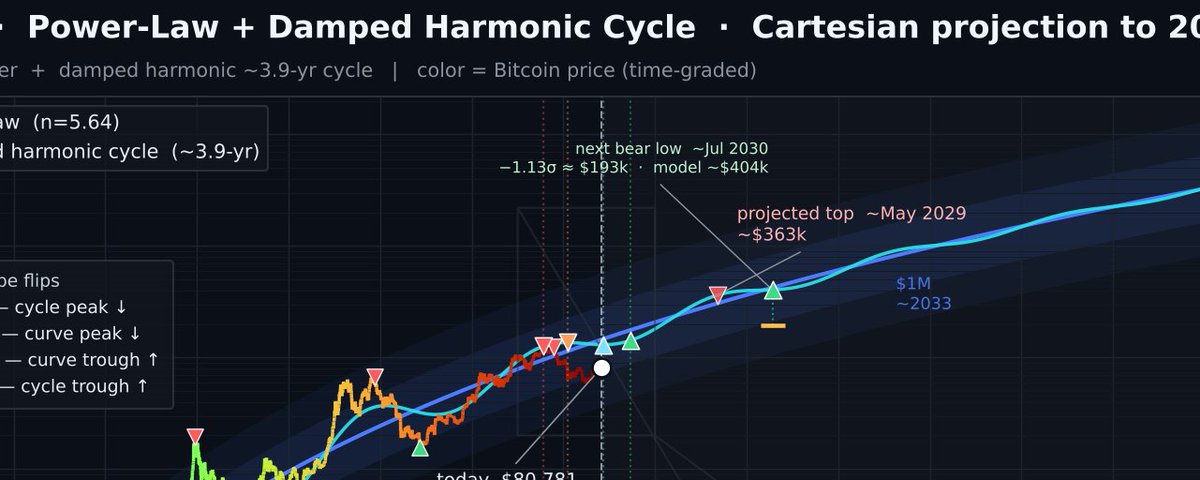
65k is the new 58k.
We are right around the bear low average of a ~1.15σ standard deviation from the Power-Law fair value.
The June low was 1.14σ. 2022's low was 1.16σ. The bear low has a tight correlation of 1.13σ (+/-0.21σ).
nitter.cf/themoneyrebel/status/2…




They're having major issues both their anchor chains have been released. That's your last ditch emergency response to stop the ship.

Another Birdseye view from another TikToker @SecDuffy why does it look like they purposely turned into the cruise ship??
1
75
This is awesome. I'm a big fan of Dr Ben Carson too, who is a director.
Pulsechain.com PLS PLSX INC HEX


Will @OldGloryBank be launching PulseChain's first official bank-backed USD Stablecoin? 👀
This would be absolutely HUGE.

4
57
The Future Is Cheap Now retweeted

“You can silence 50 scholars with one fact, but you can’t silence one idiot with 50 facts.”
— Rumi
I think that now that the midterms have been won by the Democrats we're going to start seeing a lot of the things that @realDonaldTrump and the @GOP were getting push back for are now going to start getting done and claimed as their ideas and victories which is fine. Just get it done!

In Major Win For Nuclear Energy, Nearly Half Of Senate Democrats Join GOP To Advance Permitting Overall zerohedge.com/political/near…

2
49


The Future Is Cheap Now retweeted
“Ours may become the first civilization destroyed, not by the power of our enemies, but by the ignorance of our teachers and the dangerous nonsense they are teaching our children. In an age of artificial intelligence, they are creating artificial stupidity.”
— Thomas Sowell
If everyone's a millionaire what's a million dollars worth?

Can you imagine if the presidency had not gone to @realDonaldTrump ? Do you think you'd be hearing anything about the monetary and voting fraud that has been uncovered?
Pendulum swings as memories are short.
Lots of gridlock and nonsense coming for the next 2 years.
2
41


Someone like @elonmusk spends hundreds of millions of dollars to try and limit the number of people that just straight up hate him when he just wants to build and further humanity.
Sorry buddy must be a tough day.
Hang in there. I know if it was me being you I'd be like screw it and ride off into the sunset. You have plans beyond the sunset though and keep those plans in mind on days like this.
1
61
Can you imagine if the presidency had not gone to @realDonaldTrump ? Do you think you'd be hearing anything about the monetary and voting fraud that has been uncovered?
Pendulum swings as memories are short.
Lots of gridlock and nonsense coming for the next 2 years.
It's going to be so interesting to see the ingenious ways second, third and fourth levels of thinking come up with having data centers in space. Going back to first law principles and outside of the box thinking rather than the status quo will come into play as well as they have on Earth.
Engineers at @Tesla and @SpaceX have already made back to basic breakthroughs dealing with physics on Earth. In space you're just dealing with different physics to think about and assuredly they will.

BOOOM 🚨 Elon Musk just said it's much easier to cool AI chips in space than on Earth, and the physics actually backs him up 🔥
To most people that sounds backwards. Space is a vacuum, and a vacuum is the best insulator there is.
One viral post even used it to question whether Elon is a real engineer.
The critics got the first step right. They just stopped thinking one step too early.
🧊 THE THERMOS SECRET
To see where they slipped, start with how a chip stays cool on Earth. A fan blows air across it, or water flows past it, and the heat gets carried away.
In space there's no air and no water, so nothing can carry the heat off. The critics are right about that much.
But a thermos tells the rest of the story. It keeps coffee hot with a vacuum between two walls, and those walls are coated like a mirror.
The mirror is there for a reason. Heat still escapes through a vacuum as infrared light, the invisible glow you feel on your face near a campfire.
So space doesn't trap heat. It just closes every exit except one.
A space radiator uses that last exit on purpose. It's an anti-thermos, a panel with a special coating built to glow away as much heat as possible.
So the real question is how fast a panel can glow heat away.
🔥 WHY SPACE IS THE PERFECT HEAT DRAIN
Everything warm glows in infrared, including you and the cup of coffee on your desk.
The hotter something is, the brighter it glows, and the effect snowballs fast. Physicists call this the Stefan-Boltzmann law, which says the glow grows with temperature, counted from absolute zero, raised to the fourth power.
In everyday terms, a little extra heat buys a lot of extra cooling.
A panel at around 65°C (149°F), about as hot as coffee that's just cool enough to sip, sheds about twice as much heat as one at a cool 10°C (50°F).
Then there's the backdrop. Deep space sits at about minus 270°C, which is what Elon means by "3 degrees above absolute zero," and it sends almost no heat back.
Picture stepping outside on a freezing winter night instead of into a sauna. Out in the cold, your body heat just pours away.
That's what a radiator feels in orbit, every second of every day.
That one-way street is where Elon's numbers come from.
🧮 ELON'S NAPKIN MATH
Start with the radiator. One square meter of aluminum panel, turned edge-on to the Sun and glowing from both sides, can dump about 1,300 watts.
That's nearly the output of a household space heater from a panel the size of a small table.
Now the solar panels. Sunlight in orbit delivers about 1,361 watts per square meter, and a solar panel turns only about 250 watts of that into electricity.
Here's the brilliant part.
Every bit of electricity the chips use ends up as heat, because energy never disappears. It just changes form.
The solar panels deal with their own leftover sunlight by glowing it away themselves. That means the radiator only has to handle the electricity that actually reaches the chips.
Each square meter of radiator can get rid of about five times what each square meter of solar panel produces.
So the radiator only needs to be about one fifth the size of the solar wings.
The "impossible" cooling problem turns out to be the smaller part of the satellite. That's why Elon says most of its mass is solar panels.
This isn't just napkin math, either. SpaceX built its first AI satellite around it.
🛰️ SPACEX'S AI SATELLITE RUNS ON THIS MATH
SpaceX's first AI satellite is wider than a Boeing 747, and every square meter of it follows this math.
SpaceX's June design for its AI1 satellite assumed 250 watts per square meter for the solar array and about 1,400 for double-sided radiators turned edge-on to the Sun, slightly more optimistic than the 1,300 in Elon's reply.
It paired 110 square meters of liquid radiator with 120 kW of sustained power and 150 kW at peak. Multiply 110 by 1,400 and you get about 154 kW, a clean match.
A kilowatt is a thousand watts, so 120 kW is roughly what a hundred American homes use on average.
The satellite has since grown to a 75-meter wingspan and up to 250 kW at peak. That peak matches what a V3 Supercharger can push into a Tesla.
The first launch is targeted for the fourth quarter of 2027, which is a lot sooner than "not in our lifetimes."
The brains inside will be a space-optimized version of Nvidia's Vera Rubin NVL72 system.
Data center chips are already running in orbit, too. Starcloud launched a satellite carrying an Nvidia H100 in late 2025 and used it to train the first AI model in space.
Just as impressive is how little cooling hardware the whole thing needs.
⚙️ A COOLING SYSTEM WITH ALMOST NOTHING TO BREAK
A data center on Earth is a giant building full of fans and chillers, often with cooling towers that evaporate water.
In orbit, a fluid soaks up heat next to the chips, hands that heat to the aluminum panel, which glows it away, and then loops back forever.
SpaceX backs this up with redundant pumping loops and built-in shielding against tiny space debris, so a few pumps do the job of a whole building of cooling equipment.
Elon goes even further and says the AI satellite is simpler than a Starlink satellite, because it skips Starlink's complex antennas.
The physics was never the hard part.
The hard part was the cost of lifting giant panels into orbit, and that's exactly the problem Starship was built to crush.
Of course, the skeptics still have a few cards to play.
💪 THE CRITICS' BEST SHOT
Their favorite number comes from the International Space Station.
The ISS cooling system rejects roughly 70 kW across 422 square meters of radiator, about 166 watts per square meter. That's roughly an eighth of Elon's figure.
On paper, that looks bad for Elon. But temperature is a big part of that gap.
The ISS keeps its cooling loops cold enough to serve astronauts, and by the fourth-power rule, cold radiators shed far less heat.
AI chips run hot, which is exactly what radiators love. The ISS is a station designed in the 1990s to keep people comfortable, not a satellite designed from scratch to cool a supercomputer.
Critics also point out that Earth glows in infrared too, and that radiator coatings wear down over years in orbit.
Both are real, and both are design margins rather than deal breakers.
SpaceX already flies and replaces thousands of Starlink satellites, so running a fleet that gets refreshed is its home turf.
Then there's cost. An ABI Research model in IEEE Spectrum found that running a GPU in space for a year costs at least ten times more than on Earth.
But that model assumed an Nvidia H100 rack on a spacecraft similar to Starcloud's first pilot satellite, not a purpose-built design like AI1.
Even Jensen Huang, who calls today's economics poor, says they will improve over time. His own company is now building the brains of SpaceX's first AI satellite.
🚀 THE TWIST THAT CHANGES EVERYTHING
Here's the part the critics missed.
The fourth-power rule flips chip design on its head. Here on Earth, engineers spend fortunes keeping chips cool.
In orbit, the hotter a chip can safely run, the smaller its radiator, the lighter the satellite, and the cheaper every launch becomes.
On Earth, a hot chip is a problem.
In orbit, it's a feature, and SpaceX owns the rocket.


Listening to some of these political commentators and Democrats talk about making everything better when you had Obama and Biden in office for 12 years. Is like 2 years ago when Kamala was running with the idea of turning the page after being in office for 4 years with Biden
1
2
80
