

Staff Research Scientist (actively recruiting research interns!), NVR TW @NVIDIAAI @NVIDIA (Project Lead: DoRA, EoRA, 4D-RGPT, SpatialClaw) | Ph.D. @GeorgiaTech
Taipei City, Taiwan
Joined July 2011
- Tweets1.2K
- Following1.8K
- Followers2.6K
- Likes34.5K




Pinned Tweet
(1/N)
Are you looking for #Vision #Transformer papers in various areas?
Check out this list of papers including a broad range of different tasks!
github.com/cmhungsteve/Aweso…
Feel free to share with others😀
@Montreal_AI @machinelearnflx @hardmaru @ak92501 @arankomatsuzaki @omarsar0

I'm looking for one emergency reviewer for my @iclr_conf 2027 batch! If you have experience in VLA / latent reasoning, please DM me. Thank you!
#ICLR2027
Min-Hung (Steve) Chen retweeted

🤖 What if robots could reason not just in words, but through the dynamics of the physical world?
🚀 Introducing 𝗧𝗵𝗶𝗻𝗸𝗪𝗼𝗿𝗹𝗱 from @NVIDIAAI !
💡 By reasoning through shared physical dynamics, robots could learn from human experience and transfer motion intelligence across embodiments.
𝗛𝗼𝘄 𝗶𝘁 𝘄𝗼𝗿𝗸𝘀
→ 𝗖𝗵𝗮𝗶𝗻-𝗼𝗳-𝗗𝘆𝗻𝗮𝗺𝗶𝗰𝘀 (𝗖𝗼𝗗): A shared motion reasoning space across human and robot embodiments.
→ 𝗪𝗼𝗿𝗹𝗱 𝗜𝗺𝗮𝗴𝗶𝗻𝗮𝘁𝗶𝗼𝗻: Imagines future world representations conditioned on CoD.
→ 𝗥𝗟 𝗳𝗿𝗼𝗺 𝗪𝗼𝗿𝗹𝗱 𝗜𝗺𝗮𝗴𝗶𝗻𝗮𝘁𝗶𝗼𝗻: Reinforces reasoning through alignment between imagined and observed futures, enabling learning from human and robot videos.
𝗪𝗵𝗮𝘁 𝗶𝘁 𝗲𝗻𝗮𝗯𝗹𝗲𝘀
→ Robust real-world manipulation under unseen objects and environments.
→ Human-guided skill composition for novel multi-step robot tasks.
→ Robust generalization under task and environment shifts in simulation.
🌍 𝗢𝘂𝗿 𝘃𝗶𝘀𝗶𝗼𝗻: Scale generalizable motion intelligence through human videos toward a unified System-1 reasoning layer for Physical AI.
Paper, robot demos & more below! 👇
Min-Hung (Steve) Chen retweeted
Honored to be part of this.
First time contributing to a model release at this scale. Grateful to the Nemotron team — the model, the data, and the evals are a much bigger effort than any one piece.
Our piece was SpatialClaw: used to build the agentic vision training data for video understanding.
📄 Paper: arxiv.org/abs/2606.13673
💻 Code: github.com/NVlabs/SpatialCla…
📑 Report: research.nvidia.com/labs/nem…
Grateful to the folks who pulled SpatialClaw into the agentic vision data — @EhsanHAsl @leoyerrrr @amy030619 @goelarushi27 @currenator @drewtao . The model, the filtering, and the evals were the larger lift.
SpatialClaw accepted to #NeurIPS2026 🎉
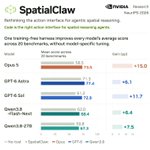
Even GPT-6 Astra gets better with the right action interface.
Same training-free harness, no model-specific tuning, 20 spatial benchmarks:
GPT-6 Astra: 71.3 → 77.4 (+6.1)
Opus 5: 58.5 → 73.5 (+15.0)
GPT-6 Sol: 61.2 → 72.9 (+11.7)
Qwen3.8-27B: 59.8 → 67.3 (+7.5)
Astra already looks “spatial.” A persistent Python kernel on top of it still wins.
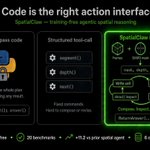
Code is the action interface: the VLM writes one cell per step, inspects SAM / depth / geometry outputs, revises, then answers.
📄 Paper: arxiv.org/abs/2606.13673
💻 Code: github.com/NVlabs/SpatialCla…
🌐 Website: spatialclaw.github.io/
@NVIDIAAI

Update: SpatialClaw was used in the agentic vision training data for NVIDIA Nemotron 3.5 Super VL. Grateful to be part of that effort.
14,169 trajectories, 81,366 actions. Details: nitter.cf/CMHungSteven/status/21…

Honored to be part of this.
First time contributing to a model release at this scale. Grateful to the Nemotron team — the model, the data, and the evals are a much bigger effort than any one piece.
Our piece was SpatialClaw: used to build the agentic vision training data for video understanding.
📄 Paper: arxiv.org/abs/2606.13673
💻 Code: github.com/NVlabs/SpatialCla…
📑 Report: research.nvidia.com/labs/nem…

Min-Hung (Steve) Chen retweeted

Remember VIEScore? It scored generated images with a VLM and explained why in text, across every image generation and editing tasks.
Today we are releasing VIEScore2: one model that scores generated & edited images AND marks exactly where they go wrong on a N by N grid, in a single pass.
Most failed mods still load. They just behave wrong: no texture, a recipe that never registers, crafting that doesn't consume its inputs.
Easy edits land. Deeper ones don't.
That's the gap we're investigating.

Min-Hung (Steve) Chen retweeted
AI game modding is suddenly all over X. Funny timing for us: we have been chasing a nearby question for almost two years.
What does it mean to deliberately *edit* an existing world, rather than generate a new one? We call it World Editing. 🧵(1/10)
Min-Hung (Steve) Chen retweeted

SpatialClaw
Rethinking Action Interface for Agentic Spatial Reasoning
paper: huggingface.co/papers/2606.1…

Min-Hung (Steve) Chen retweeted
SpatialClaw accepted to #NeurIPS2026 🎉
Even GPT-6 Astra gets better with the right action interface.
Same training-free harness, no model-specific tuning, 20 spatial benchmarks:
GPT-6 Astra: 71.3 → 77.4 (+6.1)
Opus 5: 58.5 → 73.5 (+15.0)
GPT-6 Sol: 61.2 → 72.9 (+11.7)
Qwen3.8-27B: 59.8 → 67.3 (+7.5)
Astra already looks “spatial.” A persistent Python kernel on top of it still wins.
Code is the action interface: the VLM writes one cell per step, inspects SAM / depth / geometry outputs, revises, then answers.
📄 Paper: arxiv.org/abs/2606.13673
💻 Code: github.com/NVlabs/SpatialCla…
🌐 Website: spatialclaw.github.io/
@NVIDIAAI
4 papers accepted to #NeurIPS2026 🎉
1 spotlight + 3 posters.
I led SpatialClaw: rethinking the action interface for agentic spatial reasoning.
Code is the action interface — training-free, +13.6 on 20 spatial benchmarks.
Also accepted:
🌟 TTB — Test-time MLP Baking for decoder-only view synthesis (spotlight)
📄 TTVidT — Decoupling the temporal axis for motion-centric video pretraining
📄 MARS — Harmonizing multimodal convergence via adaptive rank search
More details soon 🧵
Huge thanks to all collaborators.
@NVIDIAAI
SpatialClaw details →
SpatialClaw accepted to #NeurIPS2026 🎉
Even GPT-6 Astra gets better with the right action interface.
Same training-free harness, no model-specific tuning, 20 spatial benchmarks:
GPT-6 Astra: 71.3 → 77.4 (+6.1)
Opus 5: 58.5 → 73.5 (+15.0)
GPT-6 Sol: 61.2 → 72.9 (+11.7)
Qwen3.8-27B: 59.8 → 67.3 (+7.5)
Astra already looks “spatial.” A persistent Python kernel on top of it still wins.
Code is the action interface: the VLM writes one cell per step, inspects SAM / depth / geometry outputs, revises, then answers.
📄 Paper: arxiv.org/abs/2606.13673
💻 Code: github.com/NVlabs/SpatialCla…
🌐 Website: spatialclaw.github.io/
@NVIDIAAI
If you work on agents, robotics, or VLM spatial evals:
Cite: arxiv.org/abs/2606.13673
Star/Fork: github.com/NVlabs/SpatialCla…
Happy to help people reproduce the new frontier-model numbers.

Huge thanks to the SpatialClaw crew — this one was a real team effort.
@seokju_cho led the work during his NVIDIA internship.
Grateful to @RHachiuma, Abhishek Badki, @suhangpro, @BKLEE_NANO, @luke_ch_song, @Sifei30488L, @subhashree_r, Seungryong Kim, and Yu-Chiang Frank Wang.
Min-Hung (Steve) Chen retweeted

TT-VidT is accepted at #NeurIPS2026 🎉
A temporal-decoupled methodology in video pretraining to provide real "motion" info extracted from the video and only requires small scale training to reach high quality results.
Huge thanks to all collaborators, @NVIDIAAI and @spellbrush
