

Computational Materials Science Laboratory at UB & IQTCUB Understanding, developing, and improving new materials through Computational Chemistry
Barcelona
Joined February 2023
- Tweets117
- Following34
- Followers57
- Likes9





Can AI help us unlock the future of clean energy? 🌍⚡️
We believe so.
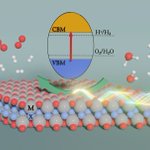
Let me walk you through our latest work in @ACSCatalysis, where we combine Machine Learning and MXenes to accelerate the discovery of photocatalysts for water splitting.
Introducing: MXgap. 🧵👇

This work paves the way for rapid materials discovery in photocatalysis and beyond. 🚀
📖 Read the full paper: doi.org/10.1021/acscatal.5c0…
🐍 Get the code: github.com/diegonti/mxgap
#MachineLearning #MXenes #CleanEnergy #Python #Research #ComputationalChemistry

Does it work? We put it to the test. 🧪
We screened 396 novel La-based MXenes (a practically unexplored family).
MXgap identified 6 promising candidates with suitable band alignment for water splitting. 🎯

We wrote a paper and built a tool. 💻
We integrated the trained models into MXgap, an open-source and user-friendly Python package. Useful to predict bandgaps using simple inputs or PBE data, skipping the computational cost of Hybrid functionals.
🔗 github.com/diegonti/mxgap

How it works:
We built a Classifier-Regressor pipeline. 🛠️
1️⃣First, it decides: Is this MXene a metal or a semiconductor? (92% Accuracy)
2️⃣If it's a semiconductor, it predicts the exact Bandgap with high precision (MAE = 0.17 eV).
The Solution:
We trained Machine Learning models on a dataset of 4,356 MXene structures.
Instead of waiting hours for a single calculation, our ML approach can predict properties in seconds. ⏱️
The Challenge:
We need materials that can turn water into Hydrogen fuel using sunlight. MXenes (2D transition metal carbides/nitrides) are great candidates, but with thousands of combinations! 🤯
Highly accurated electronic properties simmulations can be slow and expensive. 🐢💸

🧵 What if we could filter CO2 out of N2 directly from air using a carbon-based membrane?
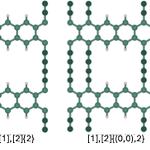
In our latest study, we show how grazynes—a family of tunable 2D carbon materials—can do exactly that.
Let me walk you through the story 👇 @IQTCUB @QuimicaUB @ChemEurope #ChemSusChem

11/
📝 One note: all of this study is computational, but synthesis routes to synthesize grazynes exist.
These materials can, in principle, be created using atom manipulation techniques.
The path to experimental validation is open.
12/
Check out the full open-access paper:
📖 A. Calzada, F. Viñes, P. Gamallo, ChemSusChem 2024, 17, e202400852.
🔗 doi.org/10.1002/cssc.2024008…
Or watch the summary video:
🔗youtube.com/watch?v=rVshQ8l7…